
How to Choose the Right Cable Size for Your Industrial Project
A practical walkthrough of the factors that actually determine cable size — beyond just matching amps to a chart.
Introduction
Cable sizing looks simple on paper — match the current rating to a chart and pick the corresponding cross-sectional area. In practice, undersized or oversized cable is one of the most common (and costly) mistakes on industrial projects, usually because one of the secondary factors below got skipped. This guide walks through what actually needs to be checked.
Why cable size isn't just about your load in amps
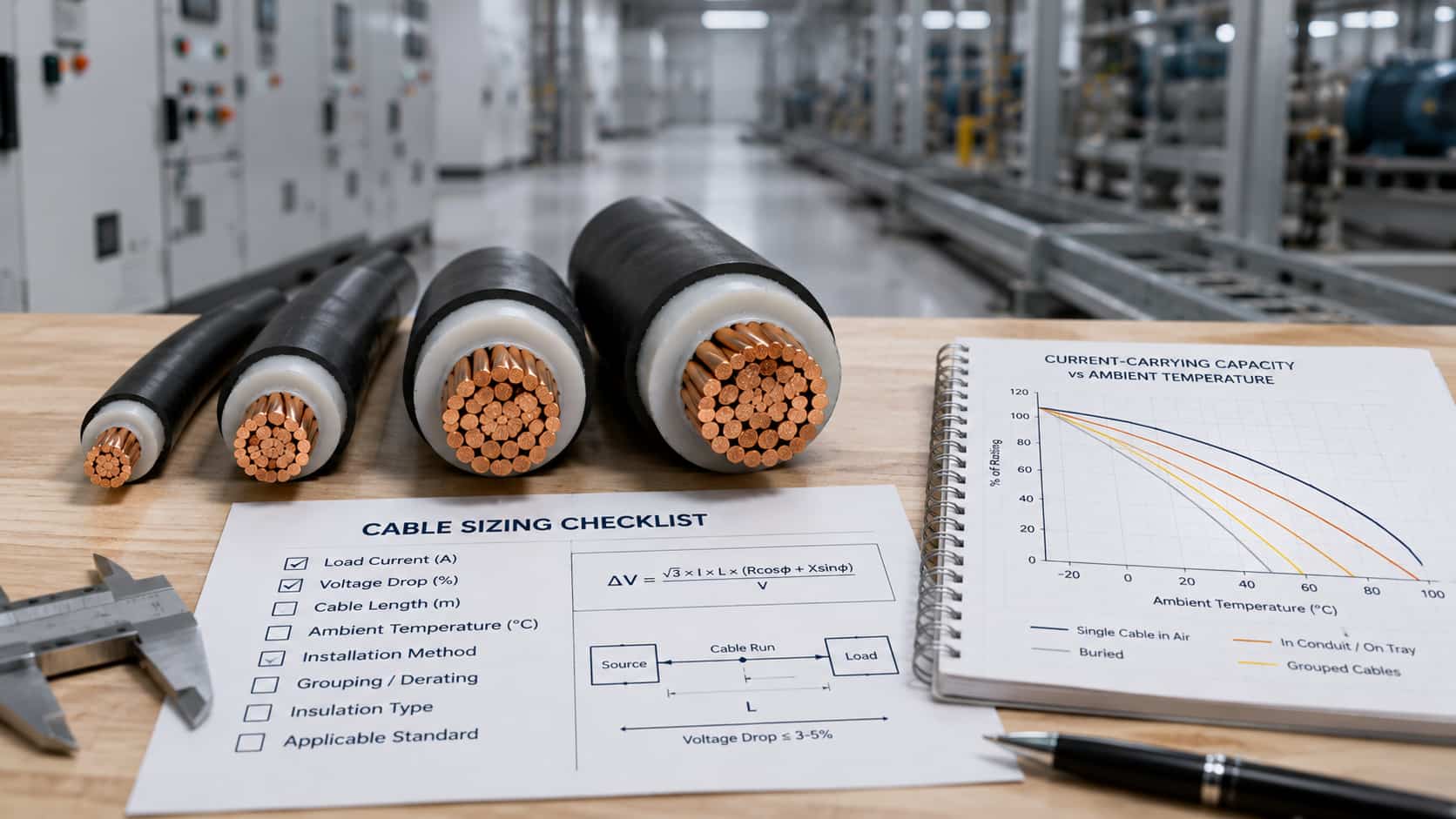
The current rating of your load is the starting point, not the final answer. The same load current can require a different cable size depending on installation method, ambient temperature, cable length, and how many other cables are grouped alongside it. Two projects with identical load currents can end up needing different cable sizes entirely once these factors are accounted for.
The core factors that determine cable size
Five factors matter most: the rated current of the connected load; the voltage drop allowed over the cable run length; the ambient temperature at the installation site; the installation method — buried, in conduit, on a cable tray, or in free air all have different heat dissipation characteristics; and grouping — how many other current-carrying cables are installed alongside this one, since bundled cables retain heat differently than a single isolated cable.
Voltage drop — the factor most people underestimate
A cable can be correctly rated for current and still cause problems if the voltage drop over its length is too high — motors underperform, lighting dims, and sensitive equipment can misbehave. As a general guideline, many standards recommend keeping voltage drop under 3-5% for the full run from source to load, though your applicable standard and equipment manufacturer specifications should always take precedence. Longer cable runs, in particular, often need to be upsized specifically to control voltage drop, even when the current rating alone would allow a smaller cable.
Derating for ambient temperature and grouping
Cable current ratings published in standard tables are based on a reference ambient temperature (commonly 30°C) and a single isolated cable. If your installation runs hotter than that reference temperature, or bundles multiple cables together, the effective current-carrying capacity drops — and the published rating needs to be adjusted downward using the correction factors provided in the applicable standard. Skipping this step is one of the most common causes of cables running hotter than expected in service.
Insulation type affects sizing too
The insulation type you choose changes the available current rating for a given conductor size — XLPE insulation, for example, supports a higher continuous operating temperature than PVC, which generally allows more current for the same cross-sectional area. If you haven’t settled on an insulation type yet, our comparison guide, XLPE vs PVC Cable: Key Differences for Industrial Buyers, covers how that decision interacts with sizing, and our earlier explainer, What Is XLPE Cable and Why Is It Used for Power Distribution?, covers the material basics if you’re starting from scratch.
A simple sizing checklist
Before finalizing a cable size, confirm: the connected load’s rated current; the total cable run length and calculated voltage drop; the actual ambient temperature at the installation site, not just a default assumption; the installation method and any correction factors it requires; how many cables will be grouped together along the route; and which standard (IEC, GB, BS, or other) governs the project, since correction factors and base ratings differ between them.
Where Kexingyu Power fits in
We manufacture power cable across a full range of conductor sizes and insulation types, and our technical team can help confirm sizing against your specific load, run length, and installation conditions before you order. Browse the full range on our Cables & Wiring Systems page.
Cable Sizing Basics
Common questions from engineers and project buyers selecting the correct power cable size for industrial installations.
01 Is it safe to round up to the next standard cable size?
Rounding up to the next standard conductor size can provide additional current-carrying capacity, but it does not automatically confirm that the cable is suitable for the installation. Voltage drop, ambient temperature, grouping, installation method and short-circuit requirements must still be checked separately before the final cable size is approved.
02 Do I need to derate cable capacity in hot climates?
Yes. Published cable current ratings are normally based on a reference ambient temperature, commonly around 30°C. When the actual installation temperature is higher, the applicable temperature correction factor must be applied. Cable grouping, buried installation and restricted ventilation may require additional derating factors.
03 Does cable length matter when the connected load is small?
Yes. Voltage drop depends on both the circuit current and the total cable run length. A relatively small load supplied over a long distance may still require a larger conductor than the current rating alone suggests. The calculated voltage drop should remain within the limits required by the applicable standard and connected equipment.
04 Can a cable supplier confirm the required size before production?
A supplier with technical engineering support can review the load current, system voltage, cable length, installation method, ambient temperature, cable grouping and insulation type before production. However, the final selection should also comply with the project design, protection settings and governing IEC, BS, GB or local electrical standard.
Recent Posts
What Is BESS? A Guide to Battery Energy Storage Systems for C&I Buyers
What Is BESS? A Guide to Battery Energy Storage Systems for C&I Buyers A clear explainer on what BESS systems actually are, how the pieces
Switchgear vs Transformer Lead Times: What EPC Contractors Need to Know
Switchgear vs Transformer Lead Times: What EPC Contractors Need to Know A practical breakdown of why these two equipment categories behave differently in procurement, and

Why Data Centers Are Facing a Switchgear and Transformer Shortage in 2026
Why Data Centers Are Facing a Switchgear and Transformer Shortage in 2026 Global lead times for switchgear and transformers now stretch 2-4 years — here’s