
XLPE vs PVC Cable: Key Differences for Industrial Buyers
A practical comparison of XLPE and PVC insulation — which one fits your project, and why the difference matters more than it seems.
Introduction
If you’ve read our earlier explainer on what XLPE cable actually is, you already know it’s built around a cross-linked polymer structure. PVC — Polyvinyl Chloride — is the other insulation type you’ll run into constantly on cable datasheets, and for a lot of low voltage applications it’s still the right, more economical choice. This article breaks down where the two actually differ, and how to decide which one fits your project.
The core structural difference
PVC insulation is a standard thermoplastic — it softens when heated and doesn’t have the cross-linked molecular bonds that give XLPE its higher thermal and mechanical performance. For a full breakdown of how that cross-linking process works, see our guide: What Is XLPE Cable and Why Is It Used for Power Distribution?.
Temperature rating and current-carrying capacity
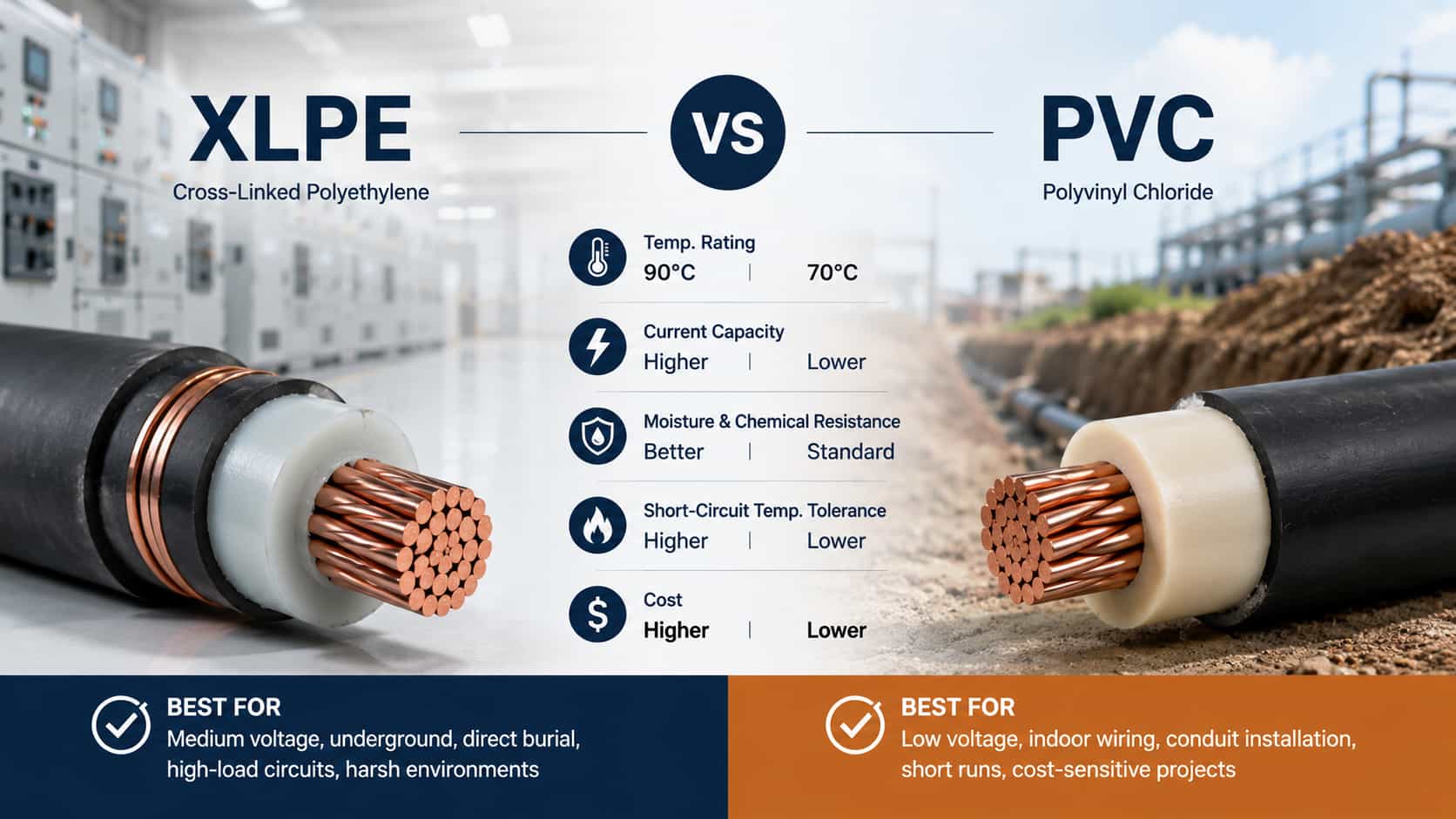
XLPE is typically rated for continuous operation at 90°C, compared to around 70°C for standard PVC insulation. In practical terms, this means an XLPE cable can carry more current for the same conductor size, or alternatively, a smaller XLPE cable can carry the same load as a larger PVC cable — which matters for cable tray space and installation cost on larger projects.
Cost comparison
PVC cable is generally cheaper per meter than XLPE cable of the same conductor size. For low voltage, short-run, indoor applications where thermal performance isn’t pushed to its limits, this makes PVC the more cost-effective choice. The calculation changes once you factor in current-carrying capacity — a smaller XLPE conductor achieving the same ampacity as a larger PVC conductor can close or even reverse the cost gap, so a fair comparison needs to be done at the system level, not just cost-per-meter.
Mechanical and chemical resistance
XLPE generally offers better resistance to moisture, chemical exposure, and environmental stress cracking than standard PVC. This is a major reason XLPE is preferred for direct burial and outdoor installations, while PVC remains common for indoor, conduit-protected wiring where environmental exposure is limited.
When PVC is still the right choice
PVC insulation remains a solid, economical choice for low voltage building wiring, indoor installations with moderate thermal loads, short cable runs where the ampacity advantage of XLPE doesn’t translate into meaningful savings, and general-purpose control wiring where the cable isn’t exposed to significant environmental stress.
When XLPE is the right choice
XLPE becomes the clear choice for medium voltage applications (6kV and above), where PVC insulation isn’t suitable at all; direct burial or underground installations exposed to moisture; high-load circuits where reducing conductor size matters for cost or space; and any application where higher short-circuit temperature tolerance is a safety requirement.
Where Kexingyu Power fits in
We manufacture both XLPE and PVC insulated power cable across low and medium voltage classes, so the specification decision can be made on technical merit rather than what a single supplier happens to stock. Browse the full range on our Cables & Wiring Systems page.
XLPE vs PVC Cable
Common questions from project buyers comparing XLPE and PVC insulation for industrial, commercial and utility cable applications.
01 Can PVC cable be used for medium-voltage applications?
Standard PVC insulation is generally not selected for medium-voltage power cables at 6kV and above. XLPE is the standard choice for this voltage range because it provides better dielectric performance, higher operating temperature capability and stronger resistance to electrical and thermal stress. The final cable construction should follow the applicable IEC, BS, GB or project standard.
02 Is XLPE always a better choice than PVC if the budget allows?
Not necessarily. PVC remains a practical and economical choice for many low-voltage indoor installations, short cable runs and general-purpose circuits with moderate operating temperatures. XLPE becomes more valuable when the project involves higher current, limited cable-tray space, underground installation, moisture, chemical exposure or medium-voltage distribution.
03 Does XLPE cable last longer than PVC cable?
XLPE generally provides better long-term resistance to heat, moisture, chemicals and environmental stress cracking, so it may offer a longer service life in demanding installations. However, actual cable life also depends on conductor loading, ambient temperature, installation quality, bending stress, jointing, termination workmanship and the suitability of the outer sheath.
04 Can XLPE and PVC cables be used in the same installation?
Yes. It is common for one facility to use XLPE cables for medium-voltage feeders, underground circuits or high-load power distribution, while using PVC cables for low-voltage indoor branch circuits and control wiring. Each circuit should be specified independently according to its voltage, current, installation environment, fire-performance requirements and applicable standard.
Recent Posts
Voltage Stabilizers vs UPS: Do You Need Both?
Voltage Stabilizers vs UPS: Do You Need Both? One device fixes how high or low the voltage is; the other fixes whether there is voltage
Energy Storage for Data Centers: A Growing Backup Power Option
Energy Storage for Data Centers: A Growing Backup Power Option Batteries have always backed up data centers in the form of UPS strings. Grid-scale BESS
Thermal Runaway in Lithium Batteries: What BESS Buyers Should Understand
Thermal Runaway in Lithium Batteries: What BESS Buyers Should Understand How thermal runaway starts, how it propagates, and which evidence buyers should require before approving