
Voltage Stabilizers vs UPS: Do You Need Both?
One device fixes how high or low the voltage is; the other fixes whether there is voltage at all—knowing which problem you have decides what you buy
Introduction
Few equipment debates generate more confusion in industrial procurement than the stabilizer-versus-UPS question. Part of the confusion is linguistic: “stabilizer,” “AVR,” “regulator” and “conditioner” are used interchangeably across markets, often for genuinely different machines. A larger part is conceptual: both devices sit in a rack or cabinet, both cost money per kVA, and both are sold as “power protection”—so a buyer with a voltage problem, an outage problem, or both, faces a menu where the labels do not map cleanly onto the problems.
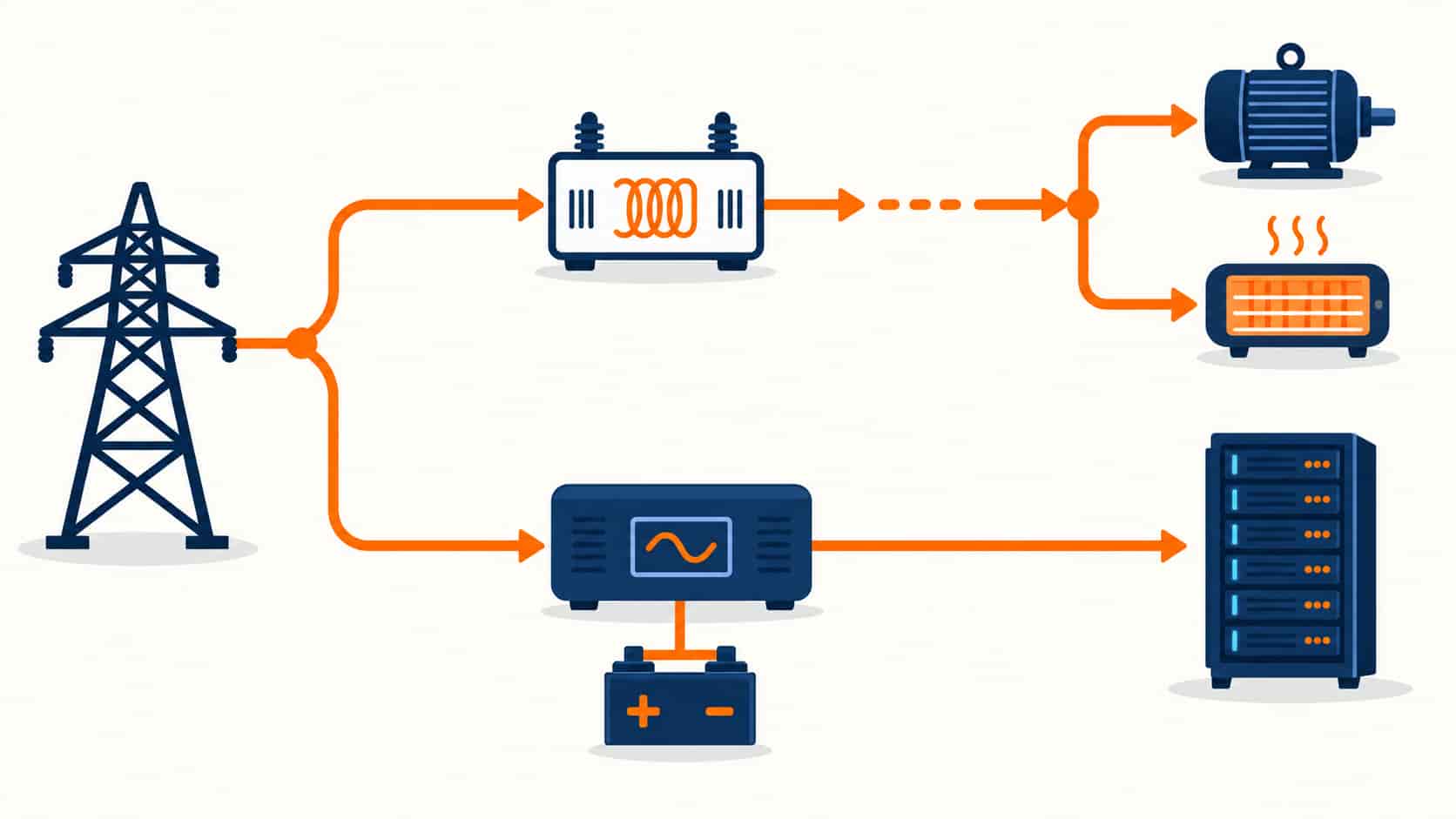
The underlying distinction is actually crisp. A voltage stabilizer answers the question “is the voltage within tolerance?”—it corrects sags, swells and brownouts continuously but stores no energy, so an outage passes straight through it. A UPS answers “is there power at all?”—it carries the load through interruptions entirely, and in its online form also regulates voltage more tightly than any stabilizer. Most real facilities have a mixture of loads and a mixture of problems, which is where the honest answer becomes not “which one” but “which one, where, for which load.”
This guide separates the two jobs cleanly, compares the devices line by line, maps the protection mix to real situations, and closes with sizing notes and a specification checklist. For the wider power equipment context, start from our data center power equipment range.
Two Different Questions: Power Quality vs Power Continuity
Power problems come in two families. Quality problems change the character of the power while it flows: voltage sags when a neighbor starts a large motor, swells when load drops suddenly, brownouts when the utility sheds voltage under stress, and chronic fluctuation on weak rural or diesel-fed networks. The load stays connected throughout—what it receives is simply the wrong voltage, and for electronics, motors and control systems, wrong voltage is expensive even when it never reaches zero.
Continuity problems are outages: the power stops, for milliseconds or hours. No amount of voltage correction matters across a gap, because correction needs something to correct. Surviving a gap requires stored energy—batteries, flywheels—or a faster backup source. The two families overlap in one place: a deep enough sag is indistinguishable from an outage to sensitive equipment, which is why the devices get confused. But the engineering response is distinct, and the first step of any protection decision is classifying your own problem: does the site’s event log show mostly outages, mostly sags, or both?
What a Voltage Stabilizer Does
A stabilizer is a continuous voltage-correction machine. The dominant industrial design—the servo stabilizer—uses a motor-driven variable transformer (variac) feeding a buck/boost transformer: a control circuit measures the output, and the servo nudges the ratio up or down to hold the output within a tight band (typically ±1–3%) across a wide input window (commonly −30% to +20% of nominal). Electronic designs switch transformer taps with thyristors instead of a motor—faster correction in discrete steps. Both designs pass mains power through continuously, reshaping its amplitude but storing nothing.
That continuous, correcting character defines both the value and the limits. The value: for sag-plagued grids, stabilizers transform chronic low voltage—motors overheating, drives tripping, lamps browning—into steady nominal power at high efficiency and low cost per kVA. The limits: response is measured in tens of milliseconds to a second depending on design and depth of correction; there is no ride-through whatsoever—when the input dies, the output dies with it; and the servo’s moving parts make it a maintenance item in a way solid-state UPS electronics are not.
What a UPS Does That a Stabilizer Cannot
The UPS’s defining feature is stored energy. When the input fails, the battery bridges the load—zero interruption in an online unit—and the facility buys time measured in minutes instead of milliseconds. No stabilizer offers anything equivalent, because nothing inside it stores a joule. For any load that must not see an interruption—servers, controls, process monitoring—the UPS is not a nicer stabilizer; it is the only device in the comparison that does the job at all.
The quieter point is that an online double-conversion UPS is itself a superb voltage stabilizer. Because it rebuilds the output waveform from its DC bus, the load never sees input sags or swells at all—regulation is inherent, not added. Buying an online UPS and adding a stabilizer for the same load usually buys the stabilizer function twice. Where the pairing genuinely makes sense is when each device protects a different stage: a stabilizer upstream tidying a brutal input window for a UPS sized near its limits, or the stabilizer serving tolerant process loads while the UPS serves only the critical bus. The pairing logic is situational, which is what the selection table below is for.
Side-by-Side Comparison
| Aspect | Voltage Stabilizer (AVR) | UPS |
|---|---|---|
| Core function | Corrects voltage amplitude continuously | Carries the load on stored energy through interruptions |
| Outage ride-through | Noneâoutput dies with the input | Minutes (battery) by design; zero transfer in online units |
| Voltage correction | Wide input window (e.g. â30%/+20%) to tight output band | Online units: inherent perfect regulation via double conversion |
| Response speed | Tens of ms to ~1 s (servo) or fast tap steps (electronic) | Zeroâno transfer in online topology |
| Efficiency | Very high (~97â99%); passive through-path | Double conversion ~94â97%, load-dependent |
| Maintenance | Servo motor and brushes on servo designs; tap wear on electronic | Battery program dominates; electronics largely solid-state |
| Cost per kVA | Lowâsimple magnetics and one servo | Higherâconverter, controls and battery system |
| Typical loads | Motors, heaters, pumps, whole-panel voltage hygiene | IT, controls, medical, anything interruption-intolerant |
When a Stabilizer Alone Is Enough
A stabilizer is the right sole answer when the process tolerates interruptions but not voltage errors. Heaters, ovens and resistive loads care little about a sag. Motors and pumps on contactor control usually tolerate short outages—restart is the cost, not damage—if the process tolerates the restart. Workshops, irrigation schemes, ventilation on non-critical halls: in grids where the brownout is weekly and the blackout is annual, a stabilizer on the affected panel fixes the daily pain for a fraction of UPS money, and honesty about the residual outage risk is part of the design, not an omission.
The other honest case is load tolerance by design. Equipment with wide-tolerance power supplies—much industrial control gear accepts −15%/+10% natively—may not need correction at all; the stabilizer then serves only the narrow-tolerance devices sharing the panel. Mapping tolerance load-by-load is the cheapest protection study a facility can run, and it regularly reveals that half the “needs a UPS” inventory needs a stabilizer, and a third of the “needs a stabilizer” inventory needs nothing.
Choosing the Protection Mix
Real sites mix loads and problems, so real answers are mixes. The table maps common situations:
| Your Situation | Protection Mix | Reasoning |
|---|---|---|
| Sag-heavy grid, outage-tolerant process (heating, motors, pumps) | Stabilizer only | Voltage is the daily problem; continuity is not |
| IT or precision load on a fluctuating grid | Online UPS alone | Double conversion already regulates better than any stabilizer |
| Large UPS on a brutally unstable upstream grid | Stabilizer upstream of the UPS | Widens the input window; reduces battery cycling and transfers |
| Mixed plant: office IT plus process hall | UPS on IT, stabilizer on process panels | Match each device to each load family's tolerance |
| Remote site on diesel or weak islanded supply | Stabilizer plus UPS on the critical bus | Engine-derived sags hit first; outages still occur |
| Small office, budget-capped, brief outages only | Line-interactive UPS | Its tap-correcting front end is a stabilizer in disguise |
Sizing Each Device
Stabilizer sizing starts from the load kVA with margin, but the decisive figure is the input window: the stabilizer must hold its output across the worst measured input, not the average—size the window from a power-quality logger’s data, not from the utility’s promise. Motor loads add the inrush question: servo stabilizers carry overload well but are rated for specific overload durations, and a direct-on-line motor start across an undersized stabilizer is a trip or a stall. UPS sizing follows the load-based method from our guide to UPS sizing—load inventory, kW and power factor, growth margin—with the battery window chosen for the bridge the site actually needs.
When pairing both, coordinate the two ratings: the stabilizer feeds the UPS, so its continuous rating must cover the UPS input plus losses, and its response speed matters only for how much of the input window the UPS sees. A well-paired set lets the UPS run fewer transfers and shallower battery events—observable in the event log, which is the honest test of whether the upstream stabilizer is earning its place.
Common Mistakes
The recurring errors mirror the device’s confusion in the market. Using a stabilizer as a backup—it is not one, and the first real outage teaches the lesson expensively. Installing an online UPS and then adding a stabilizer for the same critical load—paying twice for regulation the UPS already provides. Undersizing the input window on a stabilizer sized from nameplate data instead of a logger’s record. Ignoring servo maintenance: brushes, motors and limit switches are wear items, and an unmaintained servo stabilizer fails toward the middle of its correction range—with load attached. And the silent one: long series chains of protection devices, each adding a failure point; a stabilizer-UPS-PDU chain is only as reliable as its weakest link, and every added stage deserves a reason tied to a measured problem.
A note on the wider energy architecture: where the underlying problem is energy rather than either device—chronic shortages, fuel volatility, load growth—neither stabilizer nor UPS fixes the cause. Our overviews of generator and storage hybrid systems and data center energy storage and backup cover the tier above voltage hygiene, which many sites eventually need alongside it.
Specification Checklist
Whichever device or mix the site needs, quotations become comparable when these are pinned:
- For a stabilizer: kVA continuous rating, input window (e.g. −30%/+20%) verified against logged data, output accuracy band, response time, overload rating and duration, servo maintenance schedule.
- For a UPS: kW at stated power factor, topology (online double-conversion for critical loads), runtime at design load, battery monitoring depth, efficiency at expected operating load.
- For a paired system: stabilizer rating covering UPS input plus losses, and coordination confirmed in the UPS event log after commissioning.
- For both: protection devices and clearances per applicable IEC/EN references, bypass or maintenance arrangement, environmental ratings for the installation space, witnessed FAT scope, and documentation language.
Conclusion
The stabilizer and the UPS are not competitors; they are answers to different questions that real facilities ask simultaneously. The stabilizer corrects the voltage that flows—the cheap, efficient, high-throughput answer for sag-prone grids and tolerant loads. The UPS guarantees that power exists—the only answer for loads that cannot blink. An online UPS embeds the stabilizer’s function so thoroughly that doubling it up is waste; a stabilizer alone is a bet that outages stay rare; and the mixed plant buys both, each for the load family it actually protects.
Classify your problems from an event log, map your loads by tolerance, and buy the mix the data supports. When you are ready to price it, the team at KXY E-Power Group supplies stabilizers, UPS systems and the switchgear around them as one protection architecture—sized from your site’s measurements, not from a brochure.
Frequently Asked Questions
Recent Posts
Energy Storage for Data Centers: A Growing Backup Power Option
Energy Storage for Data Centers: A Growing Backup Power Option Batteries have always backed up data centers in the form of UPS strings. Grid-scale BESS
Thermal Runaway in Lithium Batteries: What BESS Buyers Should Understand
Thermal Runaway in Lithium Batteries: What BESS Buyers Should Understand How thermal runaway starts, how it propagates, and which evidence buyers should require before approving
What Certifications Should You Check Before Buying Electrical Equipment from China
What Certifications Should You Check Before Buying Electrical Equipment from China Certificates decide whether your equipment clears customs, satisfies the lender and survives the audit—and