GOST and IEC in Central Asian Cable Procurement: A Buyer Crosswalk
Quick Answer: Most cable tenders in Kazakhstan, Uzbekistan, Kyrgyzstan, Tajikistan and Turkmenistan quote two documents side by side, and the two are not interchangeable. GOST tells the local plant, the design institute and the acceptance inspector what they expect to receive. IEC tells an international lender, an EPC head office and a third-party laboratory what they can read. A crosswalk is a translation aid for procurement, not a declaration of equivalence. Use it to write one clause both sides can check, and put the precedence rule into the purchase order.
Introduction
Central Asian cable buying runs on two documents at once. A design institute writes the schedule to GOST, the EPC head office rewrites it against IEC, and the buyer receives one spreadsheet with two columns that look like synonyms and are not. Neither side is being difficult. Each is describing the plant it knows.
This page is for EPC buyers, procurement engineers and distributors working on Kazakh, Uzbek, Kyrgyz, Tajik and Turkmen projects. It maps the families where the systems touch, marks the fields that do not translate, and shows how to write a clause both sides can check. Supplier selection and delivery sit in our Central Asian cable buying hub. Medium voltage class selection for one country is a separate job, set out in our Kazakhstan guide to buying 6 to 10 kV cable.
Why Two Systems Sit Side by Side
The plant base is the first reason. Substations built between 1965 and 1990 were designed around GOST sections and GOST voltage classes, with a spares list held in the local utility warehouse. When a line is replaced, the new cable has to land on the old terminals, in the old ducts and on the old jointing kits.
The money is the second. Lenders, insurers and EPC head offices work in IEC because their own engineers, laboratories and loss adjusters do. A schedule written only to GOST is awkward to review in Frankfurt or Seoul, and one written only to IEC is awkward to accept in Almaty or Tashkent.
So both appear in the same document, closed with a line that says “or equivalent”. That line is where the trouble starts, because equivalent is not a standard. It is an opinion, and the person who defends it is the one who signed the order. Mapping at enquiry stage replaces a month of correspondence about a certificate that names the wrong construction.
What GOST Actually Governs
GOST is a family, not a single document. A tender naming one number rarely covers the whole cable, and a buyer who treats that number as the specification will find three of the four clauses unaddressed in the offer.
Four anchors turn up most often. GOST 31996-2012 covers power cable with plastic insulation at 0.66, 1 and 3 kV. GOST 32397-2013 covers XLPE at 6, 10, 20 and 35 kV. GOST 22483-2012 sets conductor classes and GOST 31565-2012 sets fire performance. Each governs a slice of the construction, and the slices meet in the middle of the datasheet.
The fifth anchor is a TU, the manufacturer technical specification. Control cable in particular is sold against a TU number rather than a GOST, and the TU is the real specification. A line item that says only “GOST” for control cable is one two suppliers cannot be compared on.
Reading a GOST Designation Against an IEC Type String
The Russian letter string is a construction code and nothing else. In VVG the first V is PVC insulation, the second V is a PVC sheath, and G means no protective cover. Add BbShv and you have steel tape armour under a PVC hose. A leading A means aluminium conductor, ng means flame non-propagating, LS low smoke, FR fire resistant.
IEC has no equivalent letter code. A European supplier describes the same cable in words, XLPE insulated, unarmoured, PVC sheathed, 0.6/1 kV, and the reference printed on the drum is his own. So a type string cannot be crosswalked. What can be crosswalked is the construction behind the string.
That changes what the buyer asks for. Ask for the construction list rather than the type reference: insulation compound, screen, bedding, armour, sheath, and the clause each one is claimed against. Two suppliers using identical letters can be offering different cables, and two using different letters can be offering the same one.
The Use-Voltage Question: 0.66/1 kV and 0.6/1 kV
GOST names a nominal system voltage. IEC names U0/U, the phase-to-earth figure and the phase-to-phase figure together. A 1 kV GOST cable and a 0.6/1 kV IEC cable are bought for the same duty, and the strings are still not interchangeable on a datasheet or a drum label.
At medium voltage the gap widens. IEC 60502-2 lists 3.6/6, 6/10, 8.7/15, 12/20 and 18/30 kV. GOST 32397 names 6, 10, 20 and 35 kV. A cable for a 10 kV network can be a 6/10 or an 8.7/15 depending on earthing, and choosing between them is a system study rather than a cable decision.
Get the earthing arrangement from the network owner before the enquiry leaves. The selection method, with GB and BS alongside the IEC figures, is in our note on medium voltage cable standards. Without it the supplier quotes the cheaper class, and the cheaper class is not always permissible on that network.
Conductors: Where the Two Documents Nearly Meet
This is the field where the systems come closest. GOST 22483-2012 and IEC 60228 both sort copper and aluminium conductors into classes, both set a minimum wire count for a given section, and both allow shaped conductors at the larger sizes. Close, though, is not identical.
The class numbering does not run in parallel for every construction, and the minimum wire count for a flexible class differs between the two tables. On a 240 mm² feeder the difference is invisible. On a 2.5 mm² flexible control core it decides whether the cable can be terminated with the lugs already on site.
Aluminium practice is the bigger commercial difference. Sector-shaped aluminium at 6 and 10 kV is normal across the region and rare in an IEC-only catalogue, so a schedule worded purely to IEC can exclude every plant the buyer hoped to compare. The classes themselves are in our note on IEC 60228 conductor classes.
GOST and IEC Cable Family Crosswalk
The table maps the families that appear in most Central Asian enquiries, and marks what a buyer has to declare when the offer is written against the other system.
| Cable Family | GOST Anchor | IEC Counterpart | What to Declare | Cost If Assumed Equal |
|---|---|---|---|---|
| LV power cable, 1 kV | GOST 31996-2012 | IEC 60502-1 | Voltage string as it must print on the drum, conductor class, sheath compound | Datasheet rejected at acceptance over a string describing the same duty |
| MV XLPE, 6 to 35 kV | GOST 32397-2013 | IEC 60502-2 | Nominal voltage or U0/U, screen section, thickness table used | Cable built to the wrong table for the earthing arrangement |
| MV paper insulated | GOST 18410-73 | No current IEC counterpart | Whether impregnated paper is still permitted on the route | A construction nobody in the region will joint in ten years |
| Conductors | GOST 22483-2012 | IEC 60228 | Class, minimum wire count, shaped or round, material | A section shortfall legal in one document and not the other |
| Fire performance | GOST 31565-2012 | IEC 60332-3, 61034, 60754, 60331 | Class letter or test method, with duration for circuit integrity | Low smoke claimed in a suffix, halogen test never performed |
| Control and signal | GOST 1508-78 or a TU | No single IEC text | The TU number, not the word GOST | Two suppliers quoting to different TUs under one line item |
| Insulation and sheath tests | GOST 31996 annexes | IEC 60811 series | Test method plus acceptance figure, per property | A report that passes one method and would fail the other |
| Core identification | GOST colour code | IEC 60445 sequence | Colour schedule and marker type | Phase sequence wrong at every joint on the run |
| Market access | EAC under TR CU 004/2011, low voltage only | National marks and CB reports | Which certificate, issued where, naming which construction | Drums held at the border on a voluntary certificate |
Insulation, Screen and Armour: the Fields That Do Not Map
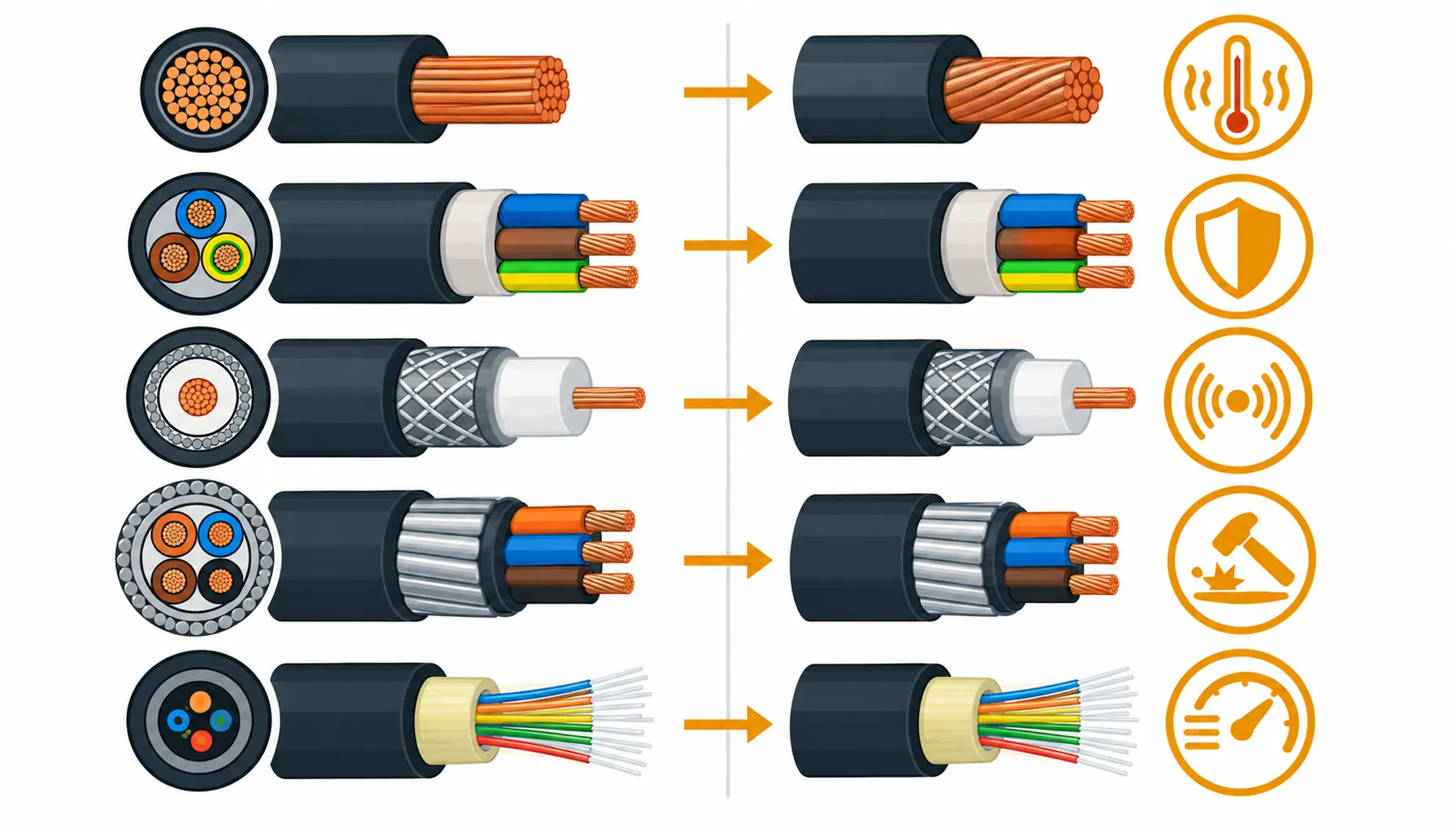
XLPE is XLPE at 90 °C conductor temperature in both systems, and that is roughly where the agreement ends. Screen section is set by prospective fault current and its duration, and the documents ask for it differently. One gives a table by nominal voltage. The other expects a figure to be calculated and declared.
Armour practice differs by habit as much as by rule. Steel tape under a PVC hose is the default in CIS low and medium voltage work. Steel wire armour is common on IEC schedules and appears in the region mainly where mechanical duty asks for it. Bedding and water blocking follow the same habit, and what the construction tables do and do not fix is set out in our note on IEC 60502.
Test Regimes: Routine, Sample and Type
All three categories exist in both systems and the boundary between them is not drawn in the same place. Under IEC practice each drum ships with its own routine test report. Under GOST practice acceptance tests are drawn per batch, and a batch can be several drums of one construction.
Type tests are the expensive half, and they attach to a construction rather than to a supplier. A report issued on a 3×240 mm² does not cover a 3×95 mm², and a buyer who accepts a type test on the strength of a supplier logo has accepted nothing that can be checked later.
Witnessing is worth the fee at medium voltage. Routine voltage, partial discharge and conductor resistance take a morning to watch and are hard to correct afterwards. The scope to write into the order is in our note on cable factory testing. Keep both columns in the report pack: one set per drum, GOST sheet and IEC sheet together.
Fire Performance and the Classes That Do Not Translate
The vocabulary is similar and the tests behind it are not. GOST 31565-2012 puts flame propagation, smoke and halogen content into a single fire safety class. IEC spreads the same concerns across IEC 60332-3 for bunched cable, 61034 for smoke density, 60754 for acid gas and 60331 for circuit integrity.
A class letter therefore cannot be read across as a category. A Russian-language designation carrying the ng-LS suffix claims no flame propagation and low smoke, which aims at the same danger as an IEC 60332-3 category plus a 61034 figure. Whether the construction reaches that level is a question for the test report, not for the suffix.
Marking, Certificates and the Paper a Border Officer Reads
What travels with the drums is decided by the destination, not by the standard. Low voltage cable falls under TR CU 004/2011 and carries the EAC mark in Kazakhstan, Kyrgyzstan, Russia, Belarus and Armenia. Medium voltage cable sits outside that regulation, so the EAC mark does not settle a 10 kV shipment.
Uzbekistan and Tajikistan are outside the customs union. The EAC mark means nothing at those borders, where O’z DSt documents and Tajikstandart certification apply instead. The country-by-country route is in our note on cable import certification by country, the full document list in our power cable certification checklist.
A certificate naming a construction is a separate problem. One issued on a 4×16 mm² does not cover a 3×95 mm², and an officer comparing certificate against drum label is doing the job he was posted to do. The marking fields are in our note on cable marking and traceability, the paper set in cable labelling and documentation.
Writing a Dual-Standard Clause Without an Equivalence Claim
Four patterns work. Name one governing document and list the other as an acceptable alternative with deviations stated. Name both and give a precedence rule. Name the construction and reference both only for the test regime. Or specify to IEC and add a national annex for the fields the inspector checks.
The precedence rule is the part buyers skip, and it decides the price. A clause reading “GOST 31996 or IEC 60502-1” with no rule lets the supplier pick whichever table gives the thinner wall, and the offer will be the cheaper of the two. Write which document governs where they disagree.
Keep the equivalence claim out of the order. A sentence saying the two documents are equivalent will be read by a lawyer after a failure, and it is not one a cable maker can support with evidence. Say that the offered construction meets the stated requirements of both in the fields listed, then attach the list and ask for the deviation list inside the offer. Our note on comparing cable quotations for Central Asia shows how to score it.
GOST and IEC Order Freeze List
These are the fields to settle before the purchase order is issued, in the order the arguments usually arrive.
| Item to Freeze | How to Write It Into the Order | Evidence to Attach | Cost of Leaving It Blank |
|---|---|---|---|
| Destination and certificate | Country named per delivery, with the certificate required at that border | Certificate naming the construction and the drum range | Drums stopped at the frontier on the wrong document |
| Governing document | One document governing, the other as alternative | Precedence rule written into the clause | Supplier picks the thinner table and wins the order |
| Voltage string | Exactly as it must print on the drum label | Datasheet page showing that string | Acceptance rejection over a formatting difference |
| Conductor | Class, material, shaped or round, minimum wire count | GOST 22483 or IEC 60228 class table | Sector aluminium excluded, comparison collapses |
| Screen and armour | Screen section against fault current, armour type named | Fault current calculation plus construction drawing | Tape ordered where wire was specified, or reverse |
| Fire class or test method | Class letter and test method, duration for circuit integrity | Test report naming construction and duration | Fire strategy unsupported by any test on file |
| Test pack per drum | Routine, sample and type tests listed separately with witness scope | Report pack in both columns, one folder | Lender engineer refuses the submission pack |
When a Crosswalk Is Not the Answer
When it is being used to cover a construction change. A supplier offering “GOST or IEC equivalent” and then shipping a thinner screen has used the crosswalk as cover. Ask for the construction list as it will appear on the drum, and compare that instead of the offer letter.
When the acceptance inspector is the one who signs. Whatever the funding requires, the person who refuses to energise the line works to the national document. Get that document into the enquiry early, even where it is not the governing one.
When the fire strategy is performance based. A crosswalk of class letters does not survive a fire engineering calculation, and the calculation will ask for a test method and a duration that no class letter contains.
When nobody has the original schedule. A crosswalk built on a translated spreadsheet with the annexes missing produces confident answers to the wrong questions. Find the source, or specify the construction fresh. A rehabilitation is usually a GOST buy for the reason its ducts are GOST shaped; a greenfield plant on lender money is usually an IEC buy with a national annex.
RFQ Checklist
- Destination country named per delivery, with the certificate required at that border
- Governing document named, plus a written precedence rule for conflicts
- Voltage string exactly as it must appear on the drum label
- Conductor class, material, and shaped or round stated
- Screen cross-section and the fault current it is sized against
- Armour type, bedding and sheath compound listed separately
- Fire class or test method, with duration for circuit integrity
- Test regime per drum: routine, sample and type, with witness scope
- Construction the type test report was issued on
- Deviation list requested as part of the offer, not after it
Conclusion
The two systems will not be reconciled by a table, and buyers who expect that will keep being disappointed by the next tender. What a crosswalk does is make the differences visible early enough to write them into a clause. That is a procurement job, and it is finished before the order, not after the drums land in the yard.
Kexingyu Cable Group (KXYE) manufactures to GOST and IEC constructions from Quanzhou, issues test documents per drum, and quotes Central Asian enquiries with the construction list and the deviation list attached. Send the schedule with the destination country printed on it. A request for quotation is the fastest way to start, and the field list we work from is in our industrial cable RFQ checklist.