
How Cable Factory Tests Work: Spark Test, Conductor Resistance and More
Quick Answer: Cable ships only after routine tests on every length — spark test, conductor resistance, high-voltage withstand — with the batch report keyed to the drum IDs at your site. A cable drum is a sealed promise: whatever was tested at the factory is what arrives a month later at your gate. The machinery of that promise is the factory's test regime — a layered system where some instruments watch every meter of production in real time, some sample every batch, and some qualify the design once for its whole life. Buyers who understand the layers read a batch test report as evidence and spot when it is decoration. Buyers who do not accept four glossy pages that prove nothing about the drums on the truck. This guide walks the layers from the extrusion line outward.
Introduction
Cable quality control is unusual among industrial products because most of the cable’s value is invisible inside its sheath: the conductor’s purity and stranding, the insulation’s thickness and concentricity, the absence of voids that would seed partial discharge. None of it can be verified at the receiving dock. That’s why the standards build verification into the factory itself — the routine tests that run on every length, the sample tests that characterize every batch, and the type tests that qualify the design — and why the documents that accompany a shipment matter as much as the cable they describe. For the buyer, the test regime is the difference between buying cable and buying hope. For the factory, it’s the daily discipline that makes a warranty meaningful. The regime’s architecture is fixed by the same standards that fix the construction — the IEC, GB and BS landscape mapped in our MV and LV standards guide — and this guide walks it layer by layer.
The Spark Test: Watching Every Meter as It Extrudes
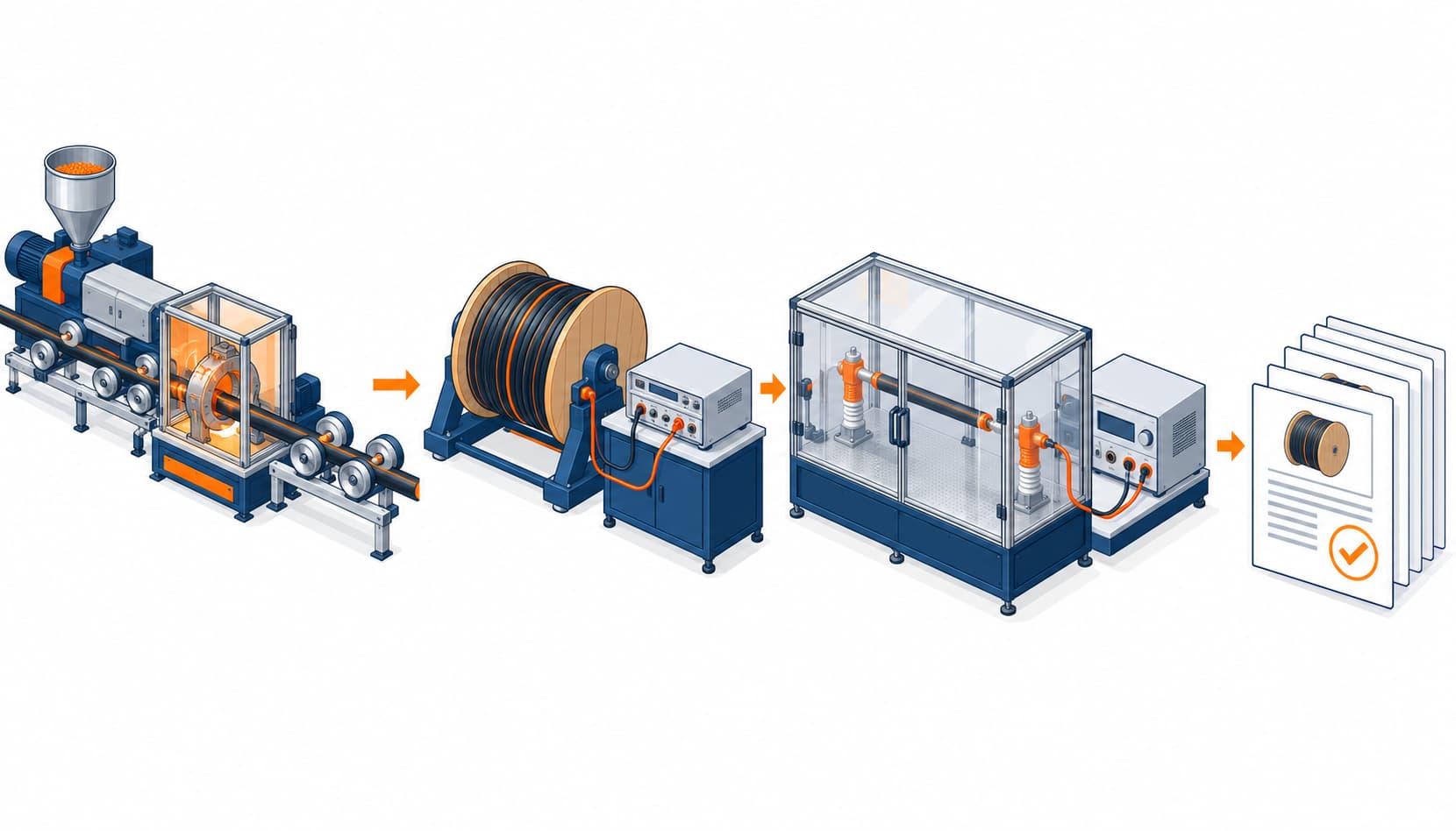
The spark test is the one instrument that sees every millimeter of insulation at the moment it is made. The insulation passes through an electrode bath held at high voltage as it exits the extruder; any pinhole, thin spot or contaminant punctures instantly, and the line alarms and marks the location. It is a hundred-percent test in the most literal sense — not sampled, not batched — and it catches the defects that later tests would find only by luck: a grain of contaminant, a die flaw, a momentary thickness sag. The counterpart at the finished-cable stage is the high-voltage withstand routine test, where the completed length holds a specified voltage between conductors and from conductors to ground for a fixed time. Together they bracket the insulation’s integrity: the spark test watched it being born, and the withstand test proves the finished article holds what it should hold. A factory without a working spark test — or one running it at reduced voltage — is shipping insulation nobody watched.
| Test Layer | Frequency | What It Catches | Report Evidence |
|---|---|---|---|
| Spark test | 100% â every meter at extrusion | Pinholes, thin spots, contaminants in insulation | Line records; defect log per shift |
| Conductor resistance | Routine â every production length | Poor copper, undersized or short-stranded conductor | Ω/km per length, keyed to drum ID |
| High-voltage withstand | Routine â every production length | Insulation flaws the spark test missed | Pass per length with test voltage stated |
| Sample tests | Per batch / per length interval | Dimensional drift: thickness, concentricity, ovality | Measured values vs standard minimums |
| Partial discharge (MV) | Routine for MV lengths | Internal voids, screen defects | pC value per length against limit |
| Type tests | Once per design | Design qualification: electrical, thermal, mechanical | Accredited laboratory certificate |
Conductor Resistance: The Test That Sizes Everything
Conductor resistance is the number every other calculation stands on — ampacity, voltage drop, losses — and the routine test measures it on every production length with a resistance bridge, reporting ohms per kilometer against the standard’s maximum for the size and metal. The test catches the quietest and most profitable fraud in the trade: copper shortchanged. A conductor drawn slightly undersized, stranded with fewer wires, or alloyed with recycled copper shows up as resistance above the limit long before it shows up as a warm feeder years later. This is why the batch report’s resistance values, keyed to drum IDs, are the single most important page in the shipping documents — they are the evidence that the size you bought is the size you got. The buyer’s verification habit is simple: spot-check the reported values against the standard’s table, and where stakes justify it, verify the delivered drums against the report — the supplier-audit framework that structures this verification is in our power cable manufacturer checklist, and the failure modes that shortchanged copper eventually produces are the resistance entries in our cable failure causes guide.
Sample Tests: Watching the Dimensions Drift
Extrusion is a process that drifts: line speed, melt temperature and take-up tension wander within shifts, and insulation thickness wanders with them. The sample tests measure the drift — cutting samples at intervals to measure insulation thickness, concentricity, sheath thickness and armor lay — against the standard’s minimum values, which are minimums precisely because the average will be higher. The buyer-relevant detail is where the factory samples from: a report built on line-start samples flatters the process, while one built on the prescribed interval sampling characterizes it. For medium voltage the routine regime adds partial discharge measurement on every length — the instrument that hears the internal voids and screen defects which survive every other test and which, left alone, drill through insulation over years. The sample layer is where dimensional quality is proven or faked, and reading the report’s sampling story — what was measured, when, against which minimum — is the core skill in turning paperwork into evidence, the same reading discipline applied to any equipment certificate in our China certification checklist.
Reading the Batch Test Report as Evidence
A batch report earns trust through traceability, and four links make the chain. The drum IDs on the report must match the drum IDs on the drums — printed meter marks and stenciled numbers that tie each test result to the physical length that carries it. The reported values must sit against the standard’s limits, not just as raw numbers, so the reader sees the margin. The test conditions — voltages, temperatures, instruments — must be the standard’s conditions, not the factory’s convenience. And the report must be signed and dated by the responsible quality function, not generated as a template. Reports that miss a link are not necessarily fraudulent — but they are unverifiable, and unverifiable is the practical synonym for worthless in a warranty conversation. Where the shipment’s destination requires third-party confirmation, pre-shipment inspection closes the chain — the inspection-regime logic and its verification economics are covered in our EPC sourcing guide.
| Link | What to Check | Red Flag |
|---|---|---|
| Drum identity | Report drum IDs match printed meter marks | Generic report "per batch" with no IDs |
| Values vs limits | Results shown against the standard's maximums | Raw numbers with no limit column |
| Test conditions | Voltages and methods match the standard | Reduced test voltage "per factory practice" |
| Construction identity | Report names the offered size and build | Family certificate offered for a specific drum |
| Sign-off | Signed and dated by the quality function | Unsigned template printouts |
When Factory Tests Are Not the Answer
The factory regime proves what the factory made, and it cannot prove several adjacent things. It doesn’t certify installation quality — a tested cable damaged by a tight bend or a bad gland fails in service with its perfect report in the file. It doesn’t cover the fire-chemistry axes beyond the type certificates that qualify the compounds — the routine regime is electrical. It doesn’t survive a mismatch between the tested design and the shipped design, which is why the construction identity on the report matters as much as the numbers. And it isn’t a substitute for the audit that verifies the laboratory instruments are calibrated and the quality system is real — the factory-visit discipline that verifies the test benches themselves is the audit path in our power cable manufacturer checklist. The tests are the evidence chain’s strongest links. The buyer’s job is making sure the chain is attached to the truck that arrives.
RFQ Checklist: Specifying the Test Evidence
Make the test regime contractual, so include:
- Routine tests required per the governing standard, on every length
- Batch test report required keyed to drum IDs with meter marks
- Conductor resistance values reported against the standard’s limits
- High-voltage withstand and spark test evidence stated per the standard
- Partial discharge results required for MV lengths with pC limits
- Sample test records: thickness, concentricity, sheath against minimums
- Test conditions stated: voltages, instruments, calibration status
- Type-test certificate on file naming the offered construction
- Third-party pre-shipment inspection where the project requires it
- Report format agreed before production, so the evidence arrives readable
Conclusion
The factory test regime is layered on purpose: instruments that watch every meter, tests that characterize every batch, and type tests that qualify the design — each layer catching what the others cannot. The buyer who specifies the evidence per layer, checks the traceability links and reads the values against the limits turns the batch report from paperwork into proof.
Kexingyu Cable Group (KXYE) runs the full routine and sample regime on accredited instruments and ships batch test reports keyed to drum IDs as standard — so the drums that arrive at your site carry their own evidence, tested and export-ready.
Recent Posts

Power Cable Warranty Terms: What to Demand and What to Watch For
Power Cable Warranty Terms: What to Demand and What to Watch For Quick Answer: A usable warranty names its scope, duration, evidence standard, exclusions and
The Cable Sample Approval Process: What to Test Before Mass Production
The Cable Sample Approval Process: What to Test Before Mass Production Quick Answer: Sample approval tests the supplier’s claims while changes are still cheap —
Cable Drum Packaging for Export: Specs, Marking and Transit Protection
Cable Drum Packaging for Export: Specs, Marking and Transit Protection Quick Answer: Export packaging is a technical specification: drum size for weight and bend radius,