
What Certifications Should You Check Before Buying Electrical Equipment from China
Certificates decide whether your equipment clears customs, satisfies the lender and survives the audit—and a surprising share of the documents circulating in the trade do not survive a careful second look.
Introduction
When buyers evaluate electrical equipment from China, the conversation usually starts with price and ratings. It should start with paperwork, because paperwork is where projects quietly fail. Certificates decide whether a transformer is accepted by the utility, whether a switchboard passes the consultant’s review, whether the bank releases the next disbursement—and whether the container clears the port without a conformity hold. A factory that cannot document its equipment cannot sell it into any regulated project, regardless of how good the hardware is.
The complication is that “certified” means at least four different things in this trade. It can mean a design was type-tested in an independent laboratory years ago. It can mean a quality system exists on paper at the factory. It can mean the product self-declares conformity with a directive. Or it can mean a market-specific scheme certificate was issued for the shipment. Each answers a different question, and a buyer who conflates them either over-pays for paperwork that proves nothing or under-buys equipment that fails the one check that mattered.
This article is the checklist version of that untangling: the certificate ladder to verify by product family, the market conformity schemes layered on top, the red flags that expose weak documents, and what to do when a certificate is not enough.
Why Paperwork Decides Projects
Three audiences read your equipment documents, and each can stop the project. The consultant or utility engineer reads them to confirm the design meets the specification—type test reports, usually IEC, are the language here. The bank or financier’s technical advisor reads them at disbursement: missing or unverifiable certificates are a standard reason results-based payments stall. Customs reads the conformity documents for the destination market—SONCAP for Nigeria, and equivalent schemes elsewhere—and a shipment without them is not late, it is stuck.
The pattern to internalize: certificates are not a marketing layer added after the equipment is chosen. They are a gate with three locks, and the cheapest time to check the keys is before the purchase order, not at the port.
The Core Certificate Ladder to Verify
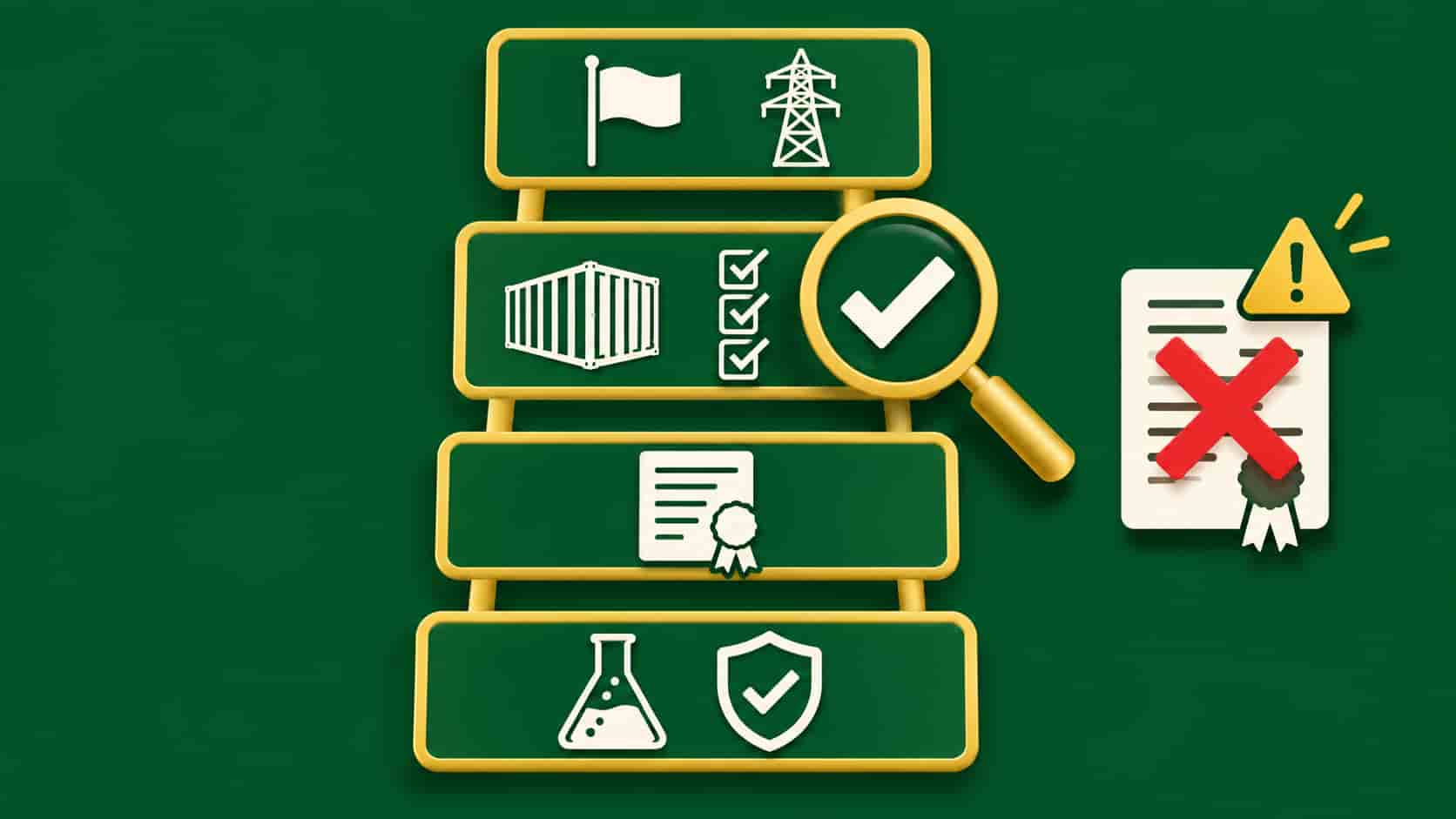
For the product families that dominate imports—transformers, switchgear, low-voltage boards—six documents cover the ground. The table below is the version procurement teams work from.
| Certificate / Standard | Applies To | What It Actually Proves |
|---|---|---|
| IEC 60076 type test report | Power and distribution transformers | The design passed independent laboratory testsâtemperature rise, lightning impulse, short-circuitâon a representative unit |
| IEC 61439 / IEC 62271 verification | LV assemblies / MV switchgear | The switchgear design series is verified for the rated values it claims; our IEC 62271 guide explains the structure |
| ISO 9001 certificate | The factory | A quality management system exists and is auditedâit says nothing about a specific unit's performance |
| CE / UKCA marking | Equipment sold into Europe / UK | Self-declared conformity with applicable directivesâonly as strong as the technical file behind it |
| Destination conformity certificate | The shipment (e.g. SONCAP for Nigeria) | The consignment cleared a pre-export conformity assessment for that market |
| Routine test report | The specific unit you are buying | Your unit passed its production testsâratio, resistance, dielectric, functionalâbefore dispatch |
The ladder logic matters: type tests prove the design, routine tests prove your unit, ISO proves the system, and CE plus destination schemes prove market compliance. A factory that can produce all four layers for the exact rating you are buying is in a different league from one that can only produce a ISO certificate and a brochure.
Market Conformity Schemes: One More Layer
On top of the technical ladder sits the destination country’s conformity scheme. Nigeria’s SONCAP requires a product certificate and, per shipment, a conformity document issued through an approved inspection route. Saudi Arabia, Kenya, Tanzania and several other markets run analogous programmes with their own pre-export verification steps. The mechanics are administrative, but the sequencing is not: scheme certificates are issued against documents the factory must supply, so a factory that cannot produce its own IEC reports will also struggle to clear the conformity assessment—weak paperwork compounds in the same direction.
Budget and schedule for this layer explicitly. The certificates add lead time to the shipping document chain, and as our piece on sourcing delays and EPC timelines shows, document gaps that surface at clearance cost demurrage, not just delay. Buyers who start the conformity process at order placement sail through; buyers who start it at packing do not.
Reading the Documents Like an Auditor
Most certificate problems are visible if you read the documents the way an auditor does—looking for coherence rather than existence. The recurring red flags:
| Document | Red Flag | How to Verify |
|---|---|---|
| Type test report | Rating on the report differs from the unit quoted; no laboratory letterhead or report number; date older than the standard's edition | Contact the laboratory with the report number; check the tested rating brackets your unit |
| Routine test report | Values suspiciously identical across units; missing instrument calibration references | Ask for raw results of your serial-numbered unit; compare against the nameplate |
| ISO 9001 certificate | Certificate issued by an unknown body; scope excludes your product family | Check the certification body's accreditation; read the scope clause |
| Third-party material or oil reports | Reports without a lab name, or the same PDF reused across different shipments | Request the original lab file with sample ID; spot-check with your own sampling at FAT |
| FAT report | Template with blanks; no witness signature; photos that do not match your equipment | Attend or send a witnessâour FAT guide covers what to watch |
One cross-check catches more fraud than any other: nameplate coherence. The serial number on the nameplate, in the routine test report, on the packing list and in the conformity documents should be the same unit. Fabricated paperwork rarely survives that consistency check.
When a Certificate Is Not Enough
A complete document set proves the paperwork is complete—nothing more. Three situations demand more. First, ratings outside the factory’s tested bracket: a type test for a 2,500 kVA unit says little about the 4 MVA design being quoted, whatever the brochure implies. Second, first orders from an unknown factory: certificates plus a third-party pre-shipment inspection, or a witnessed FAT, close the gap that distance opens. Third, financed projects with independent engineers: expect the advisor to re-verify documents at their source, and choose a factory whose certificates survive that scrutiny—because some do not, and the disbursement discovers it before you do.
The deepest version of this principle applies to whole supply chains: our checklist for battery energy storage certification and the guide to power cable certifications both end the same way—certificates shortlist factories; tests and inspections close the deal.
The Pre-Order Verification Checklist
Run this list before the purchase order, not after:
- Collect the type test reports for the exact product family and confirm your rating sits inside the tested bracket;
- Verify report numbers with the issuing laboratories—by email, in writing;
- Check the ISO 9001 certificate’s scope and the certification body’s accreditation;
- Confirm the destination conformity scheme route (SONCAP or equivalent) and who executes it, at what cost, in what time;
- Agree the routine test report format and witness rights for your unit’s FAT before ordering;
- For cable orders, cross-check insulation and material standards against our IEC, GB and BS medium-voltage cable standards guide so the certificates match the spec;
- For the transformer family specifically, pair the certificate check with the engineering questions in our transformers and substations range overview.
Conclusion
Certificates are the memory of a factory’s competence, written by laboratories and auditors instead of the factory itself. Reading them properly—by layer, by product family, by destination market—takes an afternoon and prevents the three failure modes that consume projects: the consultant rejection, the stalled disbursement and the container that will not clear.
Check the ladder before the purchase order, verify report numbers at their source, and keep nameplate coherence as your quick test for everything else. Buyers who treat paperwork as a purchasing criterion buy from better factories—and discover it at FAT, not at the port.
Frequently Asked Questions
The questions buyers ask most about equipment certificates from Chinese factories.
Recent Posts

Voltage Stabilizers vs UPS: Do You Need Both?
Voltage Stabilizers vs UPS: Do You Need Both? One device fixes how high or low the voltage is; the other fixes whether there is voltage

Energy Storage for Data Centers: A Growing Backup Power Option
Energy Storage for Data Centers: A Growing Backup Power Option Batteries have always backed up data centers in the form of UPS strings. Grid-scale BESS

Thermal Runaway in Lithium Batteries: What BESS Buyers Should Understand
Thermal Runaway in Lithium Batteries: What BESS Buyers Should Understand How thermal runaway starts, how it propagates, and which evidence buyers should require before approving