
Why More EPC Contractors Are Sourcing Power Equipment from China
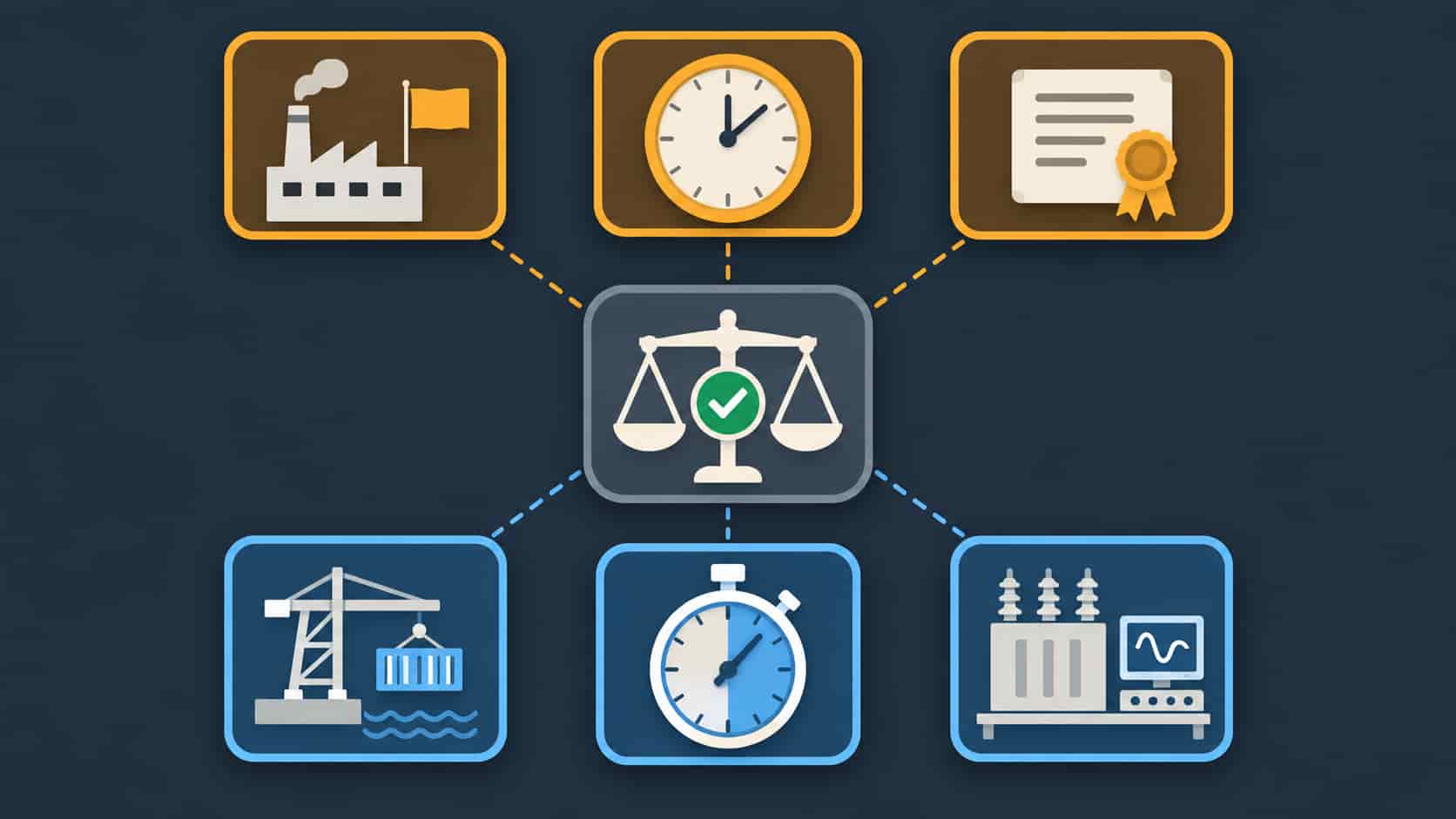
The shift is not a price story alone—it is a capacity, lead-time and product-breadth story, and the contractors doing it well manage quality with process rather than assumptions.
Introduction
Ten years ago, a European or North American EPC contractor specifying MV switchgear or distribution transformers would rarely put a Chinese manufacturer at the top of the bid list. Today the bid lists routinely contain three or four, and on many project types—renewables balance-of-plant, industrial distribution, rural electrification programmes, packaged substations—Chinese suppliers win on more than price. The shift is visible in freight: switchgear panels, transformer tanks and containerised substations leaving Chinese ports for Africa, the Middle East, Southeast Asia and Latin America at volumes the industry has never seen.
This article is an attempt to describe the shift accurately rather than cheerfully or alarmingly. What follows is the mix of forces driving it, an honest account of how Chinese manufacturing quality has changed—and where it still varies—the risks that actually bite buyers, and the checklist that separates disciplined sourcing from hopeful sourcing. The equipment itself is covered elsewhere on this site; the focus here is the procurement decision.
The Forces Behind the Shift
Four forces combine, and their weights differ by project type.
- Capacity and lead times. Post-2021, Western and regional manufacturers sold out their slots; utilities in North America and Europe booked transformer capacity years ahead. Chinese manufacturers added lines, kept slots open and quoted lead times measured in months—our analysis of the transformer lead-time shortage explains why that capacity became the decisive currency. For an EPC whose programme is gated on delivery, a shorter, committed lead time can be worth more than any discount.
- Price. Even after freight, duties and compliance costs, Chinese supply frequently lands 20 to 40 percent below Western equivalents on standard product. On competitive tenders where the equipment is a cost line rather than a differentiator, that gap decides awards.
- Product breadth under one roof. A single Chinese supplier group can quote the transformer, the switchgear, the RMUs, the cable and the packaged substation as one scope. Few Western manufacturers match that breadth, and fewer still at one contractual interface. The economics of one coordinated supply scope are covered in our article on switchgear selection and in our broader sourcing pieces; the point here is interface count—every interface a contractor removes is a risk removed.
- Certification maturity. The large export houses carry IEC type-test reports from accredited labs, KEMA/ASTA-style witness histories, and country approval files built across a decade of export projects. The paperwork barrier that once protected incumbents has thinned.
What Changed in Chinese Manufacturing Quality—and What Has Not
The top tier of Chinese electrical manufacturers is genuinely world-class: automated winding and core-cutting lines, in-house type-test laboratories, laser-cut switchgear fabrication, and engineering teams that speak the IEC standards natively. Their references include utility projects on every continent, and their documentation—test reports, factory audits, traceability—has professionalised to the point where third-party inspectors describe it as routine rather than exceptional.
The honest caveat is variance. The tier below the top is large, and the distance between the best and the merely cheap is the widest in any sourcing region. The same city can host a manufacturer whose FAT the client’s engineer extends by a day out of respect, and one whose test reports reorganise the truth. Quality in Chinese sourcing is therefore not a country attribute but a supplier attribute—and the buyer’s process, not the supplier’s brochure, is what finds the difference. The factories that fail projects are almost always the ones that were never audited, whose FATs were never witnessed, and whose certificates were never traced to the laboratory that issued them.
The Economics, Compared Honestly
The table sets out the decision factors the way an EPC procurement manager would weight them, comparing the traditional local-or-European route with direct China sourcing.
| Factor | Local or European Route | Direct China Route | What Tips the Balance |
|---|---|---|---|
| Price | Reference baseline | Typically 20â40% below on standard product after freight and duties | Competitive tenders where equipment is a cost line; less decisive where brand is contractual |
| Lead time | Slots booked out; year-plus quotes common on transformers | Months on standard product; capacity added through the shortage | Programmes gated on delivery dates; phased lots needing guaranteed slots |
| Product breadth | Deep single-category expertise; multi-vendor coordination | Transformer, switchgear, cable and packages from one group | Projects wanting fewer interfaces; coordinated supply models |
| Quality assurance | Familiar audit culture; short inspection travel | Top tier excellent; wide variance below; audits longer-haul | Buyer process qualityâwitnessed FAT and traced certificates decide outcomes |
| Service proximity | Regional service networks mature | Improving via regional partners and stockists; thinner in some markets | Markets where the manufacturer has committed stock and engineers |
| Standards fit | Native to local practice | IEC-native; local approvals vary by manufacturer history | Projects in IEC markets; national-approval depth checked per state |
The rating logic applies to the transformer line item regardless of route—capacity, losses and impedance must be engineered to the load; our transformer sizing guide covers that logic. The same holds for the cable line: order cable, joints and terminations as one matched system whichever route you choose—our guide to MV cable standards across IEC, GB and BS explains the compatibility trap. What differs by route is the process assurance wrapped around the engineering.
The Risks, Named and Managed
China sourcing carries specific, manageable risks. The first is supplier selection risk—the variance described above—managed by factory audits (in person or third-party), financial health checks and reference calls with contractors who have taken delivery, not just signed orders. The second is documentation risk: certificates that belong to a different variant, or type-test reports whose laboratory does not answer the phone. Manage it by tracing every certificate to the issuing laboratory and matching the variant numbers to the order. The third is quality-control risk at the batch level, managed by witnessed FAT with the client’s or third-party inspector present—our article on why FAT matters for switchgear describes the witness logic—and by pre-shipment inspection against a named checklist. The fourth is aftermarket risk: spares, software access and service response years after commissioning, managed contractually with regional stocking commitments and named service partners.
None of these risks is unique to China; all four exist in every sourcing region. What differs is the buyer’s distance from the factory, which raises the cost of informal assurance—a site visit, a known engineer, a shared professional network—and makes formal assurance: audits, traced certificates, witnessed tests, contractual spares. Disciplined buyers pay for formal assurance everywhere; casual buyers discover its absence everywhere, only expensively.
A Pre-Order Checklist That Works
The checklist below is what disciplined EPC procurement teams complete before signing. Each line has caught real projects.
| Checkpoint | What to Verify | Red Flag |
|---|---|---|
| Factory audit | On-site or third-party audit of production lines, QC stations and test facilities | Trading company with no factory address, or a showroom without production |
| Type-test certificates | Reports traced to the issuing laboratory, matching the exact variant and ratings ordered | Certificates for a "series" rather than the variant; lab unreachable for verification |
| References | Delivered projects of comparable scale in comparable climates, with contactable buyers | Reference list without contacts, or references limited to small lots |
| Witnessed FAT scope | Named inspector, test points at site conditions, acceptance criteria in the contract | FAT offered as a factory self-declaration without witnesses |
| Commercial structure | Payment milestones tied to inspection and approval; LC checklist agreed with the bank | Large deposits before any inspection milestone |
| Spares and service | Commissioning spares list, regional stocking commitment, named service partners | Warranty without a service footprint; spares quoted only ex-works |
When China Sourcing Is Not the Answer
Balance requires naming the cases where the traditional route still wins: projects where the contract or lender mandates approved-vendor lists that the supplier has not entered; equipment variants so specialised that the regional specialist’s engineering depth beats the generalist’s price; markets where no regional service commitment is achievable and downtime costs dominate; and schedules so tight that the certification and submittal learning curve cannot fit. EPC teams that treat China sourcing as one tool among several—rather than a blanket policy—consistently report better project outcomes than either the enthusiasts or the refuseniks.
Conclusion
The migration of EPC power-equipment purchasing toward China is a structural response to capacity, lead times and product breadth—reinforced, not caused, by price. The top tier of Chinese manufacturers delivers world-class equipment under IEC-native engineering; the market below them varies widely; and the buyer’s process is what tells them apart. Audited factories, traced certificates, witnessed FATs, milestone-tied payments and contractual spares convert the sourcing opportunity into project certainty.
Every sourcing region rewards that discipline and punishes its absence. The contractors gaining most from the current market are not the ones who switched—or refused to switch—decades of habit, but the ones who evaluate each lot on its merits with the same checklist, and buy assurance deliberately wherever the factory stands.
Frequently Asked Questions
Short answers to the questions procurement teams ask about sourcing power equipment from China.
Recent Posts
Voltage Stabilizers vs UPS: Do You Need Both?
Voltage Stabilizers vs UPS: Do You Need Both? One device fixes how high or low the voltage is; the other fixes whether there is voltage

Energy Storage for Data Centers: A Growing Backup Power Option
Energy Storage for Data Centers: A Growing Backup Power Option Batteries have always backed up data centers in the form of UPS strings. Grid-scale BESS
Thermal Runaway in Lithium Batteries: What BESS Buyers Should Understand
Thermal Runaway in Lithium Batteries: What BESS Buyers Should Understand How thermal runaway starts, how it propagates, and which evidence buyers should require before approving