
Energy Storage for Data Centers: A Growing Backup Power Option
Batteries have always backed up data centers in the form of UPS strings. Grid-scale BESS is now taking on a bigger role — here's how and why.
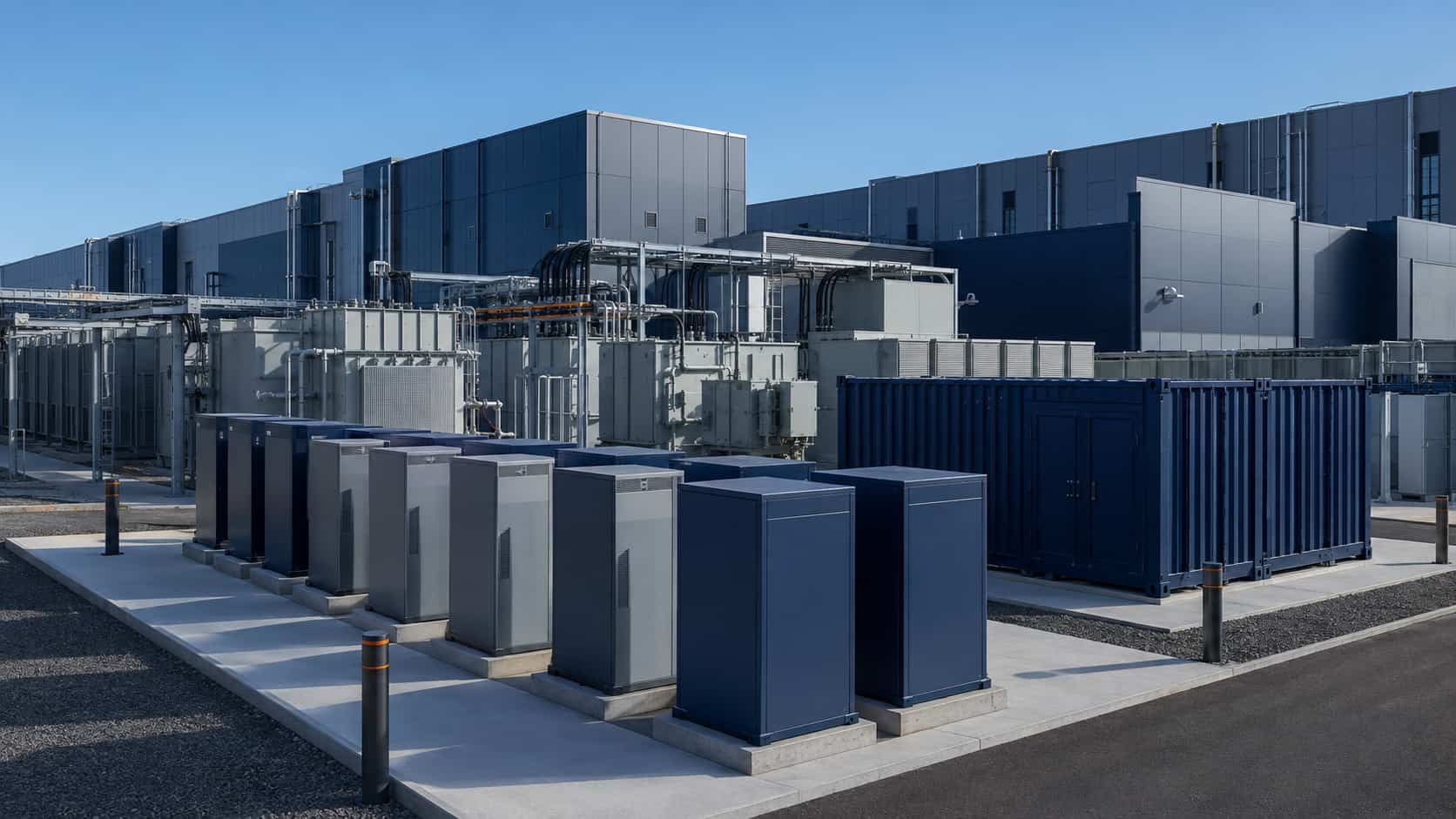
Why Data Centers Are Looking Beyond Traditional UPS Batteries
Data centers have always relied on batteries for backup power, typically in the form of short-duration UPS battery strings that bridge the gap between a utility outage and generator start. What’s changing is the growing role of larger, purpose-built battery energy storage systems alongside — and in some designs, partially replacing — that traditional architecture, driven by rising grid interconnection costs, longer generator lead times, and growing interest in reducing diesel generator dependence.
How BESS Differs from Traditional UPS Battery Strings
Traditional UPS batteries are sized for short bridge duration — typically minutes, just long enough to transition to generator power — and sit close to the critical load as part of the UPS system itself. A dedicated BESS, by contrast, is typically sized for longer duration, from tens of minutes to several hours, and can serve a broader set of functions beyond bridging to a generator, including peak shaving, participation in grid demand response programs, and providing an intermediate layer of resilience during longer grid disturbances.
Key Applications in Data Center Design
Extended ride-through and generator deferral
A larger BESS can extend the effective ride-through time beyond what UPS batteries alone provide, giving facilities more flexibility in generator sizing, start sequencing, or in some designs, reducing the number of generators required for a given resilience target.
Grid interconnection capacity management
In markets where new grid interconnection capacity is slow to obtain or expensive to upgrade, a BESS can help a facility operate within its existing grid connection limit by discharging during peak IT load periods, effectively increasing the facility’s usable capacity without a grid upgrade.
Demand response and grid services participation
In deregulated markets with demand response or ancillary services programs, a data center’s BESS can participate in these programs during normal operation, generating additional revenue or cost offset while remaining available for its primary backup function when actually needed.
| Application | Duration basis | System role | Key procurement limitation |
|---|---|---|---|
| UPS ride-through | Defined by critical-load continuity and generator transfer design; commonly seconds to minutes | Immediate no-break or tightly controlled support to the critical bus | A general BESS PCS is not automatically UPS-qualified |
| Extended backup | Tens of minutes to hours, based on protected load and outage scenario | Extends resilience or supports generator sequencing | Verify usable energy at end of life, auxiliary loads and recharge strategy |
| Peak management | Follows the site's peak duration and utility billing interval | Limits import peaks or supports phased capacity deployment | Must preserve backup reserve and cannot cover sustained energy deficits indefinitely |
| Demand response | Program-specific event duration and frequency | Reduces site import or provides an eligible grid service | Market dispatch must never compromise the critical reserve |
| Renewable shifting | Based on generation profile, load profile and target energy window | Moves renewable energy to a later operating period | Requires sufficient recharge opportunity and coordinated EMS control |
| Islanded microgrid | Derived from critical loads, generation, fuel and restoration objectives | Balances local sources and loads during a grid outage | Requires grid-forming capability, protection coordination and load shedding |
Design Considerations Specific to Data Centers
Data center BESS deployments carry stricter reliability expectations than many other commercial applications, given the cost of downtime. This typically means higher redundancy requirements (N+1 or 2N configurations depending on the facility’s tier target), tighter integration with existing building management and DCIM systems, and closer coordination between the BESS’s EMS and the facility’s overall power management strategy, so the battery’s non-critical functions like peak shaving never compromise its availability for genuine backup events.
Where Kexingyu Power Fits In
Kexingyu Power supplies battery energy storage systems engineered for the reliability and integration requirements of data center environments, alongside our broader UPS & Critical Power lineup. Explore our full Energy Storage Systems range, or see our complete approach to facility resilience in our Data Center Power solutions.
Data Center Energy Storage FAQs
Key questions about integrating BESS with UPS systems, generators and critical power infrastructure.
Not automatically. A UPS provides validated continuity and power-quality performance at the critical bus. A BESS can provide fast power and substantial energy, but its PCS topology, transfer behavior, overload capability, fault response, redundancy and controls must be engineered and tested for the required UPS function.
Storage may reduce generator runtime, support generator sequencing or cover selected outage scenarios. Replacing generators requires a complete reliability assessment covering outage duration, recharge opportunity, simultaneous failures, maintenance, fuel strategy, regulatory obligations and the targeted resilience level.
The EMS should enforce a minimum state of charge and suspend commercial dispatch whenever backup readiness is at risk. The control philosophy should also define reserve restoration, forecast errors, equipment outages, loss of communications and who has authority to override normal dispatch.
No. Redundancy must cover the complete power path and supporting systems, including PCS capacity, switchgear, controls, cooling, auxiliaries, protection, communications and maintenance isolation. Extra battery energy alone may not remove a single point of failure.
Provide critical and non-critical load profiles, step-load behavior, required autonomy, UPS and generator architecture, grid import limits, operating use cases, environmental conditions, redundancy objectives and beginning- and end-of-life performance requirements.
Recent Posts
Thermal Runaway in Lithium Batteries: What BESS Buyers Should Understand
Thermal Runaway in Lithium Batteries: What BESS Buyers Should Understand How thermal runaway starts, how it propagates, and which evidence buyers should require before approving
Switchgear Lead Times in 2026: A Buyer’s Planning Guide
Switchgear Lead Times in 2026: A Buyer’s Planning Guide Realistic timelines vary significantly by voltage class and type — here’s how to plan procurement without
What Is BESS? A Guide to Battery Energy Storage Systems for C&I Buyers
What Is BESS? A Guide to Battery Energy Storage Systems for C&I Buyers A clear explainer on what BESS systems actually are, how the pieces