Industrial Cable RFQ: The Questions That Decide the Quote
Quick Answer: An industrial cable RFQ is a specification plus a commercial envelope, and the reply is only as comparable as the questions asked. If conductor class, standard, test regime, drum lengths, copper basis and delivery basis are left open, every supplier prices a different cable and the cheapest number is simply the one with the most gaps in it.
Introduction
Industrial cable purchases rarely go wrong in the copper. They go wrong in the enquiry. Two suppliers answer the same document, one quotes a class 2 stranded conductor in PVC against a harmonised standard and the other a class 5 flexible conductor in LSZH, and the numbers differ by forty per cent for reasons nobody wrote down.
This page is for buyers, project engineers and procurement leads who have to issue the enquiry and then defend the selection. Our special wire and cable range shows the families these questions are usually asked about, and the note on reading an electrical datasheet explains how to tell whether a reply answered what you asked.
What an RFQ Has to Fix Before Price Means Anything
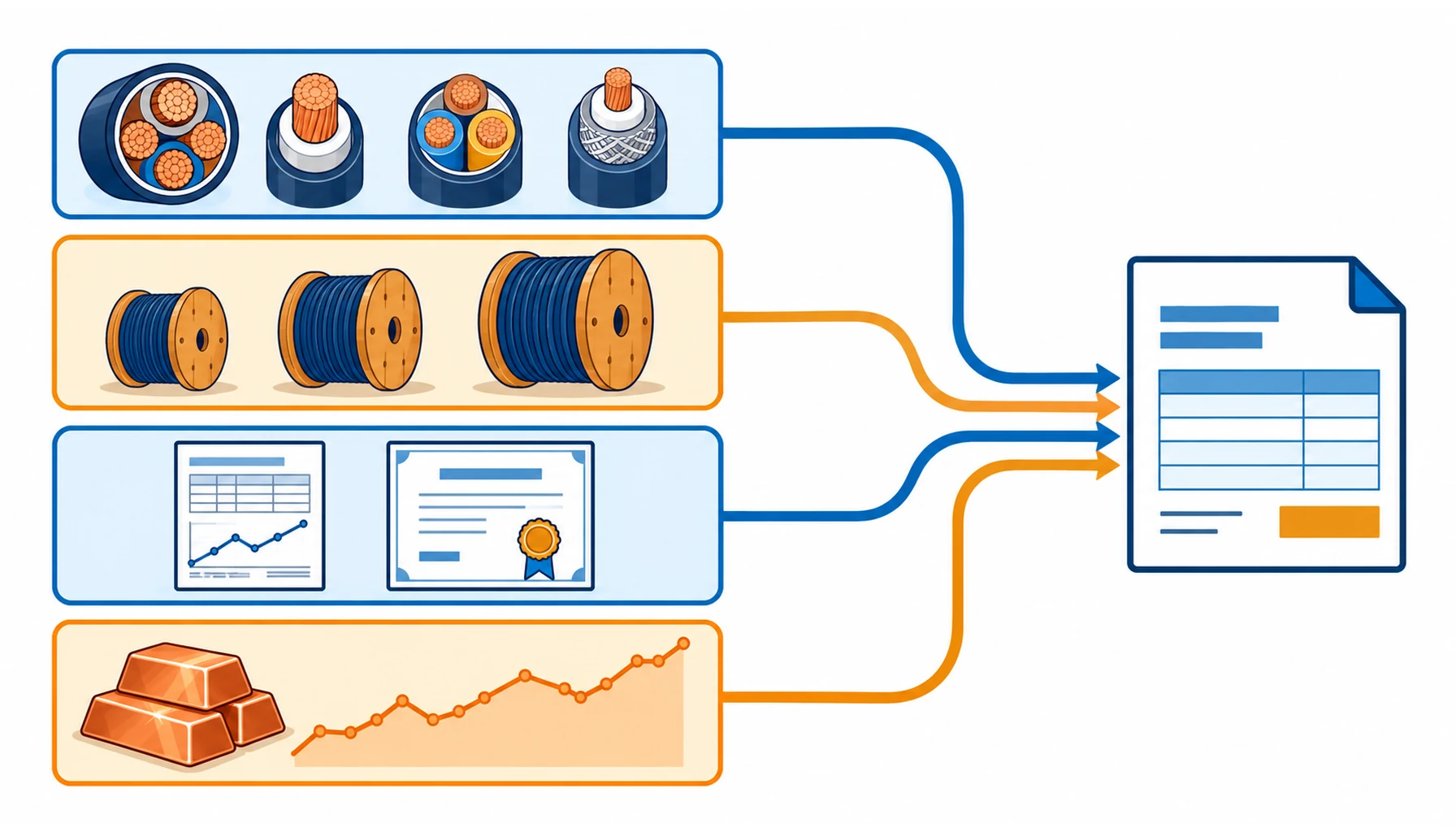
An RFQ is not a request for a price. It is a request for a price against a fixed set of assumptions, and four things have to be closed in writing: what the cable is, how much of it, what has to be proved, and how it is bought and delivered.
Construction and standard sit on top because they move the price most. Conductor class and material, insulation compound, sheath compound, screen, armour and the standard will together account for more of the spread between two quotes than anything else.
Quantity sets the factory’s economics. Twelve kilometres gives the plant a reason to schedule properly and buy conductor at a better position. Eight hundred metres of a non-standard construction is quoted as an interruption, and the price says so.
Evidence and commercial basis close the last gaps. A cable with routine tests and a cable with routine tests witnessed and a full document pack are not the same purchase. Neither is a price held for seven days and one held for sixty.
The Questions That Change the Number
Conductor class, not just conductor size. The same cross-sectional area can be a rigid class 2 strand or a flexible class 5 strand, and the flexible version costs more in conductor and in lay-up time. Where the route is fixed and the cable never moves again, a rigid conductor does the job. Our note on IEC 60228 conductor classes sets out what each class is for.
Insulation and sheath compounds. XLPE, PVC, LSZH, EPR and rubber are not interchangeable at the same size, and the choice is usually driven by fire performance, temperature or mechanical duty. A design that specifies PVC everywhere and then asks for a fire-rated riser will be re-quoted.
Voltage grade, core count and screening. Where the cable sits on the voltage scale changes insulation thickness, the test list and sometimes the standard family. Correlation between the rated voltage and the highest sustained voltage the circuit sees is worth checking before the enquiry goes out, not after the first reply arrives.
Lengths, drums and tolerance. One long length or a set of shorter ones changes the joint count, the drum count and the freight. Length tolerance belongs in the enquiry as a stated figure with a stated basis, because it is one of the few lines where buyers pay for cable they never receive.
Specification Variables Compared
The table sets out the variables that most often go unstated: what each one changes, what to specify, the evidence to demand, what drives cost and time, and how each distorts the quote when it is left open.
| Variable | What it changes | What to Specify | Evidence to Demand | Cost and Lead-Time Driver | How It Distorts the Quote |
|---|---|---|---|---|---|
| Conductor class and material | Flexibility, conductor price, terminating time and the tightest bend the installer can work to | The IEC 60228 class, the metal, and whether tinned or plain strand is accepted | Conductor schedule with strand count, plus a copper purity statement | Copper is the largest element, and fine stranding adds drawing and lay-up cost | A rigid conductor quoted against a flexible application, or aluminium offered against a copper enquiry |
| Insulation and sheath compound | Temperature rating, fire behaviour, chemical resistance and flexibility in cold | The compound family, the temperature rating and the fire requirement by name | Compound declaration plus the type test report for the fire performance claimed | LSZH and rubber cost more than PVC and carry longer material lead times | A PVC construction priced as an equal to LSZH, which reads as a saving and is not one |
| Voltage grade, cores and screen | Insulation thickness, test list, screening and armour options, and the standard family | The rated voltage, the core count, the screen type and whether armour is required | The routine test sheet and the construction drawing with dimensions | Screening and armour add material and process steps; higher grades add insulation | A cable rated below the system voltage quoted as the same item because the size matches |
| Standard and market approval | Which tests apply, which certificate is required and whether the goods can be imported | The standard by number and edition, plus the approval the destination requires | A certificate showing scope, standard edition and manufacturing address | Approval testing and certificate scope work is a one-off cost to be amortised | A general certificate presented as coverage for the exact construction and market |
| Lengths, drums and tolerance | Joint count, handling at site, freight volume and how much cable you actually pay for | Length per drum, the tolerance and its basis, drum weight limits and drum returns | A drum schedule with measured lengths, plus the tolerance clause as agreed | Drum count drives freight, and short drum runs add set-up time at the factory | A tolerance expressed as a percentage of the ordered total rather than per drum |
Quantity, Lengths and the Drum Question
Ask for the route lengths, not a rounded total. A quote against a total tonnage hides the fact that the factory will deliver it in whatever drum lengths suit the plant. Once the drums arrive, the jointing cost and the site programme absorb the difference, and neither was in the comparison.
State the drum limit before the price is fixed. Site access, crane capacity, reel stand geometry and the maximum legal load on a delivery vehicle all set an upper bound. A drum that cannot be offloaded is a re-drumming charge and a lost day. Our note on cable drum packaging covers the options.
Understand what the minimum order quantity protects. An MOQ is not a policy, it is a statement about set-up time, minimum conductor purchase and the cost of interrupting the plant. If your quantity sits close to the boundary, ask what the next sensible size is rather than what the maximum discount is. The mechanics are set out in our note on MOQ and lead time.
Standards, Certification and Market Access
The standard defines the test list. Naming a standard tells the factory which routine and type tests apply, which construction options are permitted and which marking has to appear on the sheath. Naming a cable by trade description does none of that, and it leaves the supplier free to make the least expensive cable that fits the words.
A certificate proves a scope, not a reel. Approval certificates carry a range of sizes, voltage grades, constructions and manufacturing locations. It is common for the certificate to be genuine and the construction being bought to sit just outside it. Ask for the scope page and compare the ranges against the order.
Market access is a destination question. The same cable can be correct at the factory and refused at the border. The applicable approval depends on where the goods will be installed and who signs the completion certificate. Our notes on the certification checklist and on import certification by country set out how to check this early.
Testing, Witnessing and Documentation
Routine tests come with every drum; type tests do not. Insulation resistance, continuity, conductor resistance and a high-voltage withstand test are normally performed on the finished length. Fire performance, mechanical endurance and ageing behaviour are demonstrated once on a representative sample, and the report covers the type rather than the drum you are buying.
Witness points move the cost and the schedule. If a buyer or an inspector attends for the routine tests, the plant holds the drum, prepares the test bay and has the paperwork ready on a fixed date. That is a real cost and reasonable to price. It is unreasonable to demand it and then not attend. The arrangements are described in our note on cable factory testing.
Name the document pack in the enquiry. A quote that includes a test certificate and nothing else will be cheaper than one that includes material certifications, drum schedules, a declaration of conformity and a packing list. State the list, and make clear that a missing document holds payment rather than generating a follow-up email.
Commercial Terms: Copper, Payment and Delivery
The copper basis decides how long the price is real. Cable is priced from a metal position, and the supplier either buys that position or carries the risk of it moving. A quote can be firm for a stated period, expressed as a formula against a published copper price, or held open until the order is placed. Only the first two are comparable. The mechanism is covered in our note on copper price and cable procurement.
Payment terms interact with price. Advance payment, letter of credit and open account carry different costs for the supplier and different exposures for the buyer, so a comparison on unit price alone is incomplete. Our note on cable payment terms sets out what each structure implies.
The delivery basis fixes where your risk starts. A price that stops at the port and one that stops at the site gate differ by freight, insurance, import handling and who owns the goods if something goes wrong in transit. State the Incoterm and the destination, and keep them identical across every reply. Where the schedule is long, the framework route is often the better answer, as set out in our note on moving from an RFQ to a framework agreement.
What to Freeze Before the Order Goes Out
Eight decisions decide whether the replies are a shortlist or a set of unrelated offers. Each belongs in the RFQ, not in the negotiation that follows it.
| Decision | What to State | Evidence to Attach | Cost of Leaving It Open |
|---|---|---|---|
| Construction and standard | The standard by number and edition, with the construction named to it | A sample data sheet or drawing used as the reference document | Two suppliers quoting different cables and a comparison that means nothing |
| Conductor class and size | The IEC 60228 class, the metal and the accepted strand form | A conductor schedule with strand count | A rigid cable delivered to a flexible application and a re-order |
| Insulation, sheath and fire performance | Compound family, temperature rating and fire requirement by name | Type test report for the fire performance claimed | A substitution that reads as a saving and fails at handover |
| Voltage grade and cores | Rated voltage, core count, screen and armour requirements | A construction drawing with dimensions | A cable rated below the system voltage accepted on a matching size |
| Lengths, drums and tolerance | Length per drum, tolerance with its basis, and the drum weight limit | A drum schedule with measured lengths | Short drums, extra joints and a re-drumming charge on site |
| Test and witness regime | The routine tests required, type reports to be supplied and the witness points | A test plan with the points the buyer will attend | Tests witnessed by nobody, and a claim that cannot be proved later |
| Documentation pack | The documents supplied with the goods and the language they must be in | A document list with the issuing party for each item | A handover file completed by email over several weeks |
| Copper basis, validity and payment | How the metal element is calculated, how long the price holds and the payment structure | The validity statement in writing, dated | A price that moves between comparison and order, with no basis to argue it |
Comparing Quotes Like for Like
Normalise to a delivered cost per metre. Unit price at the factory gate is the least useful number on the page. Add freight, insurance, import charges and any drum returns you agreed, divide by delivered metres, and only then put the replies in order. Our note on comparing cable quotes walks through the normalisation.
List the exclusions on one line each. A quote that excludes drums, test certificates, witness attendance or export packing is not cheaper, it is incomplete. Put every exclusion in a single column so the gaps are visible at a glance rather than buried in the terms.
Check the validity date before you rank anything. A quote that expires in a week is not comparable with one that holds for two months, and the ranking can reverse if the copper position moves first. The structure of a cable price is broken down in our note on cable price breakdown.
Cost and Lead Time
Cost has six elements. Metal at the day’s position, compound and other materials, conversion cost including drawing, extrusion and lay-up, testing and certification, packaging and freight, and margin. When a quote comes back far below the field, the reason is almost always in one of the middle elements rather than in the metal.
Lead time is driven by the slowest material. Special compounds, LSZH grades and rubber sheaths are often the constraint rather than the extruder. Add conductor purchase, drum availability, testing, third-party inspection and freight. Where the programme is tight, the honest answer is usually a split delivery rather than a promise that will not hold.
When a Formal RFQ Is Not the Answer
When it is a repeat of an approved item. Re-running a full enquiry for a cable already approved, already made and already tested costs weeks and rarely produces a better price. Use the existing specification and ask for a schedule instead.
When the plant is down. An emergency repair needs a call-off against an agreed frame, not a tender. With no frame in place, the fastest route is a standard construction genuinely in stock, accept a joint, and plan the permanent replacement properly afterwards.
When the specification is not frozen. Running an RFQ against an unfrozen design guarantees incomparable replies and a re-quote. Do the technical clarification first. Our note on sourcing mistakes shows how often this step is skipped.
RFQ Checklist
- The standard by number and edition, plus the approval the destination market requires
- Conductor class to IEC 60228, the metal, and whether tinned or plain strand is accepted
- Insulation and sheath compounds, temperature rating and fire performance by name
- Rated voltage, core count, screen type and whether armour is required
- Length per drum, the length tolerance and the basis on which it is measured
- Drum weight limit, reel stand geometry and the return arrangement for empty drums
- Total quantity, the delivery schedule and whether split deliveries are acceptable
- Routine tests required, type reports to be supplied, and the witness points to be attended
- The document pack, with the issuing party and the language required for each item
- Marking on sheath and drum, including the project reference
- The copper basis, the price validity period in writing and the payment structure
- The Incoterm, the destination and who owns freight risk in transit
- Export packing standard, and any restriction on wood packaging at the destination
- The named contact and the date by which the quotation must be returned
Conclusion
An industrial cable RFQ is mostly a document about discipline. Every variable that is closed narrows the spread between the replies and makes the comparison about price rather than assumptions. Every variable left open pushes cost into the negotiation or, worse, onto site, where it arrives as a joint, a re-drum or a cable that is not quite what the designer intended.
Kexingyu Cable Group (KXYE) has manufactured cable in Quanzhou since 1996, working from buyer specifications and standards documents rather than from trade descriptions. Send us the enquiry, the single line diagram and the site constraints, and we will come back with the construction, the tests, the document pack and the delivery plan that match. A request for quotation is the fastest route.