
Common Mistakes When Sourcing Power Equipment Internationally
Imported transformers and switchgear rarely fail because of exotic problems—the same handful of procurement mistakes causes most of the losses, and every one of them is preventable on paper before a purchase order is signed.
Introduction
International sourcing has made power equipment dramatically more accessible: a substation package that once meant a regional monopoly supplier can now be quoted from three continents. But the failure patterns have not changed as much as the logistics have. Ask anyone who has run claims for imported equipment and the stories cluster into the same dozen scenarios—the specification that was never actually agreed, the factory visit that never happened, the certificate that turned out to belong to a different design, the FAT that was skipped because the schedule was tight.
What makes these mistakes stubborn is that none of them looks like a mistake at the time. Approving “as per our discussion” instead of a datasheet feels efficient. Skipping the factory audit saves two weeks. Accepting a photocopy of a type-test certificate is faster than asking for the original. Each shortcut passes its moment without consequence and deposits its cost weeks later—during production, at the port, or worst of all during energization—when every fix runs through claims procedures and shipping schedules.
This guide collects the recurring mistakes into one list, traces the consequence each one typically produces, and pairs them with the safeguards that experienced buyers run instead. The context is cross-border procurement of the transformer, switchgear and substation families, but most of the patterns apply to any imported electrical equipment.
Mistake 1: Sending a Name, Not a Specification
The most expensive habit in international procurement is describing what you want by product name and voltage alone—”11 kV switchgear, 6 panels”—and letting the supplier fill in everything else. Two factories will both happily offer that, priced thousands apart, because they assumed different busbar ratings, different protection platforms, different degrees of protection and different amounts of factory testing. The gap surfaces at bid comparison, where the offers cannot be compared, or worse, after the order, where the cheapest assumptions quietly become your specification.
The safeguard is unglamorous: a technical particulars table that states ratings, standards, tests and interfaces, and a returned vendor datasheet with deviations marked before the purchase order. The returned document then becomes the manufacturing reference and the FAT checklist. Buyers who skip this step are not saving documentation time; they are deferring it to a claims process at ten times the cost.
Mistake 2: Treating Lead Times as Marketing Numbers
Quoted lead times are conditional statements—conditional on design approval speed, on component availability, on your own document turnaround. Buyers who copy the quotation’s number into the project schedule without unpacking those conditions set up a delay that no supplier can rescue. The current market makes this worse: transformer capacity is booked months deep, and the transformer lead-time shortage has pushed quoted times far beyond historical norms, with the switchgear planning picture similarly stretched. Ordering early with a fixed specification is the only reliable answer; negotiating dates against an unchanged specification is not.
The companion mistake is ignoring the small delays that live between the big ones: cable and accessories ordered “later” because the panels are the critical item, then arriving after them. The way cable sourcing delays propagate into EPC timelines is its own case study—packages do not slip because one product was late, they slip because interdependencies were never mapped.
Mistake 3: Skipping the Factory Audit
A website and a quotation cannot distinguish a factory with a functioning quality system from one with a good photographer. The audit does not need to be elaborate: a day on the floor confirms whether the assembly line matches the datasheet’s claims, whether test instruments carry calibration stickers, whether the type-test reports on the wall have project names attached, and whether the people answering your emails actually talk to the production supervisor. For equipment families where the manufacturer matters as much as the design, the due diligence checklists for transformer manufacturers and the audit questions they list convert a factory visit from a courtesy into an assessment.
Buyers who cannot travel still have options—a third-party inspection with a written scope, or a structured remote audit—but the mistake is not choosing a substitute carefully; it is treating the substitute as optional and ordering on faith.
Mistake 4: Trusting Certificates Without Tracing Them
Certificate fraud is rarer than certificate confusion, but the second is common enough to cause the same losses. A genuine IEC type-test report for a design family does not automatically cover the variant you are buying; a laboratory accreditation belongs to the lab, not to the reseller quoting it; and a certificate in a different brand name needs a documented trace, not an explanation by email. The disciplined question set is short: which report number, which laboratory, which design, and will a copy ship with each unit. For energy storage buyers the BESS certification checklist lays out the document set by system level, and the same structure works for switchgear and transformers.
The related mistake is assuming certification equals compliance with your network’s requirements. Grid codes, utility interconnection rules and local amendments sit outside IEC type tests, and discovering them at customs or commissioning is a classic imported-equipment failure.
Mistake 5: Cutting Factory Testing When the Schedule Tightens
When delivery pressure mounts, the witnessed FAT is the first thing buyers offer to waive—precisely when it is most valuable. Skipping witness does not change what the factory tests; it changes what you know, who signed, and what leverage exists if the equipment misbehaves on site. The economics are lopsided: a day of witness attendance against weeks of site rectification and a responsibility dispute with no signed reference document. The switchgear FAT guide details what a proper witness visit covers and why the signed report becomes the anchor for the site acceptance that follows.
The contractual version of this mistake is leaving inspection rights vague— FAT “if required,” witness “by agreement”—so that exercising the right becomes a negotiation at the worst possible moment. Rights written into the contract with notice periods cost nothing until the day they matter.
The Mistakes and Their Safeguards
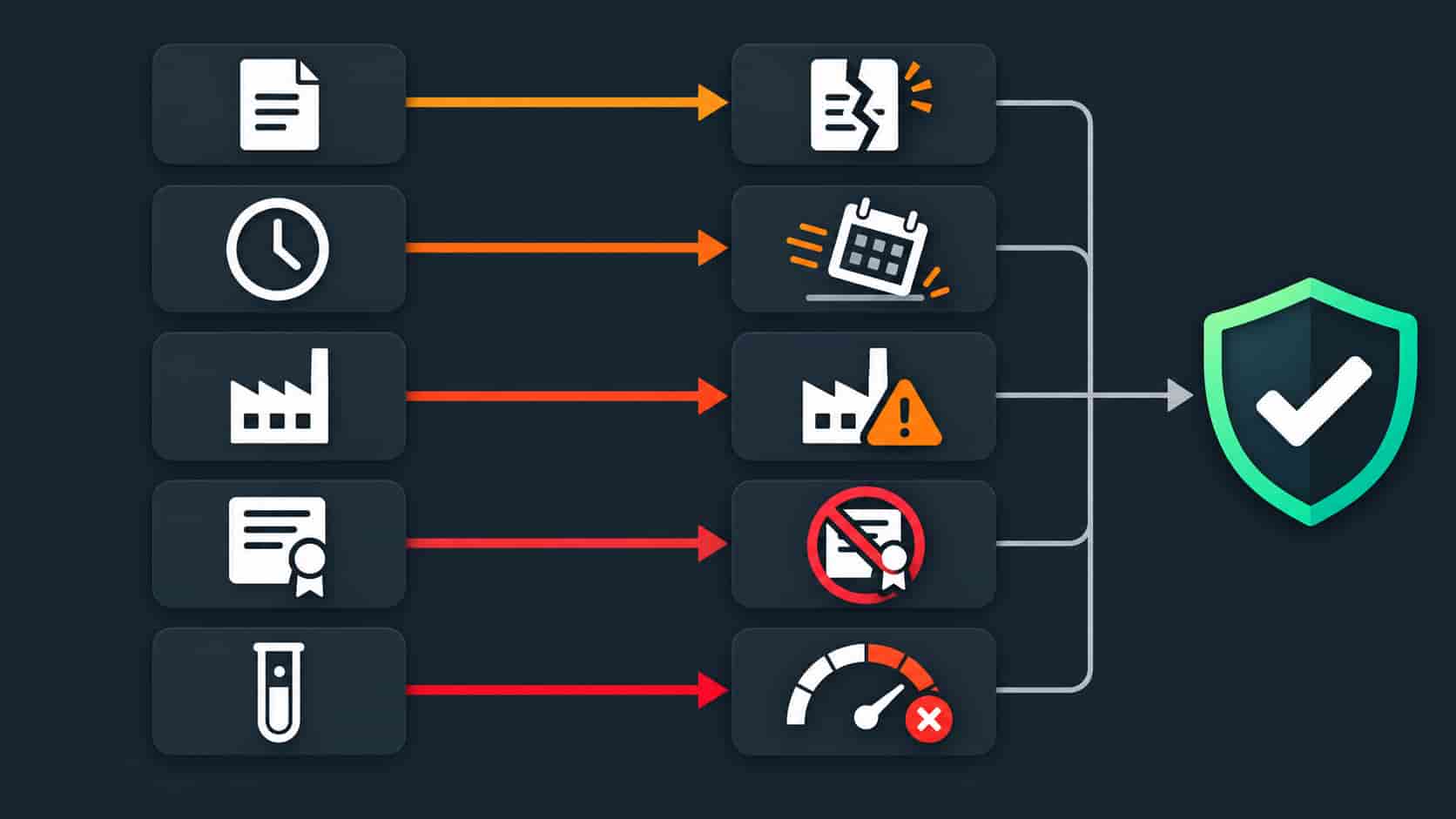
The table compresses the recurring patterns into one reference—what goes wrong, what it costs, and the process habit that prevents it.
| Mistake | Typical Consequence | Prevention |
|---|---|---|
| Ordering by product name, not specification | Offers cannot be compared; assumptions become the spec | Technical particulars table + returned vendor datasheet as contract annex |
| Scheduling on quoted lead times | Delay at design approval or component shortage, discovered too late | Unpack the lead-time conditions; order early; map interdependent packages |
| Skipping the factory audit | Quality system gaps surface during production instead of selection | On-site or third-party audit with a written scope before the order |
| Accepting certificates without trace | Variant not covered; accreditation misattributed; customs or client rejection | Report numbers, laboratory, design match and per-shipment document list |
| Waiving witness testing under schedule pressure | Site failures with no signed reference and weak claim position | FAT rights and notice periods written into the contract; witness non-negotiable |
| Ignoring Incoterms and logistics detail | Surprise charges, insurance gaps, damage disputes at the port | Agreed delivery term, packing specs, transit insurance and port-handling plan |
The Safeguard Layer: Checkpoints That Work
Each prevention in the table becomes real as a checkpoint with a date, an owner and a document. The sequence below is the one that repeatedly survives contact with real projects—not because it is clever, but because it puts every expensive discovery where it is cheap.
| Checkpoint | When | What Good Looks Like |
|---|---|---|
| Specification freeze | Before enquiry | Technical particulars table issued; suppliers return datasheets with deviations marked |
| Supplier due diligence | Before shortlist | Audit or third-party report on file; references checked for similar projects |
| Document verification | Before order | Certificate trail documented: report numbers, laboratories, design match |
| Contract annexes | At order | Datasheet, test protocol, inspection rights and Incoterms all referenced in the order |
| Production surveillance | During manufacture | Milestone photos or inspection visits at defined stages; deviations logged in writing |
When Cheapness Is the Real Mistake
One pattern sits underneath the list: many sourcing failures are price decisions wearing a process costume. The bid that is thirty percent below the field usually removed something you needed—factory testing depth, material grade, document quality, engineering hours—and none of those removals appear as line items. The protection is not to refuse low prices but to ask what changed: which test was dropped, which component became “equivalent,” which engineering review shrank. Suppliers answer that question honestly more often than buyers expect, because the honest ones are tired of losing to the ones who do not answer it at all.
A Practical Checklist Before Your Next Order
- Issue a specification, not a product name—and require a returned datasheet with deviations marked
- Unpack every quoted lead time into its conditions before it enters the project schedule
- Audit the factory or commission a third party with a written scope, especially for first orders
- Trace every certificate to a report number, laboratory and design, and list the per-shipment document set
- Write FAT and witness rights into the contract with notice periods, and defend them when schedules tighten
- Agree packing, insurance and port-handling details before shipment, not after the damage
- Ask what was removed from any bid that is dramatically cheaper than the field
Conclusion
International equipment sourcing is not more risky than domestic sourcing; it is less forgiving of informality. Distance converts every undocumented assumption into a claim, every vague right into a negotiation, and every missing document into a delay at a border or a site. The mistakes in this guide share one root—decisions deferred past the point where they were cheap to make—and the safeguards share one shape: a written artifact at the moment of decision.
None of the fixes requires new technology or unusual skill, only the discipline to freeze specifications before enquiries, verify before ordering, and test before shipping. Buyers who institutionalize those three habits stop seeing the failures on this list—not because their suppliers changed, but because their process no longer creates the conditions where those failures grow.
Frequently Asked Questions
Recent Posts

Power Cable Warranty Terms: What to Demand and What to Watch For
Power Cable Warranty Terms: What to Demand and What to Watch For Quick Answer: A usable warranty names its scope, duration, evidence standard, exclusions and
The Cable Sample Approval Process: What to Test Before Mass Production
The Cable Sample Approval Process: What to Test Before Mass Production Quick Answer: Sample approval tests the supplier’s claims while changes are still cheap —
Cable Drum Packaging for Export: Specs, Marking and Transit Protection
Cable Drum Packaging for Export: Specs, Marking and Transit Protection Quick Answer: Export packaging is a technical specification: drum size for weight and bend radius,