
The Cable Sample Approval Process: What to Test Before Mass Production
Quick Answer: Sample approval tests the supplier's claims while changes are still cheap — a sample from the same lines as your order, signed off against recorded evidence. A cable sample costs a few meters of product and a week of freight. The order it protects can be ten kilometers of feeder cable and a schedule that can't absorb a re-manufacture. That asymmetry is the whole argument for sample approval: every specification dispute discovered on a sample is a conversation, while the same dispute discovered on delivered drums is a claim. Yet sample approval is also the step most often performed backwards. Samples get collected, admired and archived, and nobody records what was actually verified. This guide structures the process so the sample produces a decision and a baseline, not a souvenir.
Introduction
Cable sampling sits at the junction of two procurement truths. The first is that cable’s value is invisible: conductor purity, stranding and insulation thickness all hide inside the sheath, so touch and appearance prove almost nothing. The second is that corrections are cheap only before production. A wrong sheath compound on a sample is an email; the same wrong compound on delivered drums is a shipment nobody can accept and a project week nobody gets back. The sample approval process exists to move every checkable property of the offer into the verifiable column before the order runs. It connects naturally to the documentation side of purchasing. The sample should match the datasheet line by line, using the reading discipline in how to read an electrical equipment datasheet, and for customized constructions the sample is the moment where OEM-style custom work either proves itself or reveals that the factory is reselling someone else’s product, the distinction explored in OEM vs ODM for power equipment.
What a Sample Can and Cannot Prove
A sample proves construction and materials: that the factory can build the offered design with the offered compounds, that the dimensions meet the datasheet, that the printing reads correctly, and that the batch documentation looks the way the quotation promised. It cannot prove process consistency. One good sample says nothing about drum four hundred, and it can’t substitute for the per-length routine testing that watches actual production. Knowing the boundary keeps the process honest. The sample verifies the design and the supplier’s documentation culture; the factory’s test regime verifies the production run. Buyers who expect the sample to certify the whole order over-test it and then relax, when the correct posture is the opposite. The sample earns a decision, and production earns its evidence per drum. The regime that watches production, with its routine, sample and type tests, is layered in our MV and LV cable standards guide, and the approval process slots in front of it as the design-confirmation step.
The Sample Types and When Each Runs
Four sample types cover most projects. The pre-production sample is produced on the actual lines and materials intended for the order, before release to mass production. This is the sample that matters and the one this guide centers on. The first-article sample is cut from the very first production length of the released order, confirming that mass production started the way the approved sample promised. It’s a checkpoint, not a negotiation. The type-test sample is the length sent to an accredited laboratory when the project requires certificates for a construction the factory has not yet tested. It doubles as verification that the laboratory paperwork names a real, buildable design. And the courier sample is the short, fast length sent early in discussions to check basics like printing, jacket feel and stranding view before deeper investment. Each type answers a different question, and confusing them is the first process failure. Approving a courier sample and treating it as production release is how wrong compound reaches a kilometer of drums.
| Sample Type | Timing | What It Proves |
|---|---|---|
| Courier sample | Early discussion stage | Basics: printing, finish, stranding view â a filter, not an approval |
| Pre-production sample | Before mass production release | The offered design built on the order's lines and materials; the approval decision |
| First-article sample | First length of the released order | Mass production started consistent with the approved sample |
| Type-test sample | When certificates are required | An accredited laboratory qualifies the exact offered construction |
What to Do with the Sample When It Arrives
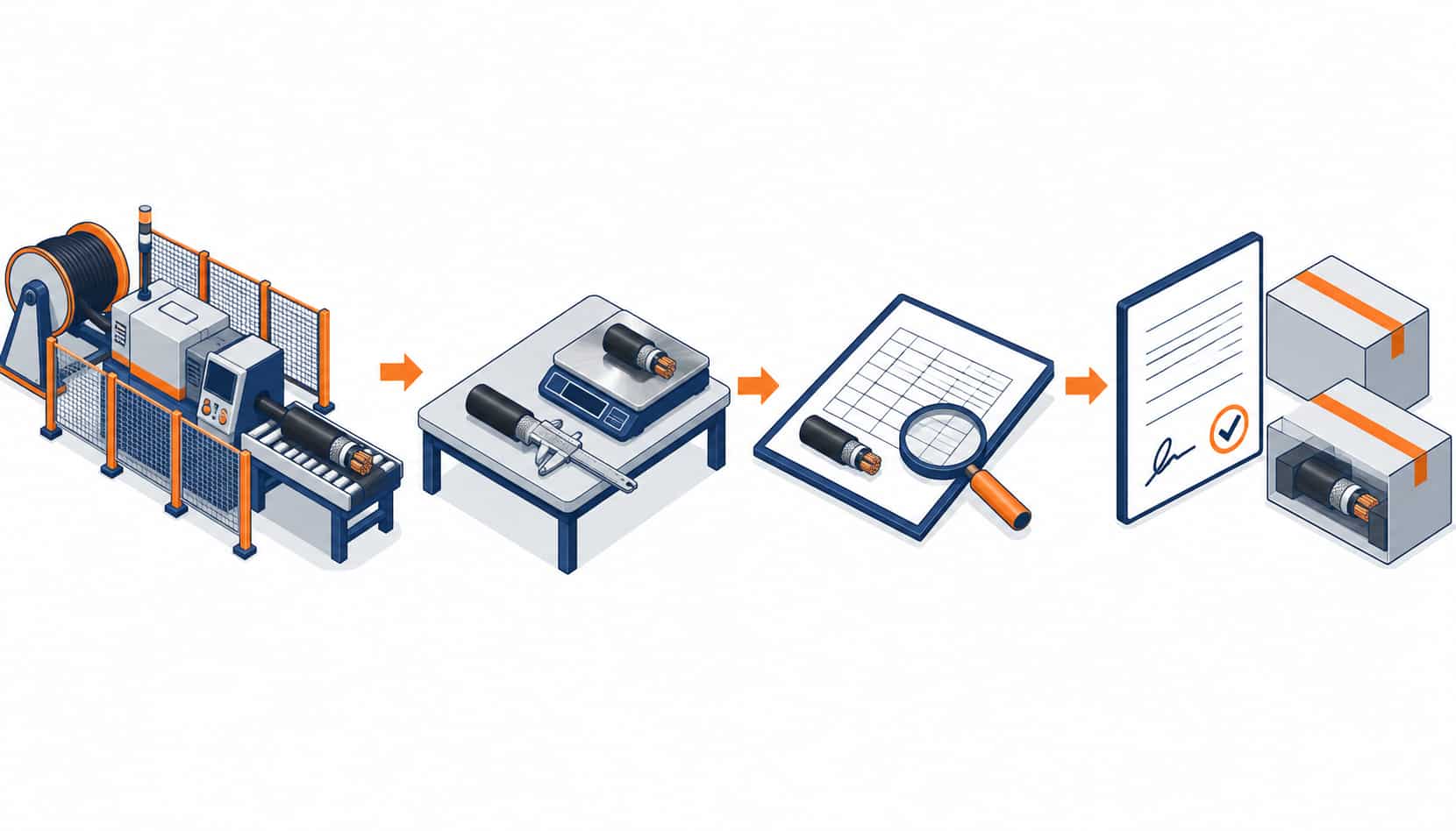
The verification is mechanical if planned. First, compare the sample’s printing against the specification character by character: voltage, size, standard, manufacturer. Printing errors are trivially cheap to fix now and expensive to explain on site. Second, cut and measure: jacket and insulation thickness with a caliper or microscope section, conductor diameter and strand count against the declared class, lay length visible to the eye. Third, weigh or calculate. Copper content per meter against the offered construction is the fastest fraud detector in the trade, and a sample light in metal is an order you now know not to place. Fourth, if the stakes justify it, send a length to an independent laboratory for conductor resistance and insulation checks; a few hundred dollars against an order’s value. Fifth, read the documentation that traveled with the sample. The more the factory’s sample paperwork resembles what a batch report will look like, the more you’ve learned about the culture you’re buying. The verification habits mirror the certification logic in the power cable certifications checklist: evidence over assertion, every time.
Signing Off Without Signing Away
Approval is a decision with consequences, and the discipline is in the record. The sign-off document should list what was verified, meaning construction, dimensions, materials, printing and documentation, with the measured values rather than a bare “sample approved”. Deviations found but accepted must be written down with the acceptance reason, because an undocumented deviation is a dispute installed in the file, waiting for the claim conversation. The approval should state its scope explicitly: this sample, this construction, this production line, this release for mass production. Not a general blessing of the supplier. The retention samples should be defined too: factory keeps one sealed reference, buyer keeps another, both keyed to the order, so any later dispute compares production against the same physical baseline rather than against memory. This is also where small print earns its keep. The approval document is the natural home for the statement that first-article verification and per-drum batch reports remain required. The evidence regime from the China certification checklist doesn’t pause because a sample was approved.
| Check | How | Red Flag |
|---|---|---|
| Printing and marking | Character-by-character vs specification | Standard or voltage abbreviated "as usual" |
| Dimensions | Cut section: jacket, insulation, conductor measured | Thickness "typical", no measured values offered |
| Conductor construction | Strand count, diameter, lay vs declared class | Stranding refuses inspection or "confidential" |
| Metal content | Weigh per meter vs offered construction | Sample visibly light against the quoted build |
| Documentation | Sample report format and drum-ID keying | Generic certificate with no values against limits |
| Sign-off record | Written approval with measured values and scope | "Approved" by email thread with nothing attached |
When Sample Approval Is Not the Answer
Samples have three boundaries worth stating in the process itself. They don’t watch production drift. The line that made your perfect sample can change compound lots, tooling and shifts next month, which is why first-article checks and the per-drum evidence regime exist, and why the sourcing timeline in cable sourcing delays and EPC timelines budgets time for the checks after approval, not only before. They don’t replace acceptance testing on delivered drums either; the arrival inspection and its photographic protocol remain the buyer’s last gate. And they can’t fix an underspecified order. A sample approved against a weak specification merely proves the factory built what you failed to specify, which is why the RFQ lines below belong before the sample, not after the claim.
RFQ Checklist: Building Sample Approval into the Order
Make the process contractual so it survives schedule pressure:
- Pre-production sample required on the order’s lines and materials before release
- Sample verification scope stated: construction, dimensions, printing, documentation
- Written approval with measured values; deviations recorded with acceptance reasons
- Retention samples defined: factory and buyer, sealed and keyed to the order
- First-article check from the first production length, before shipment release
- Independent laboratory testing rights for the sample stated in the RFQ
- Sample approval does not waive batch reports and per-drum evidence
- Sample lead time and freight responsibility agreed in the schedule
Conclusion
Sample approval is the cheapest verification point in the entire cable supply chain, and it pays in proportion to how mechanically it’s run: compare, cut, measure, weigh, read the paperwork, sign against values. The sample that earns a decision also leaves behind a physical baseline, and a baseline is what every later shipment gets measured against.
Kexingyu Cable Group (KXYE) supplies pre-production samples built on the order’s own lines and materials, with full construction data and documentation formatted like the batch reports that will follow. A sample should preview the evidence regime, not just the product.
Recent Posts

Power Cable Warranty Terms: What to Demand and What to Watch For
Power Cable Warranty Terms: What to Demand and What to Watch For Quick Answer: A usable warranty names its scope, duration, evidence standard, exclusions and
Cable Drum Packaging for Export: Specs, Marking and Transit Protection
Cable Drum Packaging for Export: Specs, Marking and Transit Protection Quick Answer: Export packaging is a technical specification: drum size for weight and bend radius,

Copper Purity in Cable Conductors: Grades, Risks and How to Verify Them
Copper Purity in Cable Conductors: Grades, Risks and How to Verify Them Quick Answer: Cable conductors use electrolytic tough pitch copper at about 99.9 percent