Cable Flame Rating Declarations: What a Buyer Must Test and Verify
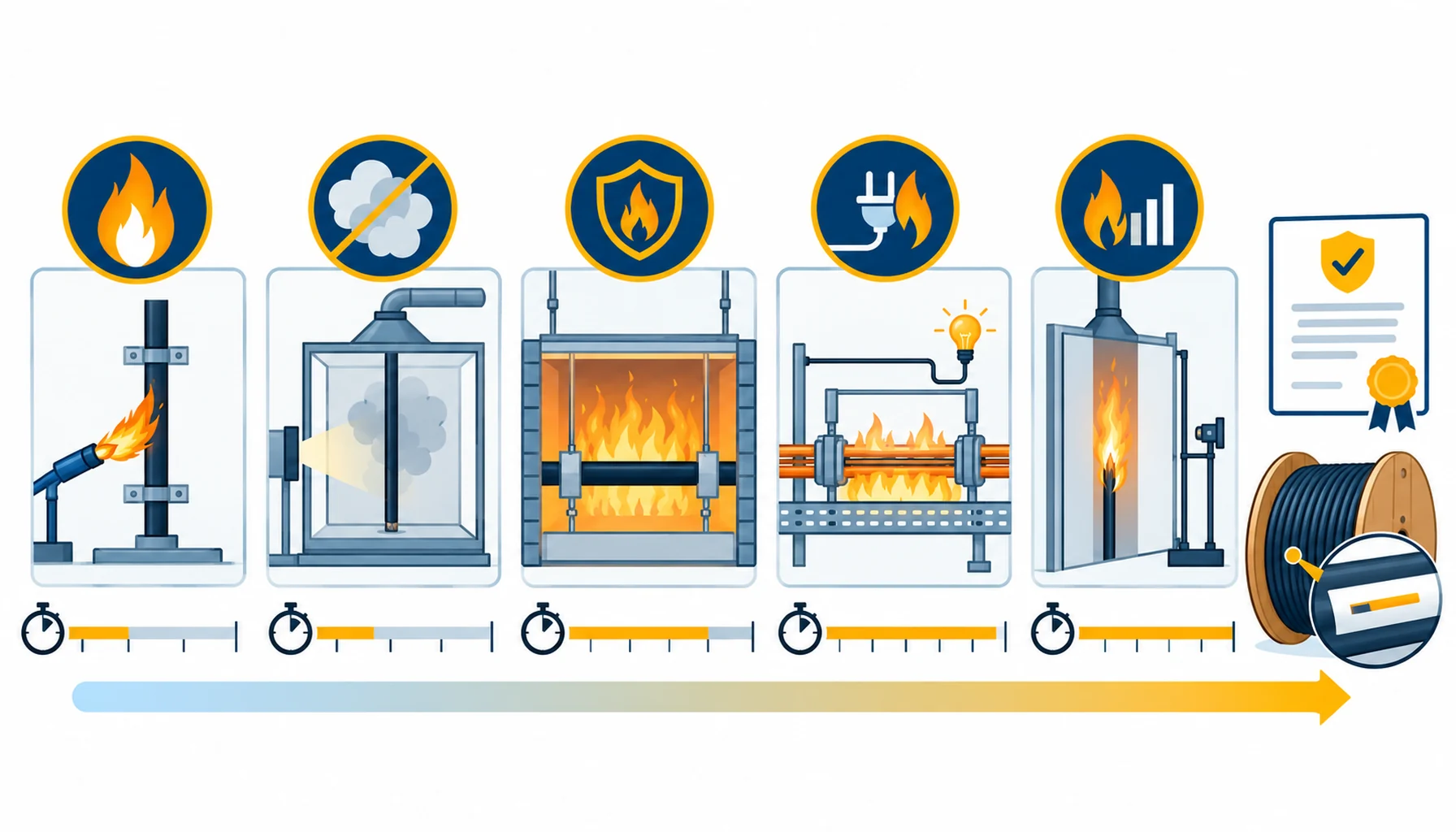
Quick Answer: A cable flame rating is a test result against a named standard, not a material description. Flame retardance, low smoke and halogen-free performance, fire resistance and circuit integrity are four different claims tested four different ways, and a supplier who answers all of them with the words flame retardant has answered none of them. Ask for the standard, the method, the measured values and the certificate covering the exact construction quoted.
Introduction
Fire performance is the part of a cable specification where loose language costs the most. A cable that carries the wrong rating into a tunnel, a public building or an escape route is a compliance problem on the day it arrives, and the paperwork that would have caught it existed at quotation stage.
This guide is written for the person raising the requisition. It separates the rating families, sets out what each test actually proves, explains how declarations and marks work, and lists the evidence to demand and the decisions to freeze before the order goes out. The difference between the two most confused claims is covered in our note on low-smoke halogen-free versus fire-retardant cable.
The Claims That Look Alike
Flame retardant means the cable resists propagating a fire along its own length. It does not mean the cable keeps working during a fire, and it does not mean the smoke is clean.
Low smoke and halogen free is about what the cable releases while it burns: limited smoke density so people can see to escape, and no acidic halogen compounds to attack equipment and lungs.
Fire resistant means the cable keeps the circuit alive for a defined period while being heated or burned, which is what a fire alarm, a lift or a boiler-house circuit needs.
Circuit integrity is the strictest version of the same idea, tested with a defined thermal and mechanical regime over a stated time. It is what a code calls for where the circuit must continue to operate, and it is not the same as a fire resistant classification under a lighter test.
Reaction to fire classification is the construction-product regime applied to cables in many markets, where the whole cable is classified by test into a band that describes the fire performance of the product rather than a laboratory sample. Our note on GB 31247 B1 cable covers that class system.
What Each Rating Family Proves
The table below separates the families on the duty they suit, with what to specify, the evidence to demand and how each one fails when it is bought on a general claim.
| Rating family | What it proves | What to Specify | Evidence to Demand | Cost and Lead-Time Driver | How It Fails |
|---|---|---|---|---|---|
| Flame retardant | The cable does not propagate fire along its own length in the test arrangement | The standard and the test category, the number of cables in the test, the mounting arrangement | Test report naming the method and the result, for the construction supplied | Compound cost is modest; the test regime and the paperwork add time | Test performed on a single cable where the site will have a bundle |
| Low smoke and halogen free | Limited smoke density and no acidic halogen release when the cable burns | Smoke density limit, halogen content, acidity of the emissions, test method | Smoke density and halogen content test results from a third party | Certified compounds cost more and extrude slower | A halogen-free claim defeated by a PVC sheath or a PVC-filled gland |
| Fire resistant | The circuit continues to carry for a stated time under fire conditions | The standard, the survival time, the applied voltage during the test, the mechanical shock regime | Fire resistance test report with the time achieved and the conditions applied | Insulation and barrier materials dominate the cost | A report for a shorter survival time than the specification requires |
| Circuit integrity | The circuit keeps operating under a defined fire and mechanical regime | The standard, the survival time, the shock and water application, the circuit to be tested | Type test report covering the whole specified regime, naming the construction | Longest test regime and the highest material cost of the families | Approval issued against a lighter test quoted as the equivalent |
| Reaction to fire classification | The whole cable is classified by test into a defined performance band | The classification system, the class required by the project, and the test standard behind it | Classification report or declaration for the construction as supplied | Certification administration and retesting sit in the lead time | A declaration that names a product family rather than the construction delivered |
Declarations, Test Reports and Marks
Three documents get called a certificate on site, and they do different jobs.
A declaration of conformity is the supplier stating that the product meets a standard. It is a statement, not evidence, and it is only as good as the test report behind it.
A type test report is the evidence: it names the standard, the method, the conditions applied and the values measured, and it was produced on a construction. Read it for the construction, not the brand, because substituting an insulation, a sheath compound or an armour arrangement breaks the result on paper even when the cable looks the same.
A mark or approval is issued against a named construction by a body recognised in the destination market. On export work the question is which mark the receiving authority accepts, not which one the factory holds for home. Fire survival constructions are a good example of where the answer differs by market, as our notes on BTLY fire resistant cable and on BS 6387 fire survival cable show.
Scoring the report. Check the number of cables in a propagation test, the mounting arrangement, the applied voltage in a survival test and the time achieved. A result achieved on one cable in a light arrangement is not the same claim as a bundle in a tray, and the two are not interchangeable.
What to Freeze Before the Order Goes Out
These six items are cheap at specification stage and expensive once drums are on a truck.
| Decision | What to State | Evidence to Attach | Cost of Leaving It Open |
|---|---|---|---|
| Required performance per circuit | Flame retardance, low smoke, fire resistance or circuit integrity, circuit by circuit | A circuit schedule mapping each run to its fire requirement | One construction bought for a duty that needed a higher class |
| Standard and class named | The exact standard and class the destination market accepts | The standard reference and a sample of the report required | A delivery that cannot be inspected in |
| Test conditions in the report | The cable count, mounting arrangement, applied voltage and survival time required | A test report showing conditions comparable with the installation | A result that does not represent a bundled installation |
| Construction identified | The conductor, insulation, screen, armour and sheath that the report covers | A construction drawing cross-referenced to the report | Approval invalidated by a compound substitution |
| Certification for the destination | The mark or approval the receiving authority recognises | Certificate issued against the exact construction quoted | Material rejected at the port or the site gate |
| Witnessing and records | Which tests are witnessed, and what records ship with each drum | A written test plan with acceptance criteria and dates | Volume accepted on a sample nobody kept |
Witnessing and Third-Party Evidence
Routine tests prove the delivery; type tests prove the design. A type test is performed once on a construction and is the evidence behind the claim. Routine tests are performed on the goods and are what link a drum to the type test. Buying without both leaves the claim and the delivery unconnected. Our note on cable factory testing covers what a factory normally runs.
Witnessing is worth it on fire-rated orders. Where the construction is certified, the test regime and the compound are the product, so a witnessed test or an independent verification removes most of the argument later. Our note on third-party cable inspection covers how that is usually arranged.
Check the mark against the construction, not the catalogue. The most common failure on a fire-rated package is an approval issued for one construction and a delivery of another that looks identical. Match the certificate reference to the drum marking at goods-in, while the supplier still has an interest in answering.
Buy the accessories to the same standard. A halogen-free cable through a PVC gland, or a fire-rated cable with a non-rated joint, takes the claimed performance back to whatever the weakest component is. Where the performance is regulated, the glands, joints and supports belong in the same package. Our fire-resistant cable range is supplied with the tested construction and the matching accessories, which keeps the report and the installation aligned.
Matching the Standard to the Installation
The requirement is set by the installation, and the installation is a description a buyer can write down. A single cable in an open duct, a bundle of cables in a tray and a cable in a vertical shaft behave differently in a fire, and most standards test them as different arrangements rather than one.
Three inputs decide which test is relevant. First, how the cables are installed: single or bundled, in tray, duct or free air, horizontal or vertical. Second, whether the circuit has to keep working, because that is the difference between a propagation requirement and a survival requirement. Third, whether people have to escape past the route, because that is what drives the smoke density and halogen content limits rather than the flame rating alone.
Put those three against the standard the destination market accepts and the choice of rating family usually narrows to one answer. Read the test report against the same three inputs, because a result obtained under lighter conditions than the installation is a result that does not transfer.
Cost and Lead Time
Stock cable is generally flame retardant PVC or XLPE, because those are the constructions that sell in volume. Made-to-order halogen-free and fire resistant constructions run on the compound, the barrier materials and the paperwork. Certified circuit-integrity constructions are the longest line, because the compound has to be the certified one, the test regime follows the standard and the certification is part of the product rather than an add-on.
The cost driver that catches buyers out is not the copper. It is the certified compound, the barrier layers and the administration of the certification, and buyers who discover the approval requirement after award routinely lose weeks rather than days on the lead time. Ask at quotation stage which standard the destination accepts and how long the certification takes to issue.
When a Flame Rating Is Not the Answer
When the requirement is a specification clause rather than a circuit need. Fire performance is bought to protect people and continuity, not to decorate a schedule. Applying a circuit-integrity requirement to every circuit on a project inflates the order without improving anything.
When the accessories are not rated to match. A rated cable with an unrated gland or joint does not deliver the rating where it is needed. The package has to be rated as a package.
When the report does not represent the installation. A single-cable propagation result quoted against a site with bundled trays is a claim that does not apply. Read the conditions, not only the result.
When the destination market’s mark is left until after award. Certification against the wrong regime is discovered at the port, and it is the most expensive way to learn which standard applied. Our note on cable import certification by country covers how the requirement is normally confirmed.
RFQ Checklist
- Fire performance required per circuit: flame retardant, low smoke, fire resistant or circuit integrity
- The exact standard and class named, matching the destination market’s requirement
- Test conditions required: cable count, mounting arrangement, applied voltage and survival time
- Smoke density and halogen content limits where low smoke or halogen free is specified
- Construction identification: the insulation, sheath, screen and armour the report must cover
- Certificate or mark required, issued against the exact construction quoted
- Routine tests required, with records per drum and the link to the type test
- Witnessing arrangement, with dates and acceptance criteria agreed at order stage
- Accessories supplied to the same standard: glands, joints, supports and seals
- Certification lead time for the destination market, and the copper basis with its validity window
Conclusion
A flame rating is a test result with conditions attached, and the buying job is to match the conditions to the installation and the standard to the market. Name the requirement per circuit, read the test report rather than the declaration, and buy the accessories to the same class. Then match the certificate reference to the drum marking at goods-in, which is the last moment when the question is still cheap to ask.
Kexingyu Cable Group (KXYE) has manufactured cable in Quanzhou since 1996, supplying flame retardant, low smoke halogen free and fire resistant constructions with type test reports, construction drawings and certification that travel with the drums. Send us the circuit schedule with the fire requirements, the destination market and the installation conditions, and we will come back with the constructions, the evidence that applies to each and a delivery plan against your programme. A request for quotation is the fastest route.