
NG-A (BTLY) Flexible Fire-Resistant Cable: A Complete Buyer's Guide
Quick Answer: NG-A (BTLY) is the flexible fire-resistant cable that made mineral-family protection installable — mineral insulation that holds circuits through flame while bending like ordinary LV cable. Between the rigid perfection of BTTZ and the mica-tape modesty of WDZN-YJY sits the construction Chinese contractors actually pull through most of their risers: NG-A (BTLY) — flexible enough for a standard crew on a normal schedule, strong enough for life-safety ratings.
Introduction
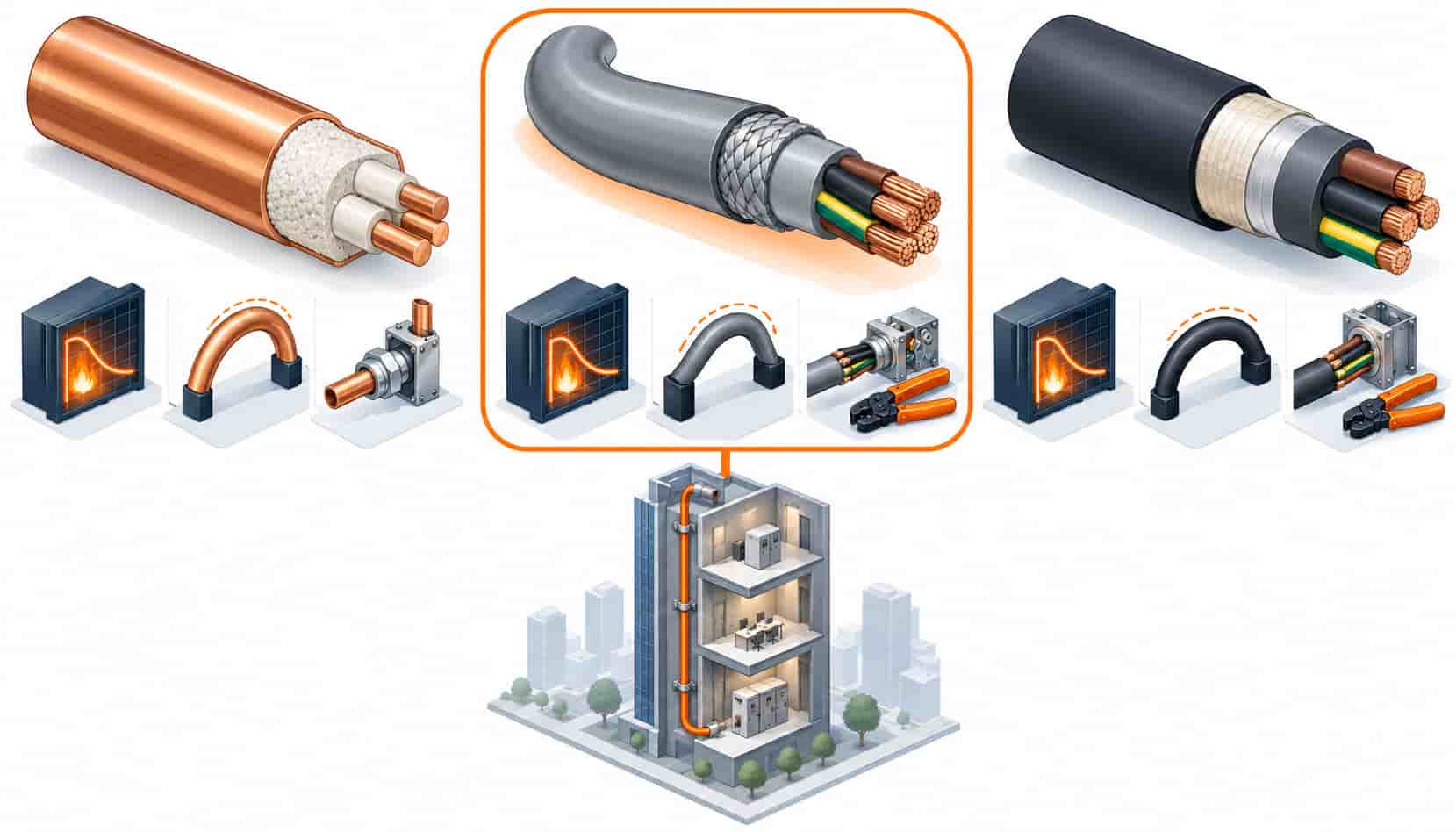
The fire-resistant cable market sorts into three construction families, and buyers meet all three in Chinese schedules: rigid mineral insulated (BTTZ), flexible mineral (BBTRZ and the NG-A/BTLY family) and mica-tape XLPE (WDZN-YJY). This guide works through the NG-A (BTLY) family specifically — what the name means, how the construction earns its fire rating while staying flexible, where it gets specified, and how to write it into an export RFQ. Its position in the family landscape is easiest to see against the alternatives, compared in our rigid-versus-flexible guide and in our LSZH versus fire-retardant overview; the insulation platform it shares with ordinary cable is covered in our XLPE primer.
The Name and the Family
NG-A marks the family: fire-resistant cable in the mineral construction generation, with BTLY describing the build-up — a flexible mineral-insulated construction, typically copper conductors over mica-glass tape and mineral compound, a metal or metal-clad sheath element, and an LSZH outer jacket. Manufacturing variants exist across the family, which is exactly why the RFQ should describe the required construction and fire test rather than just the letters. What unites the family is the promise: fire-resistance ratings comparable to the mineral class, delivered in a cable that handles like polymer-jacketed LV cable.
| Family | Construction | Fire Behavior | Best Fit |
|---|---|---|---|
| BTTZ (rigid MI) | Copper, MgO, copper sheath | Survives flame, impact, water spray | Absolute-survival feeders |
| NG-A (BTLY) | Flexible mineral, LSZH jacket | Holds circuit through rated fire curve | Risers, tunnels, general life-safety network |
| BBTRZ | Flexible mineral variant | Holds circuit through rated fire curve | Same class; construction varies by maker |
| WDZN-YJY | Mica tape under XLPE | Holds circuit through rated fire curve | Life-safety circuits, easiest handling |
How It Earns the Rating While Staying Flexible
The construction stacks defenses. Mica-glass tape directly over the conductor provides the inorganic dielectric that survives combustion — the same mechanism WDZN-YJY uses — while mineral compound layers and the sheath element add thermal mass and insulation integrity at cable temperature. Because the mineral function is distributed in tapes and compounds rather than a rigid powder column, the cable keeps normal bend radii and pulling behavior. The fire test behind the family requires insulation integrity under direct flame for the rated duration, in the standard families mapped in our IEC, GB and BS standards guide.
The honest caveat for buyers: within the flexible-mineral family, construction details vary between manufacturers — the sheath element, compound formulation and layer stack all differ. Verify by test report, not by family name.
Where NG-A (BTLY) Gets Specified
The application map is the Chinese high-rise and infrastructure world: vertical risers feeding floors, fire pump and smoke-extraction feeders, tunnel and metro life-safety circuits and — more and more — data center critical circuits where rigid MI is impractical but mica-tape-only construction feels thin. The flexible form is what makes those routes possible: long vertical pulls with standard equipment, bends at landings, terminations by regular crews with regular glands — the accessories discipline is in our cable accessories checklist.
Data centers deserve a specific word. Fire-resistant feeders into occupied halls combine with the LSZH behavior of the outer jacket, and the overall protection architecture they serve follows our data center power collection. Upstream ties toward substations take the same construction where fire-rated generator and transformer feeders are specified — the protection logic sits in our transformers and substations collection.
Installation: The Whole Point of the Family
The family exists because installation is where fire-resistant projects fail on schedule. NG-A (BTLY) pulls like LV cable: standard drum stands, standard rollers, standard bend radii, standard glands — and terminations a normal crew performs without pots, sealing compounds or MI-specific training. Verification after installation is the ordinary IR-and-continuity routine, not moisture forensics. On a compressed high-rise program, the difference against rigid MI is measured in weeks and in termination-quality risk avoided.
Discipline still applies, though. Mica tape under the insulation deserves its bend radius, mechanical damage before the pull is invisible after it, and the batch fire certificates belong in the handover file.
| Check Item | Requirement | Why It Matters |
|---|---|---|
| Fire test named | Temperature, duration, standard stated | Family name is not a rating |
| Construction described | Layer stack specified in the RFQ | Variants differ between makers |
| LSZH jacket verified | 60754 / 61034 reports per batch | The occupied-building claim rides on it |
| Standard-crew install | Normal glands, bend radii, tools | The family's reason to exist |
| Batch fire certificates | Keyed to drum IDs for handover | Audits ask exactly this |
| Mica bend radius kept | Pulling limits respected on site | Damaged tape silently voids the rating |
Export Mapping: Buying NG-A (BTLY) From Abroad
Three moves make the family portable. First, define the required construction in the RFQ — layer stack, sheath element, LSZH jacket — because BTLY is a family, not a single part. Second, name the fire test: the rated curve, temperature and duration, in the standard family the destination market reads (IEC 60331 and BS 6387 being the usual references). Third, demand batch fire certificates keyed to drum IDs and attach the LSZH reports — the same evidence package philosophy as any export order, with supplier verification depth per our power cable manufacturer checklist.
When NG-A (BTLY) Is Not the Answer
Three boundaries keep the choice honest. Where the specification demands survival through impact and water spray — the combined profile only rigid MI reliably delivers — BTTZ is the answer regardless of schedule pain. Where the circuit is an ordinary life-safety feeder in an accessible route with no geometry challenges, mica-tape WDZN-YJY delivers the same rated curve more simply. And where no life-safety job exists at all, fire-resistant pricing of any family is spent on nothing; plain LSZH XLPE is the honest cable. The route and the paragraph decide, not family loyalty.
RFQ Checklist: Ordering NG-A (BTLY)
Make the family quotable by writing these into the RFQ:
- Fire test target: rated curve, temperature and duration, standard named
- Construction described: layer stack, sheath element, LSZH jacket
- Voltage class, core counts and conductor sizes per circuit
- IEC 60754 and 61034 reports for the LSZH jacket, per batch
- Batch fire-test certificates keyed to drum IDs
- Bend radius and pulling limits in the installation notes
- Standard glands and termination kits matched to equipment
- Copper price linkage across the delivery calendar
- Drum labeling by circuit, both ends marked
- Delivery phased to installation fronts
Conclusion
NG-A (BTLY) earned its place in Chinese construction by solving the fire-resistant cable’s oldest problem: it installs like ordinary cable and protects like the mineral class. For risers, tunnels and the general life-safety network it remains the pragmatic default — provided the RFQ describes the construction, names the fire test and demands the batch certificates.
Kexingyu Cable Group (KXYE) supplies the NG-A (BTLY) family with defined constructions, batch fire-resistance certificates, LSZH reports and export-ready documentation — so the flexible workhorse arrives with its promises attached. For buyers, the practical proof is twofold: the fire-resistance test report for the mineral construction, and a pulling record showing the cable installed on a comparable project without damage.
Recent Posts
Thermal Runaway in Lithium Batteries: What BESS Buyers Should Understand
Thermal Runaway in Lithium Batteries: What BESS Buyers Should Understand How thermal runaway starts, how it propagates, and which evidence buyers should require before approving
Energy Storage for Data Centers: A Growing Backup Power Option
Energy Storage for Data Centers: A Growing Backup Power Option Batteries have always backed up data centers in the form of UPS strings. Grid-scale BESS
YJV vs YJY: Reading Chinese Cable Designations Like a Local
YJV vs YJY: Reading Chinese Cable Designations Like a Local YJV vs YJY: Reading Chinese Cable Designations Like a Local Quick Answer: YJV and YJY