
Cable Import Certifications by Country: A Global Overview Map
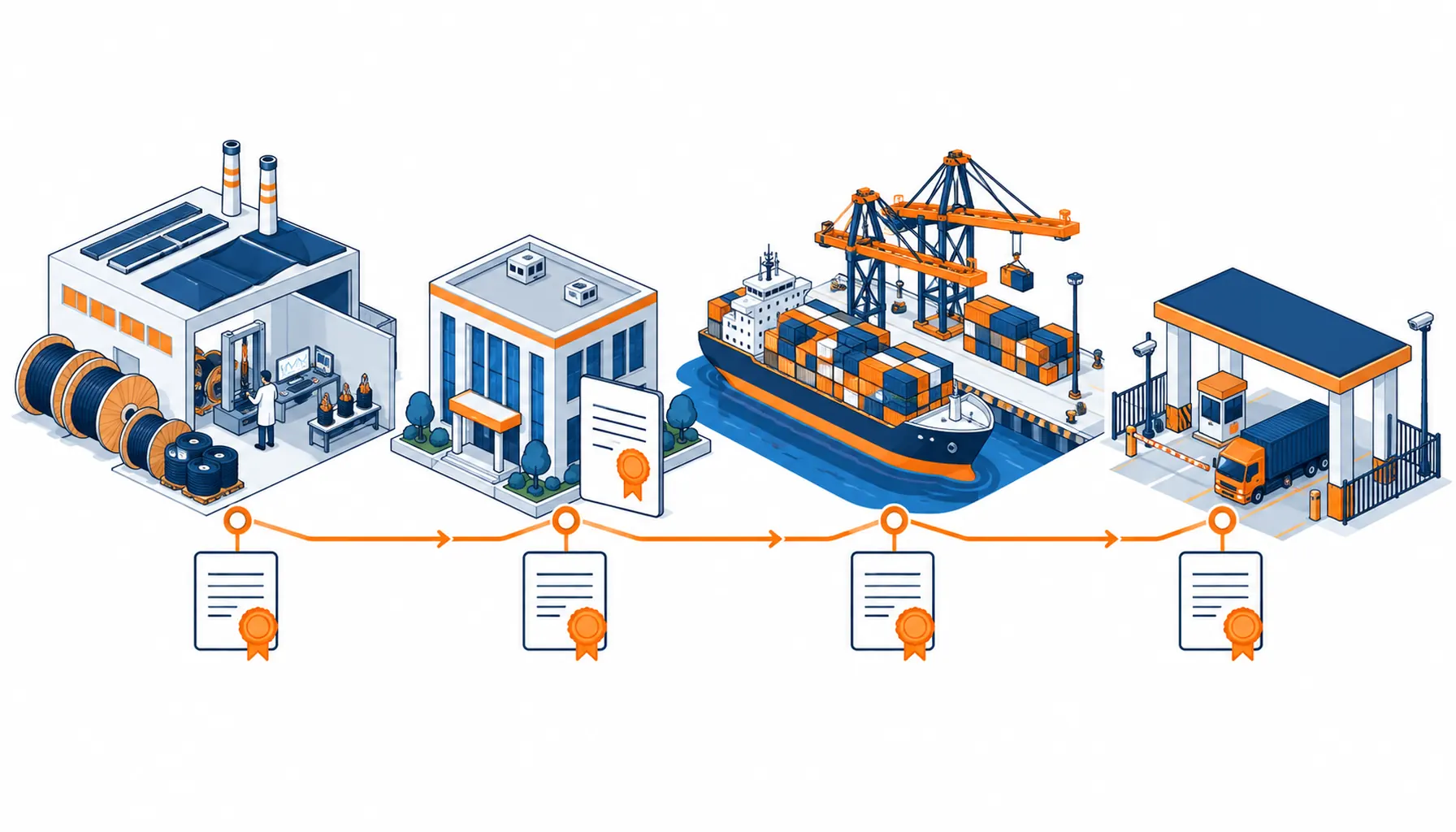
Quick Answer: Market access is country-specific — CCC in China, CE in the EU, SASO/SABER in Saudi, BIS, SNI, SIRIM elsewhere — and the sequence is learnable: certify the construction, then book the shipment.
A cable that is perfectly legal in one port can be contraband in the next. Market access is the least visible dimension of cable sourcing. It appears on no datasheet, yet it decides whether the shipment clears customs, passes the consultant’s submittal review, and can legally be installed. Buyers who map the certification landscape before ordering move smoothly. Buyers who discover the landscape at the port pay demurrage for the education. This guide is the map: the major schemes, what each actually demands, and how to sequence them.
Introduction
Why does cable attract more border controls than almost any other electrical commodity? Because cable is installed into buildings and infrastructure where failure means fire, and because cable is easy to counterfeit. A drum of “2.5 mm²” wire can hide anything. Governments respond with mandatory approval schemes that certify the product before it enters the market, and each scheme reflects local priorities: fire safety in Europe, plug and product safety in China, climate-driven durability in the Gulf. For the buyer, the practical consequence is that certification is a property of the destination, not of the factory. The same cable construction may need one approval for Europe, another for Saudi Arabia and nothing beyond a test report for a third market. The buying logic that flows from this is simple but strict: the market is chosen first, the construction and its certificates second, and the price last. This page is the overview. The deep dives on the major destinations follow the same structure as the destination guides in Middle East power equipment sourcing and Southeast Asia data center power.
How Cable Market Access Actually Works
Three mechanisms cover nearly everything. Mandatory product certification: a government scheme that requires the product itself to be certified before import, such as CCC in China, SASO in Saudi Arabia, SIRIM in Malaysia, SNI in Indonesia and BIS in India. Conformity assessment at the border: pre-shipment verification against the destination’s standards, common in Gulf and African markets through programs like SABER and various COC schemes. And self-declaration backed by standards: the European model, where the manufacturer declares conformity to harmonized EN standards and the market’s surveillance, along with the buyer’s consultants, checks the declaration’s substance. Each mechanism moves the burden differently. Mandatory certification pushes cost to the factory, border conformity pushes urgency to the shipping schedule, and self-declaration pushes diligence to the buyer, who must audit what the declaration claims. Knowing which mechanism a market uses tells you where the risk sits before you negotiate.
The Map: Major Markets and Their Schemes
The table below is the overview map: one row per major market, the scheme, and the practical note that matters most for cable. The columns deliberately separate the scheme’s name from what it demands, because schemes with similar names work very differently. SASO is a standards body while SABER is the platform that certifies shipments; CE is self-declaration while CCC is factory-registered. The deep-dive articles of this certification cluster expand each row into its own guide, covering the CCC regime, the European CE and CPR model and the Saudi SABER process among them, and the map below shows where each fits.
| Market | Scheme | What It Demands for Cable |
|---|---|---|
| China | CCC | Compulsory certification for cable categories in the CCC catalog; factory inspection and annual follow-up |
| European Union | CE + CPR | Self-declaration to harmonized EN standards; CPR fire classes for construction products; DoC and technical file |
| Saudi Arabia | SASO / SABER | Product certificates of conformity issued through the SABER platform per shipment; IECEE recognition where applicable |
| UAE | ECAS / Civil Defence | Emirates conformity assurance for electrical products; Civil Defence approval for fire-system-related cables |
| India | BIS | ISI marking for cable categories under BIS licensing; foreign manufacturer certification with factory audit |
| Malaysia | SIRIM | SIRIM QAS certification and labeling for cable categories under the Energy Commission's regime |
| Indonesia | SNI | National standard certification for cable categories; factory audit and surveillance |
| Vietnam | QCVN | National technical regulations with conformity certification for wire and cable categories |
| Africa (varies) | National / COC | Mixed landscape: national schemes, pre-export COC programs, utility-specific approvals |
Reading the Schemes: What Actually Gets Certified
Across schemes, certification attaches to four things, and knowing which is which prevents most confusion. The product construction: the cable type, voltage class and fire performance, tested against the scheme’s adopted standards, which usually mirror IEC with local amendments. The factory: mandatory schemes certify the production plant, not just the sample, with initial audits and annual surveillance, so a certificate owned by a factory cannot be borrowed by a trader. The shipment: border-conformity programs certify each consignment against the product certificate, which is why they interlock with the shipping schedule. And the documents: declarations of conformity, test reports from accredited laboratories, and the certificates themselves must name the exact construction and the certificate holder. The buyer’s checks follow the same four lines. The certification-verification discipline is the same one applied to any electrical product in the China certification checklist and its export counterpart in the power cable certifications checklist.
Sequencing: Certifications Against the Order
Certification lead times are the dimension that wrecks schedules, because they run in months while production runs in weeks. The workable sequence treats market access as part of specification. Fix the destination market and its scheme at RFQ time, verify the factory already holds the scheme’s certificate for the offered construction or budget the application lead time, and only then lock the delivery date. For first-entry markets, add the border-conformity cycle to the shipping plan: a SABER-type shipment certificate is applied for before sailing and completed before arrival, and a missing certificate at the port means demurrage, storage and a customs broker’s emergency fee. Multi-market orders deserve a matrix, not a hope. Put constructions down one axis and markets on the other, certificate status in each cell, and the gap becomes the certification project plan. Buyers who maintain this matrix discover a second benefit: it doubles as a submittal package for the consultant approval cycles that govern projects in the regulated markets described in sourcing power equipment for China EPC projects.
| Stage | Buyer Action | Classic Trap |
|---|---|---|
| RFQ | Name the destination market and its scheme in the specification | "International standards" treated as a market entry ticket |
| Supplier selection | Verify the factory holds the scheme's certificate for the construction | Accepting a trader's borrowed or family certificate |
| Contract | Allocate certification costs, lead times and re-test responsibilities | Delivery dates locked before certification lead times checked |
| Pre-shipment | Start border-conformity applications; assemble the submittal file | SABER/COC started after the vessel sails |
| Arrival | Match certificate, test report and shipment at customs | Construction drift: shipped goods not matching the certificate |
When a Certificate Is Not the Answer
Three limits keep the map honest. A certificate is not quality: it proves the certified sample and factory met the scheme at audit time, not that the drum in the container matches the certificate. Construction identity remains the batch report’s job. A certificate is not a specification either: passing a market’s minimum does not mean the cable suits the project’s fire strategy, ampacity or environment, since project specification and market access are separate decisions. And the map changes. Schemes add categories, standards get revised, and programs get re-platformed, which is why the verification habit in international power equipment sourcing mistakes, checking current status rather than brochure history, applies double in market access. Use this page as the map, and verify the territory before every order.
RFQ Checklist: Market Access Lines for the RFQ
Write the destination’s requirements into the RFQ, not the freight annex:
- Destination market and its mandatory scheme named in the specification
- Factory-held certificate required for the offered construction, certificate number stated
- Test reports from accredited laboratories against the scheme’s adopted standards
- Border-conformity certificates (SABER/COC class) applied before shipment, costs allocated
- Declaration of conformity and technical file provided per the scheme’s rules
- Marking and labeling per the destination’s requirements included in the packaging spec
- Certification lead times reflected in the delivery schedule, with re-test responsibilities
- Certificate and shipment identity match verified at arrival per the receiving protocol
Conclusion
Cable market access is a map, not a maze. Identify the destination’s scheme, certify the construction at a factory that holds the certificate, sequence the border conformity against the shipping schedule, and keep the certificate matched to the drums that carry it. Buyers who treat certification as part of specification move smoothly. Buyers who treat it as paperwork discover it at the port.
Kexingyu Cable Group (KXYE) holds the factory certifications behind its product lines and supports export market access with accredited test reports, declarations of conformity and border-conformity documentation keyed to the shipment. The drums clear customs as cleanly as they left the line.
Recent Posts

158 · CCC Certification for Cables: What It Covers and Who Needs It
CCC Certification for Cables: What It Covers and Who Needs It Quick Answer: CCC runs three layers — type testing, factory audit, annual surveillance —
156 · Third-Party Cable Inspection: SGS, BV and TUV Pre-Shipment Checks
Third-Party Cable Inspection: SGS, BV and TUV Pre-Shipment Checks Quick Answer: A third-party pre-shipment inspection verifies quantity, marking, construction and documents before the drums sail

Power Cable Warranty Terms: What to Demand and What to Watch For
Power Cable Warranty Terms: What to Demand and What to Watch For Quick Answer: A usable warranty names its scope, duration, evidence standard, exclusions and