What Drives Cable Prices: Copper, XLPE Compound and Aluminum Breakdown
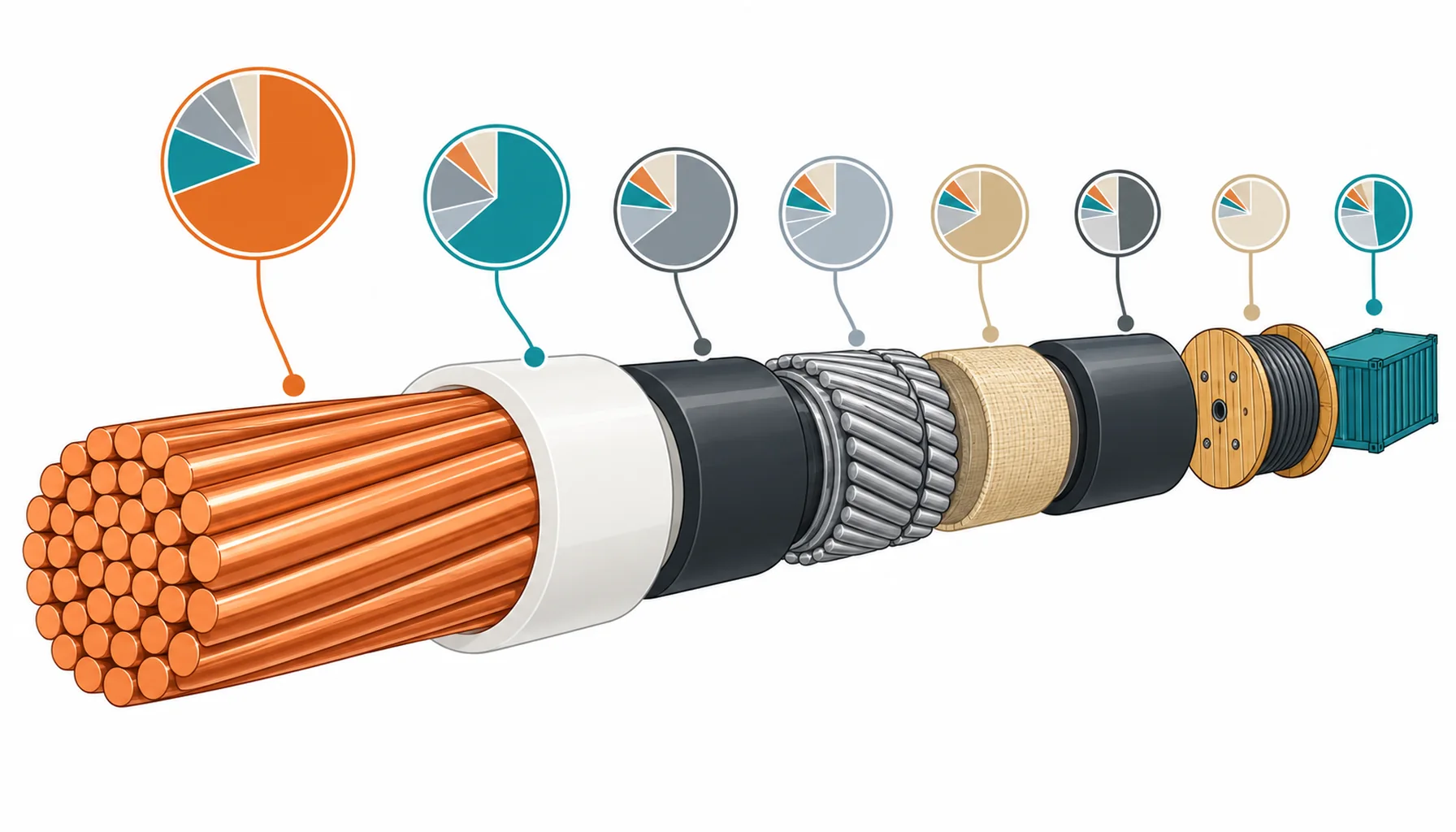
Quick Answer: A cable’s price is conductor metal first — copper or aluminum — then insulation and sheath compounds, armor, manufacturing, testing and freight. Knowing the split explains why quotes differ.
Two quotes for the same cable arrive 30% apart, and both suppliers swear they are honest. Both probably are — because “the same cable” almost never is. A cable price is a stack of priced decisions: which metal carries the current and how much of it, which insulation and sheath compounds, whether the construction is armored, how the batch is tested, how it is packed and shipped. Each decision moves the number, and each can be varied quietly in ways that only show up years later, in service. Buyers who understand the stack move past comparing prices to comparing cables, and that’s the comparison that actually protects the project. This guide walks the stack layer by layer: what copper and aluminum contribute, what XLPE and PVC compounds cost and why they differ, where armor and testing and freight fit, and why two honest quotes for a drawing can still differ.
Introduction
The breakdown matters because the choices inside it are engineering choices with price tags, and the price tags are visible only when the layers are named. Conductor metal is the largest single line — the metal weight is public arithmetic, set by the cross-section chosen per the cable size selection guide — and the compounds around it are a second economy: the insulation and sheath families explained in the XLPE cable guide trade cost against temperature rating, flame behavior and longevity. Every downstream decision — armor, screens, drums, freight — prices itself onto the conductor base. Read the stack once and the quotes you receive stop being bare numbers; they become positions you can interrogate line by line.
The Conductor: Where Most of the Money Lives
Copper’s claim on the price is arithmetic: conductor weight equals cross-section times length times density, and the metal trades on public exchanges every day. For a typical low-voltage power cable, that weight makes copper roughly half the material cost — more at large sections, less in control and instrumentation types. The conductor decisions refine the number further: annealed versus hard-drawn temper, compacted versus standard stranding (compaction changes the finished diameter and the amount of compound around it), and class of stranding for flexibility. Aluminum rewrites the economics entirely — roughly a third the density and a fraction of the price per kilogram of copper — which is why aluminum conductors dominate overhead lines and long distribution runs, as the insulation comparison context and distribution practice both show. The trade-offs are engineering ones — larger cross-section for equal ampacity, different termination practice, galvanic care at joints — and they are why conductor material is chosen per circuit, not per budget.
Compounds: XLPE, PVC and the Insulation Economy
Insulation and sheathing are the second cost layer, and their price spread is wider than buyers expect. Standard PVC is the economy baseline: cheap compound, easy processing, adequate for many service conditions — and limited by temperature rating and smoke and halogen behavior in fire. Cross-linked polyethylene (XLPE) costs more per kilogram and per meter — the crosslinking step is real production cost — and buys a 90°C continuous rating, better short-circuit tolerance and longer thermal life, which is why it has become the default insulation for power cable. Inside each family, grades multiply the spread: flame-retardant compounds, low-smoke zero-halogen (LSZH) formulations for enclosed public and data spaces, and UV-stabilized grades for outdoor sheaths all carry premiums over commodity material. The compound decision also interacts with the conductor decision — compacted conductors use less compound per meter — so the layers of the stack price each other, and a quote that quietly downgrades one layer can fund a discount on another. That interaction is the mechanism behind many suspiciously low quotes, and it is invisible unless the specification names the grades.
| Layer | What Drives It | Watchpoint |
|---|---|---|
| Copper conductor | Cross-section, stranding class, exchange price | Undersized or thin-stranded conductor |
| Aluminum conductor | Density advantage, larger sections for ampacity | Termination and jointing practice ignored |
| XLPE insulation | Crosslinking cost, grade and temperature rating | PVC substituted and labeled as XLPE |
| Sheath compounds | LSZH and flame-retardant premiums | Commodity sheath where LSZH was specified |
| Armor and screens | Steel or aluminum tape/wire, application | Armor omitted on direct-buried runs |
| Manufacturing and testing | Run length, test scope, certification amortization | Test scope trimmed to fund the discount |
| Packing and freight | Drums, container utilization, incoterms | Poor drum yield inflating the landed cost |
The Rest of the Stack: Armor, Testing, Freight
Armor prices itself onto hazardous routes: steel tape or wire armor adds material and conversion cost, and earns it on direct-buried, pulled-duct and mechanical-risk installations — the selection logic is in the armored vs unarmored comparison, and the watchpoint is simple: armor omitted where the route requires it is the cheapest line item in the quote and the most expensive in service. Screens and bedding layers carry similar logic for MV constructions. Testing and certification amortize across the batch: a factory-run with full routine and sample testing costs more per meter on a 2 km order than on a 20 km order, and third-party certification fees spread the same way — which is part of why small orders price poorly. Freight closes the stack: drums consume container space inefficiently, drum length and drum count are negotiable engineering, and the incoterm decides which legs appear in whose invoice. A quote that looks expensive landed may simply be priced honestly across legs another quote left out.
Why Two Honest Quotes Differ
Given the stack, legitimate spread is normal: different copper fixing dates, different conductor compaction, different compound grades at the same family name, different drum yields and different margin structures for factories of different overhead. The spread to hunt is the other kind — quotes that are cheap because a layer was quietly thinned. The defense is specification discipline and datasheet literacy: name the grades, the stranding class and the test scope in the RFQ, then read offered datasheets line by line against them, per the datasheet reading guide. A quote that answers the stack line by line can be compared; a quote that offers nothing but “price per meter” is pricing a cable it hasn’t described yet. When buyers are ready to test suppliers against a real bill of quantities, the RFQ page accepts the specification with the stack made explicit.
| Line Up | Why It Moves the Price | Red Flag |
|---|---|---|
| Conductor material and class | Metal weight is the largest cost line | Class or compaction not stated |
| Insulation and sheath grades | XLPE, LSZH premiums over commodity PVC | "Equivalent compound" without a grade |
| Armor and screen build-up | Steel or aluminum tape/wire per route | Armored and unarmored priced alike |
| Test scope and certification | Amortized over batch size | No test documents included |
| Drum lengths and freight basis | Container yield and incoterms | Landed cost missing from comparison |
When the Lowest Price per Meter Is Not the Answer
Two cautions finish the guide. The first is the per-meter illusion: a low price per meter built on poor drum yield, missing armor or trimmed tests is a high price per installed, compliant meter — and the installed, compliant meter is the unit that actually bills the project. The second is the downgrade spiral: every layer thinned quietly funds the discount, and the compound that “meets the grade” on paper without the premium formulation is a fire-behavior decision made by whoever offered the discount. The stack exists to be read. Buyers who read it line by line buy cable; buyers who read only the total are buying paper. Price the cable you specified, then let honest factories compete — it’s that simple, and it works on every order.
RFQ Checklist: Price-Stack Lines for the RFQ
Put the market’s questions in writing:
- Conductor material, cross-section and stranding class stated per circuit
- Insulation family and grade named — XLPE class, LSZH where required
- Sheath compound grade and UV/fire requirements stated
- Armor type and route requirement matched
- Test scope per batch and certification documents listed
- Drum lengths and container yield proposed by the supplier
- Copper pricing basis and validity window stated in the quote
Conclusion
A cable price is a stack of priced decisions, and the stack is readable: conductor metal first — copper’s weight times the exchange, aluminum’s density advantage against its engineering trade-offs — then XLPE and PVC compounds with their grade premiums, armor per route, tests amortized per batch, and freight per drum. Two honest quotes differ across that stack; a dishonest one differs because a layer disappeared.
Kexingyu Cable Group (KXYE) quotes from the stack, not the summary: copper basis stated per drawing, XLPE and LSZH grades named as specified, armor matched to route, batch testing documented per drum range, and drum yields planned for the container — cable pricing that breaks down into decisions a buyer can check line by line.