MOQ and Lead Times for Custom Cable Orders: Planning Your Project
Quick Answer: Custom cable carries minimum order quantities and multi-week lead times because setup, compounds and testing amortize over the run. Both are plannable — backwards from the site date.
Every custom cable buyer meets the two numbers early: the minimum order quantity and the lead time. Both feel like arbitrary obstacles — why can a factory not make just the 800 meters you need, in two weeks? — and both are actually the visible edge of real production economics: a line that must be set up and changeover-adjusted, compounds that come in batch quantities, tests that cost the same on 2 kilometers as on 20. Suppliers who hide these realities in the quote recover them elsewhere; suppliers who state them plainly give the buyer something more useful than a low number — a schedule that still holds once it reaches the factory floor. This guide explains what drives MOQ and lead time in custom cable, how the two interact, and how to plan a project backwards from the site date so the cable arrives when the installation is ready for it.
Introduction
Planning matters more in cable than buyers expect, because cable sits early in the dependency chain: ducts and tray are installed around it, terminations are stocked for it, and the energization date inherits its slip. The equipment side of data center and industrial projects has already learned this discipline — the calendar realities of switchgear lead-time planning and transformer lead times are standard reading for EPC teams — and cable belongs on the same page of the schedule, with its own quirks: smaller items, faster production, but MOQ logic and drum logistics that equipment does not have. The cost of getting it wrong is documented in how cable sourcing delays hit EPC timelines — a few weeks of slip at the drum stage cascades into crews standing idle at the tray.
What Actually Drives the Minimum Order Quantity
MOQ is the smallest order at which the factory’s fixed costs stop distorting the price. Three drivers set it. Setup and changeover: a production line must be tooled for your construction — conductor dies, insulation tooling, screening and sheath heads — and every changeover consumes hours of paid line time; short runs spread that cost over few meters. Compound batches: colored, LSZH and flame-retardant compounds are supplied and mixed in batch quantities, and a half-used compound batch is waste or inventory someone pays for. Drum yield: cable is made and shipped in drum lengths, and an order that does not fill whole drums leaves odd lengths nobody wants. This is why standard constructions carry low or no MOQ while customs carry higher ones: a new insulation color, a special screen, a non-standard print text each force a changeover or a compound batch of their own. The negotiation move is not to fight the MOQ but to shape it — batch multiple types into one production window, accept standard colors where possible, or hold a framework with scheduled releases that keeps the factory’s setup working for you across the program.
The Anatomy of a Lead Time
A cable lead time is a stack of stages, each with its own floor. Design and drawing confirmation runs days, not weeks, when the specification is complete — and stretches indefinitely when it is not. Material preparation depends on the bill: standard copper rod and commodity compounds are usually in stock; specialty compounds and unusual screen or armor materials add procurement weeks. The production run itself is fast by industrial standards — extrusion and laying-up move meters per minute — but it queues behind other orders, and custom constructions queue longer than catalog ones. Testing is the stage buyers forget: routine tests are inline, but sample and type tests, especially third-party witnessed ones, add days to weeks. Drumming, packing and export documentation close the stack. A realistic custom-order lead time therefore spans a few weeks for near-standard constructions and can reach two to three months for fully custom ones with witnessed testing — and the honest quote states which stages are queue time, because queue time is the part a buyer’s planning can influence.
| Driver | What It Sets | Buyer Lever |
|---|---|---|
| Setup and changeover | MOQ floor on custom constructions | Batch types into one production window |
| Compound batches | MOQ on colors, LSZH, flame grades | Standard colors where the design allows |
| Drum yield | Order rounding and odd lengths | Order in whole-drum multiples |
| Material procurement | Lead time for specialty inputs | Confirm drawings early to start sourcing |
| Test scope | Days to weeks at the end of the run | Agree test plan at contract, not after |
| Production queue | The invisible share of lead time | Framework slots and early PO placement |
Planning Backwards from the Site Date
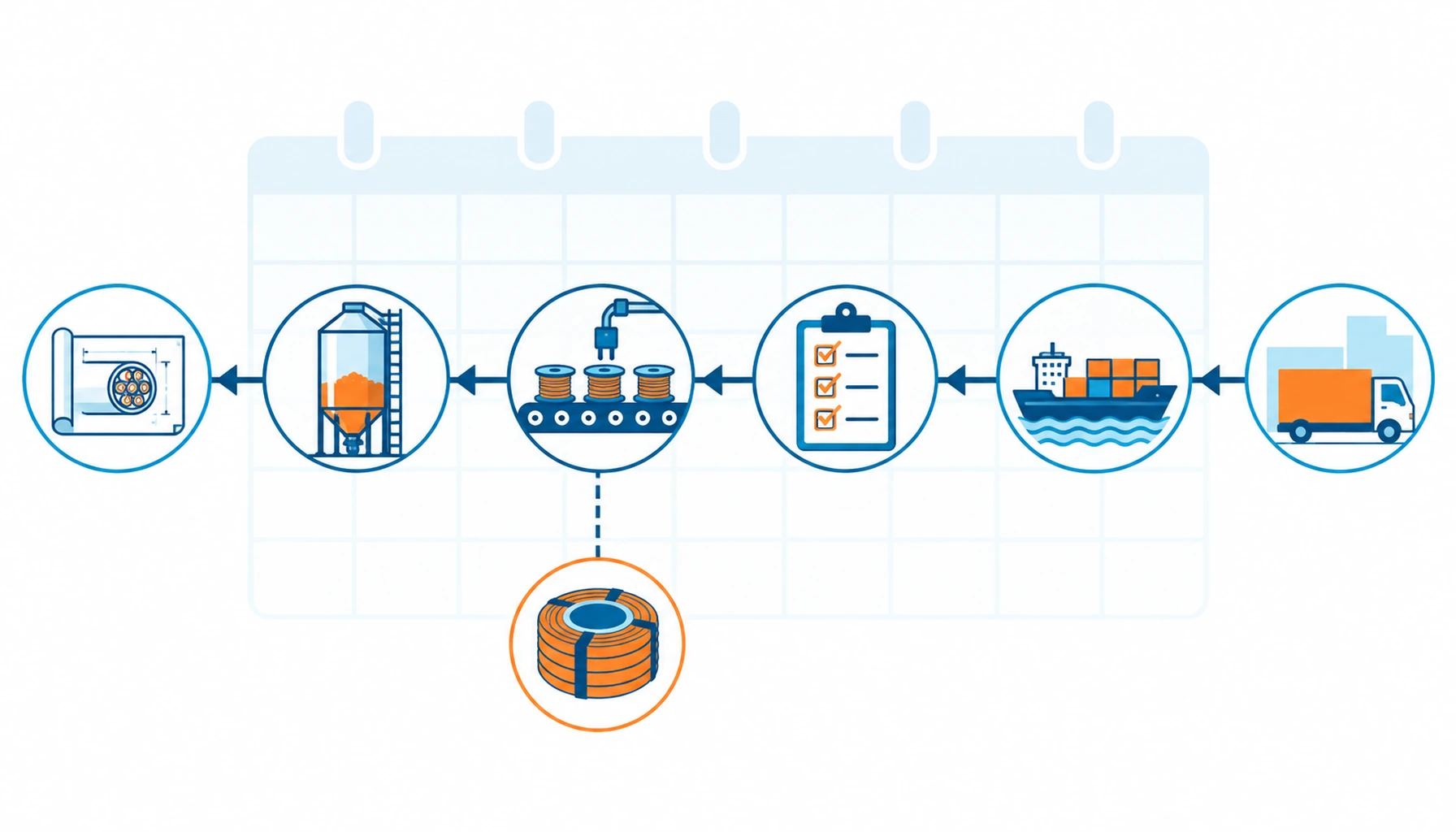
The planning discipline is to invert the calendar: start at the day the installation crew needs the first drum, and walk backwards through each stage — ocean transit and customs clearance, drumming and documentation, testing, production, material preparation, drawing approval — adding each stage’s stated duration and a stated buffer at the port, not a hidden one. The walk produces two dates that matter: the PO date, by which the order must be placed for the schedule to hold, and the drawing-freeze date, by which the specification must stop changing, because every change after freeze restarts the stack. Programs that run this walk put cable orders in months before the tray is ready — it feels early, but it’s simply what the calendar requires — while programs that order when the site asks for cable have already handed the queue time over. The same backwards walk exposes which types are critical path — the long-lead custom constructions — and which are commodity, so the expensive calendar attention goes where the calendar actually risks slipping, a triage that mirrors how specification discipline sorts the cable list in the first place.
When Chasing the Smallest MOQ Is Not the Answer
Two cautions close the planning loop. The first is the tiny-order trap: winning a fight to cut the MOQ to exactly the meters needed usually means paying a disproportionate per-meter price, losing drum-yield efficiency and buying zero spares — and cable projects consume spares, because site damage is a fact of pulling life. The better question is not “how little can I order” but “what should the extra drums be”: the phase-two quantities, the spare percentage the installers will thank you for, the second construction that shares the changeover window. The second is the compressed-schedule trap: squeezing the lead time by skipping the sample stage or collapsing the test plan saves weeks on paper and buys rework at the tray — the risk allocation is the buyer’s, and it is the expensive kind. Where the schedule genuinely cannot absorb a custom run, the honest alternatives are standard constructions that meet the requirement or a supplier with the stock depth to ship near-standard types quickly — testable by asking, per the manufacturer checklist, what is actually on the floor. When the quantities and dates are real, the RFQ page prices the schedule, not just the cable.
| Stage | Typical Content | Planning Note |
|---|---|---|
| Drawing freeze | Specification stops changing | Every later change restarts the clock |
| Material preparation | Copper, compounds, armor inputs | Specialty materials add weeks |
| Production run | Extrusion, laying-up, sheathing | Custom constructions queue longer |
| Testing | Routine plus sample and type tests | Witnessed third-party tests add days |
| Packing and documents | Drums, export file | Documents must agree with each other |
| Transit and customs | Ocean leg plus clearance | State the buffer, do not hide it |
RFQ Checklist: MOQ and Lead-Time Lines for the RFQ
Put the market’s questions in writing:
- MOQ stated per construction, with the reason for customs
- Lead time broken into stages, not one blanket number
- Queue position and production window confirmed at PO
- Test plan and any witnessed tests agreed at contract
- Drum lengths and whole-drum multiples proposed by supplier
- Spare quantity and phase-two release planned with the MOQ
- PO date and drawing-freeze date derived from the site date
Conclusion
MOQ and lead time are not supplier stubbornness; they are the visible edge of setup, compound, testing and logistics economics that no honest factory can waive away. Buyers who understand the anatomy stop fighting the numbers and start shaping them — batching constructions, planning whole drums, walking the calendar backwards from the site date and placing the PO while it still looks early.
Kexingyu Cable Group (KXYE) quotes custom orders with the MOQ explained and the lead time broken into stages, proposes changeover windows that batch multiple types into one run, and confirms the production queue at PO — cable supply planned around the project calendar the drums actually have to meet.