From Copper to Flex: What a Cable Partner Must Prove to a Robot OEM
Quick Answer: A robot OEM needs a cable partner to prove five things: construction control, measurable flex life, change control, continuity of supply and honest documentation, because the cable ships inside a machine carrying the OEM’s name.
A distributor buys cable to sell it. A robot OEM buys cable to bury it inside a machine, route it through an axis, connect it to a drive, and ship the whole assembly to a customer who will judge the machine, not the cable. That difference changes what the OEM needs from a supplier, and it changes what counts as proof.
Introduction
Robot builders live with a specific asymmetry. Their machines carry their own name in the field, while a large part of the reliability inside those machines comes from components they did not make. Cable is the clearest example, because it is a wear part, it is difficult to inspect after installation, and it sits behind panels where nobody looks until something stops. A cable partner who can be relied on therefore becomes part of the machine’s reputation, and qualification is the process by which the OEM decides whether that trust is earned.
This article sets out what a robot OEM should demand from a cable partner, the evidence that settles each requirement, and how a qualification programme usually runs from first sample to annual requalification. It is written for both sides of the relationship: for OEM engineers building a supplier programme, and for suppliers who want to understand what a serious buyer is actually asking for.
Why a Robot OEM Asks More Than a Distributor
Three requirements appear in OEM programmes that rarely appear elsewhere. Repeatability across years is the first: a machine platform may be built for a decade, and the cable specified in year one has to be available, identical, in year eight, when the original engineer has moved on. Field data is the second, because the OEM sees the failures, and a partner who can analyse a returned cable and explain the cause is worth more than a lower price. Response speed is the third, since an OEM with a stopped production line cannot wait for a supplier to investigate at leisure.
None of this is exotic. It is the ordinary apparatus of industrial supply, applied to a component that fails gradually and expensively. What makes it difficult is that cable quality is largely unobservable at the point of purchase, so the OEM has to qualify on process and evidence rather than on inspection. The distinction between an OEM and ODM relationship matters here, and the structural differences are set out in the comparison of OEM and ODM supply models.
The Five Proofs
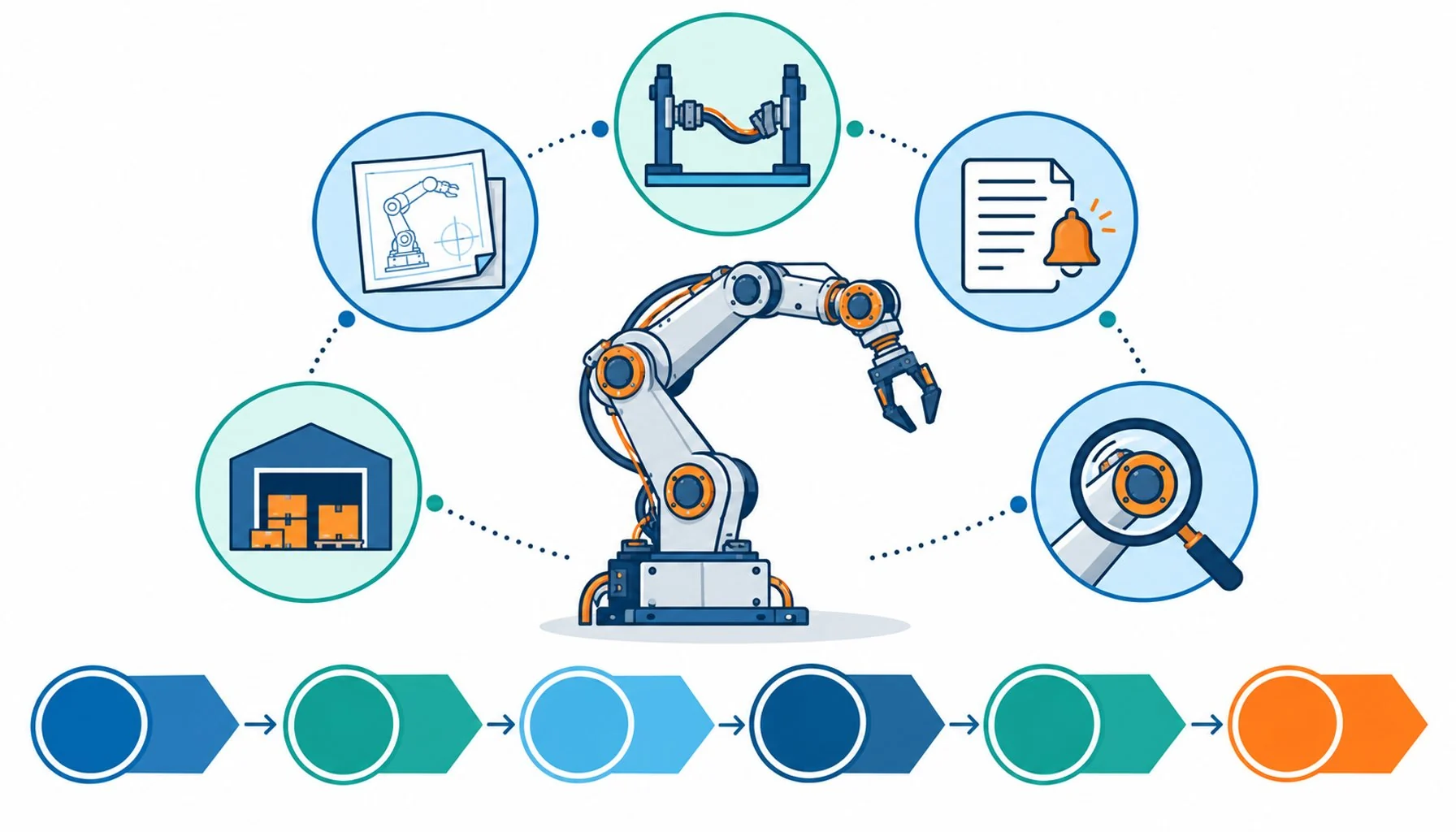
Five requirements cover almost everything a robot OEM needs to establish. Each one has evidence attached, and a supplier who can produce the evidence is a supplier who can hold the position.
| What must be proven | Why the OEM cares | Evidence that settles it |
|---|---|---|
| Construction control | A platform is built for years and cannot tolerate a drifting build | Documented construction sheet, process parameters, in-house stranding |
| Measurable flex life | The cable is a wear part inside a machine under warranty | Bend or torsion reports with radius, angle and failure criterion stated |
| Change control | An unannounced change becomes the OEM's field failure | Written notification route, approval gate, reissued records |
| Continuity of supply | Production schedules cannot absorb a cable shortage | Capacity statement, call-off or stocking terms, replenishment time |
| Honest documentation | Claims must survive the OEM's own customer reviews | Test records, batch traceability, certification scope in writing |
| Failure analysis capability | Field returns need a diagnosis, not a replacement | Named technical contact and a described investigation method |
How Qualification Actually Runs
The last row is the one suppliers underestimate. An OEM does not only want a replacement for a failed cable; it wants to know whether the failure came from the build, the installation or the duty, because the answer determines whether the machine platform needs a change. A partner who can look at an uncut specimen and a set of batch records and reach a defensible conclusion is solving the OEM’s problem. A partner who can only issue a credit note is leaving the OEM to guess. The diagnostic discipline involved draws on the same body of failure knowledge as common cable failure causes. The evidence conventions that make the paperwork usable in a review are described in the guide to reading an electrical equipment datasheet.
What a Partner Programme Looks Like in Practice
OEM qualification is a sequence of gates, and each gate needs evidence before the next one opens. The stages below are typical, though the durations vary with the programme and the certification requirement.
| Stage | What the OEM does | Evidence gate |
|---|---|---|
| Capability screening | Reviews process, equipment and quality systems | Documented process flow and audit access |
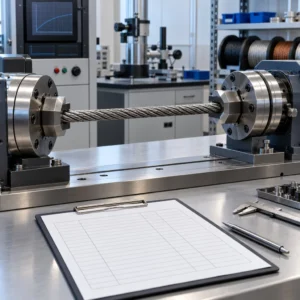
| Sample and rig test | Validates the construction against the axis duty | Flex report on the exact build, at the real radius |
| Pilot build | Fits the cable into the first machine and monitors it | Assembly feedback and early service data |
| Field trial | Tracks machines in customer hands over a service period | Failure rate and any returned specimens analysed |
| Production release | Freezes the construction and sets delivery terms | Signed specification, change control, call-off plan |
| Requalification | Reviews the partner annually or after any change | Retained sample comparison and updated records |
When an OEM Cable Partnership Is Not the Answer
The pilot and field stages are where most programmes fail, and usually for reasons that are cheap to avoid. A pilot that runs on the wrong axis proves little. A field trial without a recorded baseline of cycles and shift patterns cannot be interpreted. A release without a signed construction sheet quietly reopens the question the whole programme was meant to settle. The verification logic behind the release gate is the same as in acceptance testing: what was measured before shipment is the reference for everything after.
RFQ Checklist: Briefing a Potential Cable Partner
The structure is easier to see in a working example than in a specification. Kexingyu Cable Group (KXYE) supplies motion, control and power cable to a Ningbo-based robotics equipment manufacturer that builds automated handling and assembly cells. The programme began with a specific problem rather than a general enquiry: the OEM needed one cable construction that would behave the same way across a family of machines and a multi-year build plan, and its previous supply had produced acceptable samples followed by inconsistent batches.
The programme reduced to four commitments. The construction was frozen in writing, down to stranding, shield and jacket compound, and referenced in every purchase order. Each production batch was tested and the record retained, with a length held back as a physical reference against the approved sample. Any material or process change required written notification and approval before it took effect. And replenishment was planned through a call-off arrangement so the OEM’s build schedule was not tied to the supplier’s production campaign. None of those commitments is unusual in industrial supply, and none of them is expensive. Together they removed the variable the OEM could not manage from the outside, which was whether the tenth delivery would behave like the first.
Two things made the arrangement work beyond the paperwork. The first was batch traceability, which turned a field failure into a question with an answer: the OEM could identify which machines carried which batch, rather than recalling a machine family on suspicion. The second was a direct technical channel, so a question about an installation radius did not have to travel through a sales conversation. OEMs evaluating partners can test both cheaply during the pilot stage, and the qualification questions worth asking first are gathered in the checklist for evaluating a Chinese cable manufacturer and, more broadly, in the guide to vetting an electrical equipment manufacturer.
Conclusion
Three situations argue against building a dedicated programme. If the machine volume is small and intermittent, the qualification effort and the minimum order will outweigh the benefit, and a stockist relationship is more efficient. If the cable duty is standard, a catalogue construction with a documented history does the job, and specifying a bespoke build adds cost without adding reliability. And if the OEM cannot fund the pilot and field stages, a partnership with a specialist supplier will not fix the quality problem, because the problem is in the absence of verification rather than in the choice of supplier. Cable is not the only long-lead component where this logic applies, and the supply model behind a coordinated equipment supplier programme follows a comparable pattern.