Procuring Mine Pump Cable and Ventilation Fan Feeders: Duty, Drop and Standby Switching
Quick Answer: Mine service circuits take about a fifth of the cable budget and cause more unscheduled stops than the production feeders. A mine pump cable sits in water, runs long and is swapped between duty and standby; a fan feeder runs continuously and is ignored until the airway goes short. Buying them well means fixing immersion, temperature rise and the changeover arrangement up front, not pulling scrap lengths off the same reel as a roadway feeder.
Introduction
On most mines the cable schedule is written around the machines that make money. Service circuits get whatever length is left and whatever construction is already on site. That works until a dewatering pump trips on a wet shift and the sump starts rising, or a fan feeder fails at the tail of a long airway.
Pumps and fans are also the easiest circuits to buy badly, because neither looks demanding on paper. A pump is a small motor far away. A fan is a motor that never stops. Both statements hide the two things that actually kill service cable: overcurrent at a distance, and a construction that was never asked to sit in water for years. Sites buying skid distribution alongside the cable will find that side covered in our note on the mining power equipment package.
Why Service Circuits Fail Differently
A production feeder fails loudly, and the cable is replaced that shift. A service circuit fails quietly for weeks. A pump feeder that has absorbed water runs at a slightly higher leakage current until the earth leakage relay calls it a fault. A fan feeder sized too tight heats a few degrees more each summer until the insulation gives up in a joint.
That difference decides what the specification carries. On a service circuit you write the environment, the distance and the switching regime, which set the construction far more than the load does.
Sump and Submersible Pump Runs
The pump moves, and so does the cable. A fixed sump pump is laid once. A portable dewatering pump is dragged from sump to sump as the water follows the workings, which makes it a mobile duty whether the site calls it one or not. Writing one line item for both is the most common error on a pump package.
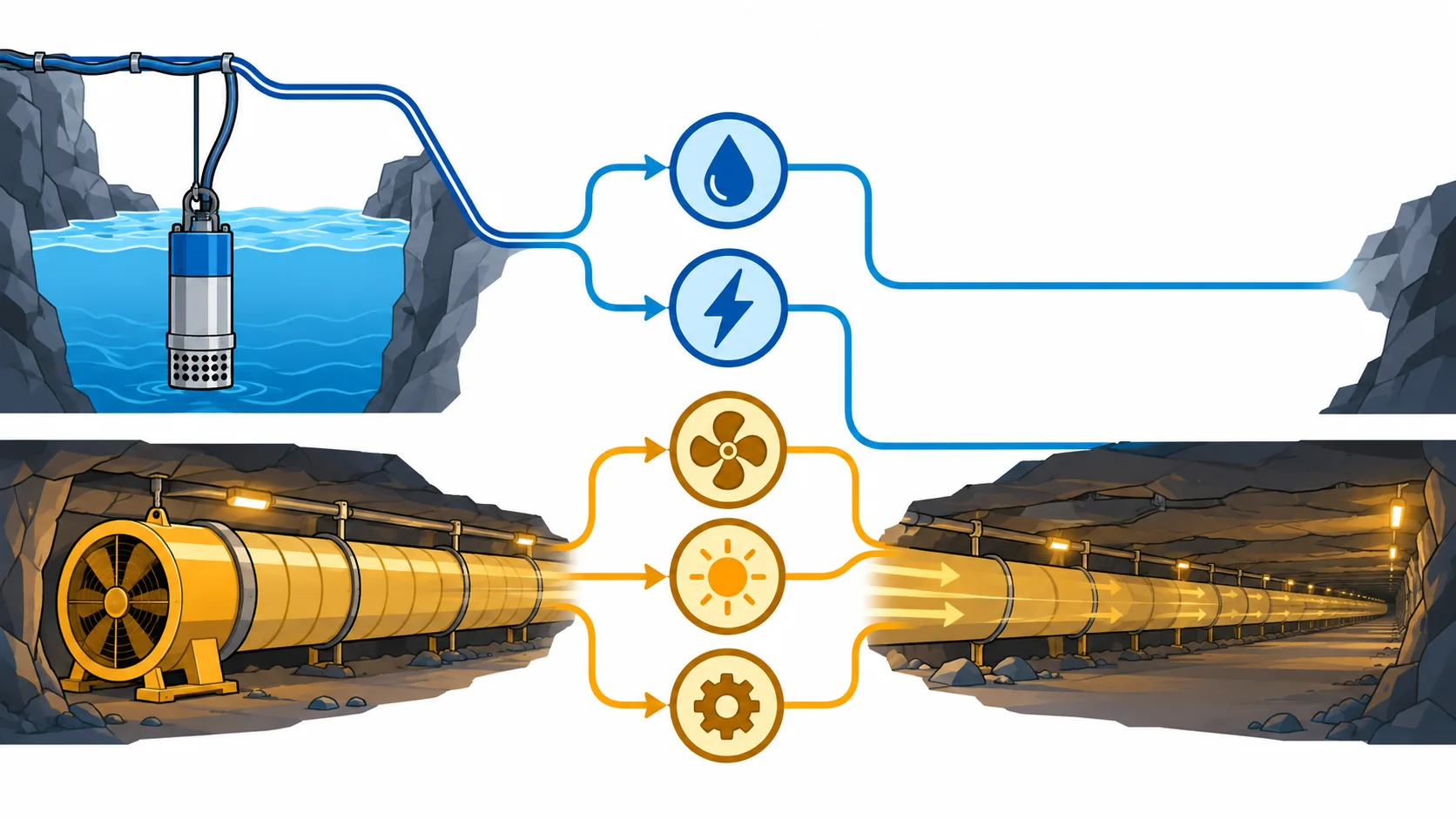
Immersion is a construction, not a rating. A cable that is merely splash resistant is not submersible. Where a pump is lowered into a flooded sump, water works in past the sheath at the clamp and cycles hot to cold on every start. Longitudinal water blocking and a sheath that tolerates standing water are what stop the cable turning into a leaking capacitor. The submersible pump cable range is built for continuous immersion rather than for wet floors.
Depth is a cable parameter. The deeper the pump sits, the longer the vertical drop, and a drop carries full starting current with no chance to cool in air. Ask for the vertical run separately from the horizontal run. Forty metres of head with two hundred metres horizontal is a different electrical problem from five metres of head at the same motor rating.
Where the level changes, the cable needs a moving construction. A cable raised and lowered with the water behaves like a slow reeling duty. On a float or winch arrangement, a reeling-duty cable outlives a straight drop bent repeatedly at one spot.
Ventilation Fan Feeders
Continuous duty at a fixed load. Main fans run for the life of the mine, so temperature rise binds before starting current does. A feeder sized on continuous current without the derating for grouped cables on shared brackets runs hot in the middle of its life, not at the start.
Long runs and voltage drop. Fan stations sit at the end of airways, so the feeder is often the longest run on the level. Voltage drop decides the cross-section, and a fan starting against a moving air column draws more than its nameplate. Give the RFQ the true route length, not the distance on a plan.
Variable speed drives change the cable. On a drive, the cable is part of an EMC problem. A screened construction with the screen bonded and a motor earth conductor run back to the drive is what stops nuisance earth fault trips when the air column surges. Reflected voltage at long lengths belongs in the drive sizing conversation, not the installation stage.
Control is a separate small cable. Fan monitoring, damper position and methane interlocks run along the same airway. A screened cable separated from the power feeder is the difference between a clean signal and a false trip. The screened rubber control cable range is built for this duty.
The Five Service Circuits and What Each Needs
Most mine service packages reduce to five circuits. Buying them as five lines keeps the specification honest.
| Circuit | Real Duty | What to Specify | Evidence to Demand | Cost and Lead Time | How It Fails |
|---|---|---|---|---|---|
| Sump pump feeder | Laid, wet floor, occasional flooding | Water-tolerant sheath, cross-section by route length | Immersion or water-blocking data at the stated condition | Standard lengths, short lead time, small copper content | Moisture ingress, rising leakage current, earth leakage trip |
| Submersible pump drop | Continuous immersion, vertical drop, hot to cold cycling | Longitudinal water blocking, immersion-rated sheath, flexible core | Immersion test report and sheath ageing data | Made to order on the drop length; a step at the joint | Water treeing in the insulation, then a short in the cable |
| Main fan feeder | Continuous, fixed load, long route | Cross-section by voltage drop on the true route, derating named | Derated current calculation and route length on the drawing | Longest copper length on the level; drives the lead time | Thermal ageing mid-life, then failure at a joint |
| Fan on a drive | Continuous with a switched output | Screened construction, screen bonded, separated earth return | Screen arrangement and earth conductor details | Screening and terminations add cost at each end | Nuisance earth fault trips, bearing damage from shaft currents |
| Monitoring and changeover | Low level, shares the airway route | Screened control cable separated from the feeder, spare cores | Screen continuity test and conductor schedule | Small cost, usually ordered last and late | False alarms and failed automatic changeover |
Sizing the Long Run: Voltage Drop Before Copper
On a service circuit the calculation is almost always a voltage drop calculation wearing a current-carrying disguise. A fan feeder three kilometres down a roadway may carry under a hundred amps and still need a large cross-section, because the motor will not start on the voltage that arrives.
Three inputs decide the answer, and all three are usually missing from a first enquiry. The route length, measured along the roadway. The starting current, which for a fan is close to locked rotor for several seconds. And the acceptable voltage at the motor terminals, which is a motor question and should come from the fan supplier in writing.
Derating is where service cables get quietly undersized. Cable grouped on brackets, cable in a hot return airway and cable in direct sun on a surface fan pad all carry less than the catalogue figure. The table value is a starting point. Our note on cable derating factors works through the cases that catch mines out, and the practical fix is to ask the manufacturer for the derated current at site conditions.
Standby Switching and the Control Side
Dewatering is normally bought in pairs, one running and one on standby, changed over automatically. The cable side of that arrangement is where packages underperform, because changeover is treated as a switchgear item and the cable is ordered by someone else.
Every standby circuit needs the same cable on both legs and enough spare length at the switchboard to remake a termination without a new drum. Where changeover is manual, the moving end needs a connector rated for that condition, or a sequence that guarantees the pump is stopped first. A coupler rated for a stopped machine, fitted to a live-switched circuit, is a failure waiting for a wet night.
Control cores deserve their own line. Level probes, run confirmation and the interlock that stops the standby pump starting into a full sump need cores and screens not shared with a power circuit. Bundle them and one insulation fault takes out both the pump and the indication that it has stopped.
What to Freeze Before the RFQ Goes Out
Six items are cheap to decide at specification stage and expensive once drums are made.
| Decision | What to State | Evidence to Attach | Cost of Leaving It Open |
|---|---|---|---|
| Circuit list | Every pump and fan as its own line, portable or fixed marked | A schedule mapping each circuit to its machine and route | One construction bought for two duties and wrong for both |
| Route lengths | Measured along the roadway, plus vertical drops | Route length on the drawing with the measuring basis stated | A feeder that will not start the fan it was bought for |
| Derating basis | Grouping, ambient and installation method, derated current asked for | The manufacturer's derated current at the stated conditions | A cable that runs hot and ages out years early |
| Immersion class | Which circuits sit in water and which only see wet floors | Immersion or water-blocking evidence for the immersed lines | A pump feeder that leaks and trips within a season |
| Switching scheme | Automatic or manual changeover, couplers named | A single line diagram with the changeover shown | A connector rated for the wrong condition and a stopped pump |
| Control and spares | Screened control cable per circuit, plus a spare drum per type | Conductor schedule and spares list agreed in writing | A recovered pump held by a control cable nobody stocks |
Lead Time and Cost Structure
Service cable is not the expensive line on a mine order, but it is often what holds up commissioning because it was ordered last. The pattern is predictable: production feeders get the engineering attention, service circuits get written from a template, and the enquiry lands three weeks before the pumps are due.
The long lead item is usually the submersible drop, because the water-blocked construction and the factory joint at the pump end are made to order and the drop length must be fixed before the sump is dewatered. On a project with both packages, place the pump order first. Fan feeders are usually standard and can follow, provided the cross-section is already settled by calculation.
Copper is a large part of a long feeder and a small part of a short drop, so the two lines carry different price risk. Where a project fixes prices early, the copper basis and its validity window belong on the fan feeder quotation in particular. Our note on cable MOQ and lead time explains how minimum quantities interact with the mixed drum lengths a services package contains.
Incoming Inspection for Service Cable
Check the drops against the sumps. A submersible drop that arrives half a metre short of the deepest sump is scrap, and the error is in the sending rather than the manufacturing. Measure one drum per size before the rest are unwrapped.
Run the electrical checks before anything is cut. Conductor resistance and continuity, insulation resistance between cores and to earth, and screen continuity end to end on control lines. On an immersed pump cable, do the insulation resistance check with the drum standing as it will be installed, because a cable that passes dry and fails wet points at the sheath or the termination.
Verify the derating claim on paper. The acceptance criterion for a long fan feeder is the derated current at the site conditions you stated, not the catalogue figure. Keep the calculation with the drum records so that a later thermal problem can be traced to a cable or an installation cause.
When One Services Specification Is Not the Answer
When the fault is the pump, not the cable. A submersible pump tripping on overload after a cable replacement is usually telling you about a worn pump or a blocked strainer. Replacing the feeder again repeats the repair without touching the cause.
When the run is short but the supply is weak. If the starting dip is a supply problem, no larger cable fixes it. A soft starter or a generator change is the honest answer and cheaper than two rounds of oversized copper.
When the site wants one submersible construction for every pump. A portable pump dragged between sumps and a fixed pump lowered on a chain do not share a duty. One construction is either too stiff for the drag or too light for the immersion.
When the changeover is manual but the cable is specified as fixed. A circuit rearranged every shift needs a connector and a moving end designed for it. Fixed glanded terminals on a circuit swapped weekly fail at the gland, not mid-cable.
When the fan feeder is sized on the nameplate alone. A fan on a drive, a fan starting against a closed damper and a fan with a long air column all start harder than the nameplate suggests. Get the starting duty and the drive length limit in writing before fixing the cross-section.
RFQ Checklist
- Every pump and fan as its own circuit, portable or fixed marked
- Route length along the roadway, plus the vertical drop at each pump station
- System voltage, motor rating, starting current and starting frequency
- Acceptable voltage at the motor terminals, from the machine supplier
- Grouping, ambient and installation method, with derated current requested
- Which circuits are immersed and which only see wet floors
- Sheath and water-blocking requirement per immersed circuit
- Screened or unscreened construction, with the screen bonding arrangement
- Control cores and screens per circuit, kept separate from power cores
- Changeover scheme, live or dead, and the coupler type required
- Drum lengths, factory-fitted ends versus field joints, per circuit
- Copper basis and validity window on the long feeders
- Spare drum allowance per construction
- Acceptance criteria and tests to be witnessed, with dates
Conclusion
Mine service cable is bought against water, distance and standby duty rather than fault level, and the specification should say so. List the pumps and fans separately, measure the route honestly, and settle the changeover arrangement before the drums are made.
Kexingyu Cable Group (KXYE) has supplied electrical cable from Quanzhou since 1996, including the water-blocked, screened control and rubber-sheathed service constructions that pump and fan circuits call for, along with the joints, couplers and glands that go with them. Send the circuit list with the route lengths, the immersion conditions and the changeover scheme, and we will come back with the constructions, the derated currents at your site conditions, and a delivery plan that fits commissioning. The fastest route is a request for quotation.