
Mining Power Packages: Equipment for Remote and Off-Grid Sites
A mine is a power plant that happens to produce ore—and packaging generation, transformation and distribution as one coordinated set is what keeps it running hours from the nearest grid
Introduction
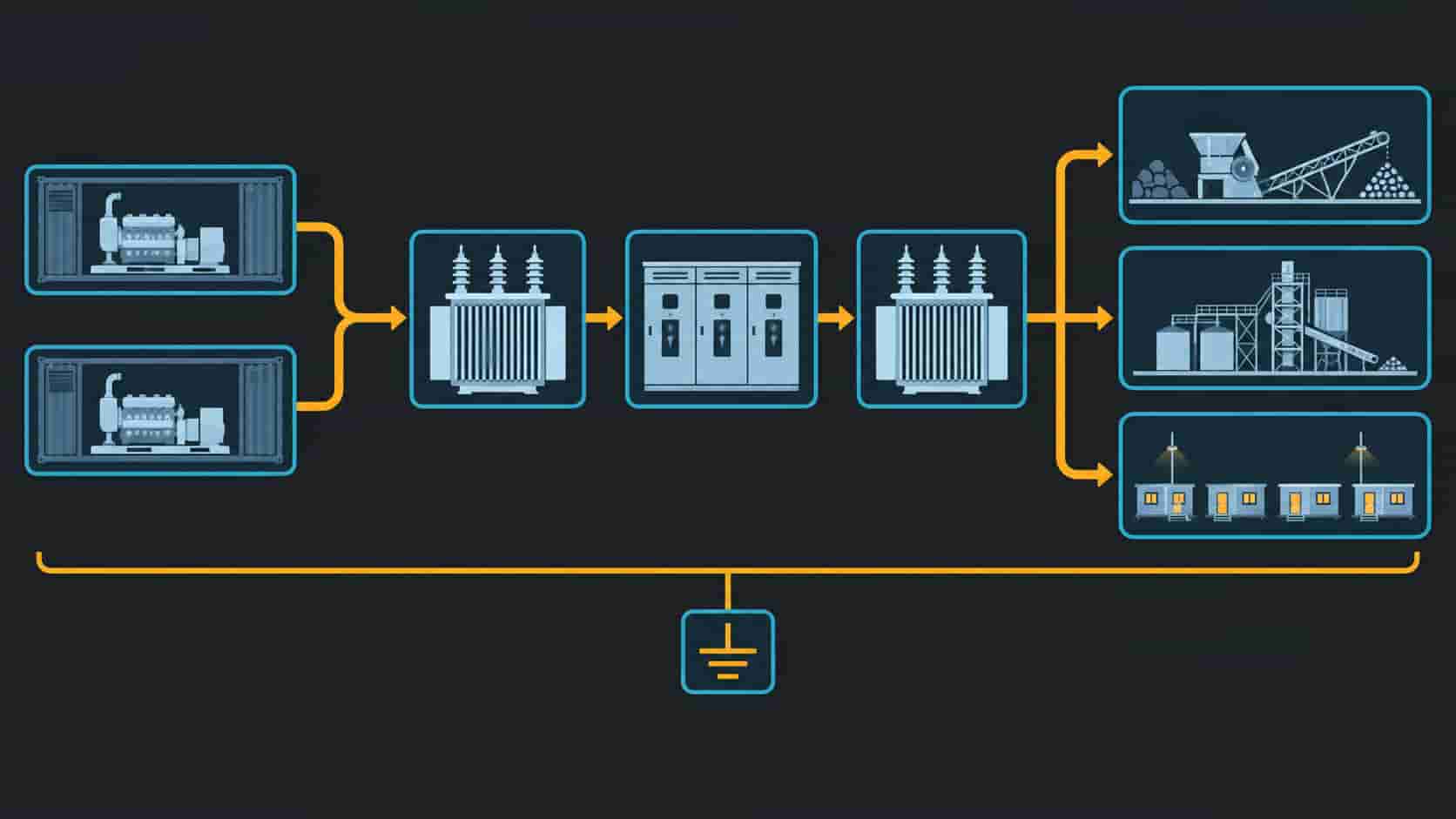
Mining is one of the most power-hungry industries per tonne of product, and many of the world’s best deposits sit where the grid is weakest or absent entirely. Crushers, mills, conveyors, dewatering pumps and ventilation fans run around the clock; camps need lighting, water treatment and refrigeration; and none of it tolerates a supply that flickers with the weather or the fuel truck schedule. For a mine developer, the electricity question is not a utility connection form—it is an industrial plant design problem with logistics attached.
The practical answer that has emerged across the industry is the power package: generation, transformation, switching, distribution and protection specified together, rated against one load schedule, and delivered as a coordinated set rather than as separately sourced items. The package approach exists because the alternative—buying a genset here, a transformer there, and hoping the interfaces work out—reliably produces the classic remote-site failures: a generator that trips on the mill motor start, a transformer derated into uselessness by altitude, a spares pool that fits none of the installed equipment.
This guide sets out what a mining power package actually contains, how the composition changes across four typical site scenarios, how to size the main components against a mining load profile, and what logistics and commissioning look like when the site is hours from the nearest town. For the transformation and switching heart of any such package, start from our transformers and substations range, which covers the equipment most mine sites build around.
Why Mining Sites Break the Usual Power Rules
The load profile is motor-dominated and step-heavy. A processing plant’s largest motors—crushers, ball mills, slurry pumps, ventilation fans—draw starting currents several times their running current, and many start across-the-line or with limited soft-start assistance. The power system must accept these steps without a voltage dip that stalls other equipment or trips sensitive drives. Commercial and IT-oriented power designs systematically underestimate this; mining designs live by it.
The environment degrades everything. Dust loads heat sinks and insulators, ambient heat reduces machine ratings, and altitude reduces the output of both engines and air-cooled electrical equipment—commonly around one percent of capacity per hundred metres above the reference, on top of temperature derating. A package specified from nameplate data at sea level will disappoint on site, so derating is a design input, not a footnote.
Logistics dominate the margins. Every kilogram shipped to a remote site costs more than it did at the factory, every crane lift needs planning, and every specialist who must fly in costs schedule. Equipment that arrives commissioning-ready, pre-tested and pre-assembled in skids or containers is not a luxury at a mine—it is usually the difference between an eight-week install and a six-month one.
The site grows and shifts. Pits advance, plants expand, camps relocate. A package designed with expansion headroom—spare switchboard ways, transformer capacity margin, generator slots—absorbs the next phase; one sized exactly to the first phase forces a mid-life rebuild.
The Building Blocks of a Mining Power Package
Whatever the site scenario, the same functional blocks recur, and the package decision is really about how each block is rated and how they connect.
Generation. Diesel gensets remain the backbone, typically multiple medium-speed or high-speed sets in the hundreds of kVA to low MVA range, operated in parallel rather than as one large machine. Paralleling several sets buys redundancy, maintenance flexibility and better part-load fuel economy, at the cost of a synchronising and load-sharing control layer that must be specified deliberately. Containerised or weatherproof enclosures, integral fuel tanks, and jacket-water or radiator cooling matched to site ambient are standard.
Transformation and switching. Generation at low voltage suits small sites; larger plants generate or distribute at mine-standard medium voltages—6.6 kV and 11 kV are common—so step-up and step-down transformers sit at the centre of the package, with the MV switchgear, ring main units or compact substations that connect them. Transformer vector group, impedance and earthing arrangement determine how the whole earth-fault protection scheme behaves, so these are package decisions, not transformer decisions.
Distribution and motor control. Main LV switchboards, distribution boards, motor control centres with starters, soft starters and variable speed drives, and the cabling and cable management that reach the pit, the plant and the camp. In a mineral processing plant the MCC and drive scope often rivals the generation scope in both cost and engineering effort.
Protection, control and monitoring. Protective relays and settings coordinated across the whole site, synchronising and load-sharing controls on the generation, metering, and increasingly a SCADA layer that lets a small site team see everything from one room. Communications protocols should be fixed before equipment is ordered, because retrofitting integration across mixed-vendor devices is slow.
Site infrastructure. Fuel storage and polishing, earthing and lightning protection sized for the site’s soil and storm profile, and the cable routes and containment that survive dust, water and vehicle traffic. These items are the least glamorous lines in the package and the most common sources of commissioning delay when omitted.
| Site Scenario | Generation | Transformation & Switching | Distribution & Motor Control | Typical Additions |
|---|---|---|---|---|
| Exploration camp | One to several containerised gensets, roughly 100â500 kVA total | Small step-down transformer, compact RMU or main distribution board | Temporary distribution boards, site and camp lighting, small pump and workshop feeders | Bunded fuel farm, solar-battery hybrid for camp loads, skid mounting for relocation |
| Open-pit mine with processing plant | Multiple MV or LV gensets paralleled, from about 1 MVA upward | 6.6 or 11 kV switchgear, step-down transformers to utilisation voltage | MCCs and drive panels for crushers, mills, conveyors, dewatering and services | Dust-mitigation cooling, power factor correction with detuning, expansion bays |
| Underground mine | Gensets sized with dedicated capacity for ventilation and hoisting | Shaft-head substation; explosion-protected or flameproof switchgear where the jurisdiction requires it | Underground distribution, guarded feeders, redundancy on ventilation fans | Ventilation-on-demand power control, emergency supply arrangements per mining code |
| Permanent camp or township | Gensets or hybrid generator-solar-storage set | Prefabricated or package substation feeding the camp network | LV reticulation, metering, street lighting, water and sewage plant feeders | SCADA and prepaid metering, fuel polishing, spares store with core items |
Four Scenarios, Four Different Packages
The table compresses the main variations; the reasoning behind each row matters more than the row itself.
Exploration camps buy relocatability. The power system must move when the drill programme moves, so skid or container mounting, weatherproof ratings and simple LV distribution dominate. Investing in heavy MV infrastructure here is money spent on the wrong phase; the honest package is modest, mobile and quick to redeploy.
Open-pit processing plants buy step-load capability and coordination. The mill motor start is the design-defining event: the generation and the network must absorb it without dragging the bus down. That pushes designs toward multiple paralleled sets, generator excitation and governing specified for step loads, transformers with impedances chosen for the fault level and the dip, and a protection study that actually spans generation to the largest motor.
Underground mines buy compliance and fan security. Mining codes treat ventilation as a safety system, so the package must show, on paper, how the fans stay fed—dedicated capacity, protected feeders and often an explicit emergency arrangement. Equipment certification for underground or hazardous locations varies by jurisdiction and must be settled before ordering, because non-certified gear cannot simply be substituted on site.
Permanent camps buy network thinking. Once power serves a township rather than a plant, the design questions shift toward reticulation, metering, street lighting and small-customer safety—closer to a small utility than to an industrial plant, which is why prefabricated substations and standardised LV networks work well here.
Sizing the Package: Motors First, Kilowatts Second
Mining sizing discipline starts from the load schedule, and the load schedule starts from motors. For every significant motor, record running kW, starting method, starting current and what else is running when it starts. The largest single start—usually the mill or a main fan—sets the generator step-load requirement and often the transformer impedance conversation; the simultaneity of plant start-up after a shutdown sets the worst-case block load the generation must accept in stages.
Generation sizing therefore follows running load plus the largest start plus a growth allowance, checked against the block-loading sequence the operations team actually plans. Fuel autonomy is a separate decision: storage for days, not hours, is normal at remote sites, and the fuel system—storage, transfer, polishing—belongs inside the package scope rather than beside it.
Transformer sizing follows the demand calculation with derating for ambient and altitude, plus the impedance choice that balances fault limitation against voltage dip on motor starts. The capacity method and the margin logic are the same as any industrial project—our guide to choosing transformer capacity covers the arithmetic—and the mining-specific part is the environment: dust, heat and altitude all push the same rating downward.
Motor control sizing walks through each drive’s duty: continuous, intermittent, high-inertia starts, torque requirements, speed control needs. Variable speed drives bring harmonic currents with them, which propagates into the power factor correction design—capacitor banks in drive-heavy networks need detuning reactors or an active solution—and into transformer thermal loading. This is where a harmonic study earns its cost.
| Equipment Group | Rating to Fix | Sizing Driver | Common Error |
|---|---|---|---|
| Diesel generation | Standing load, largest motor start, block-load sequence, fuel autonomy in days | Motor-dominated load profile with heavy steps | Sizing on average load and discovering the mill start during commissioning |
| Transformers | kVA with ambient and altitude derating, impedance, vector group, earthing | Demand load, dip limit on the largest start, fault coordination | Using sea-level nameplate capacity at a high-altitude, hot site |
| MV switchgear and RMUs | Voltage, busbar and short-circuit withstand, IP and enclosure class | Fault level from the transformer and generation in parallel | Withstand chosen for one source while sources actually run in parallel |
| Motor control and drives | Starter types, drive ratings, harmonics and cable screening | Motor duties, torque and speed-control needs per process | No harmonic study; capacitors later fail in the drive-rich network |
| Hybrid solar-storage | PV kW, battery kWh and kW, inverter rating against camp or daytime load | Fuel saving target, solar resource, load shape | Treating storage as an ups system instead of a fuel-displacement asset |
| Cabling and earthing | Sizes with grouping and ambient derating, earth resistance target, SPD zones | Route lengths, soil conditions, lightning exposure | Nameplate currents without derating; earth system left to be discovered later |
Hybrid Generation: Where Solar and Storage Fit
Solar and battery storage have moved from novelty to default consideration in mining power design, especially for camps, dewatering loads and other duties with daytime-heavy profiles. The economics are straightforward at a high level: fuel delivered to a remote site is expensive, sunlight is free, and a battery displaces both fuel and engine hours while shaving the peaks that gensets dislike. The engineering is more particular—the battery must integrate with the generation’s synchronising and load-sharing scheme, the inverter must be specified for the site’s harmonic and earthing context, and the control logic must define clearly which source leads under which condition.
Where the hybrid ambition extends beyond fuel saving—firming an intermittent grid connection, or running long periods with engines off—storage sizing becomes an energy-management study rather than a bridging calculation. Our overview of generator-storage hybrid systems sets out the architecture options and the trade-offs between them, and it applies directly to the mining context.
Logistics, Installation and Commissioning Far from the Grid
Design for the shipping route first. Container dimensions, skid weights, crane capacities at site and road limitations on the last hundred kilometres shape what the package can physically be. Equipment that cannot make the journey is not equipment; it is a redesign. Factory assembly into the largest transportable modules is usually worth more than any on-site labour saving.
Pre-assembly and pre-testing pay for themselves. Prefabricated substations—transformer, MV and LV switchgear, protection and cabling assembled and tested as one unit—have become the default for mine sites precisely because site hours are the expensive hours; our guide to prefabricated substations explains why they compress deployment so sharply. Where the pit or plant will move before the infrastructure does, a mobile substation turns relocation from a rebuild into a tow.
Commissioning is a plan, not an event. Witnessed factory testing before shipment, a commissioning spares package shipped with the equipment, local technician training with translated documentation, and a first-year support arrangement with defined response times—these are the items that separate packages that energise on schedule from packages that wait weeks for a specialist and a spare part. The load-bank test on the generation and the protection coordination verification on the network deserve full scope, not abbreviated versions, because the site has no utility fallback to lean on.
When a Standard Package Is Not the Answer
The package model is strong, but three situations call for honest deviation. First, grid extension becomes viable: where a utility line is genuinely planned and funded, designing a permanent package around generation it will obsolete wastes money—the right answer is a bridging design with an explicit transition plan. Second, hazardous or underground jurisdictions demand certified equipment: explosion-protected switchgear and mining-certified machines follow their own certification paths, and a supplier without that scope cannot be stretched into it by specification courage. Third, very large, long-life operations justify building toward a real network: a decades-long process complex with its own transmission connection is a utility-scale design problem, and forcing it into package thinking under-specifies it. Recognising these cases early is worth more than any negotiating skill at purchase order stage.
Specification Checklist
Bring these to any package quotation so that bids are comparable:
- Load schedule: running kW, motor list with starting methods, block-load sequence, growth allowance, and the environmental design basis (temperature, altitude, dust, seismic).
- Generation: number and rating of sets, paralleling and load-sharing philosophy, fuel autonomy in days, fuel system scope, enclosure and noise limits.
- Transformation: transformer kVA with derated site conditions, impedance, vector group and earthing arrangement, plus the substation form (prefabricated, mobile or built).
- Switching and protection: MV and LV switchgear ratings against the coordinated fault level, protection study scope, relaying functions, SCADA protocol and point list.
- Motor control: starter and drive schedule, harmonic mitigation approach, cable screening requirements.
- Logistics: transport envelopes, packing standards, commissioning spares list, training scope and documentation language.
- Testing and support: witnessed FAT scope, site commissioning plan, load-bank testing, and first-year service response commitments.
Conclusion
A mining power package succeeds or fails on coordination: one load schedule behind every rating, one protection philosophy across generation to motor, one logistics plan from factory floor to gravel pad. Sites that buy the blocks separately inherit the coordination problem themselves, usually at commissioning, when it is most expensive. Sites that buy the package still have to write the load schedule—but then the supplier’s engineering carries the interfaces instead of the site team’s evenings.
KXY E-Power Group supplies mining power packages as coordinated sets—generation interface, transformers, switchgear, motor control and the distribution between them—sized from your load schedule and your site’s environment rather than from a catalogue. Send us the motor list and the site conditions, and we will respond with ratings and a deployment plan, not a price list.
Frequently Asked Questions
Recent Posts
Voltage Stabilizers vs UPS: Do You Need Both?
Voltage Stabilizers vs UPS: Do You Need Both? One device fixes how high or low the voltage is; the other fixes whether there is voltage
Energy Storage for Data Centers: A Growing Backup Power Option
Energy Storage for Data Centers: A Growing Backup Power Option Batteries have always backed up data centers in the form of UPS strings. Grid-scale BESS
Thermal Runaway in Lithium Batteries: What BESS Buyers Should Understand
Thermal Runaway in Lithium Batteries: What BESS Buyers Should Understand How thermal runaway starts, how it propagates, and which evidence buyers should require before approving