
What Is a Prefabricated Substation and Why Is It Faster to Deploy?
Factory integration can move electrical assembly and testing off the critical site path—but civil works, grid approvals, interfaces, transport and commissioning still determine the real energization date.
Introduction
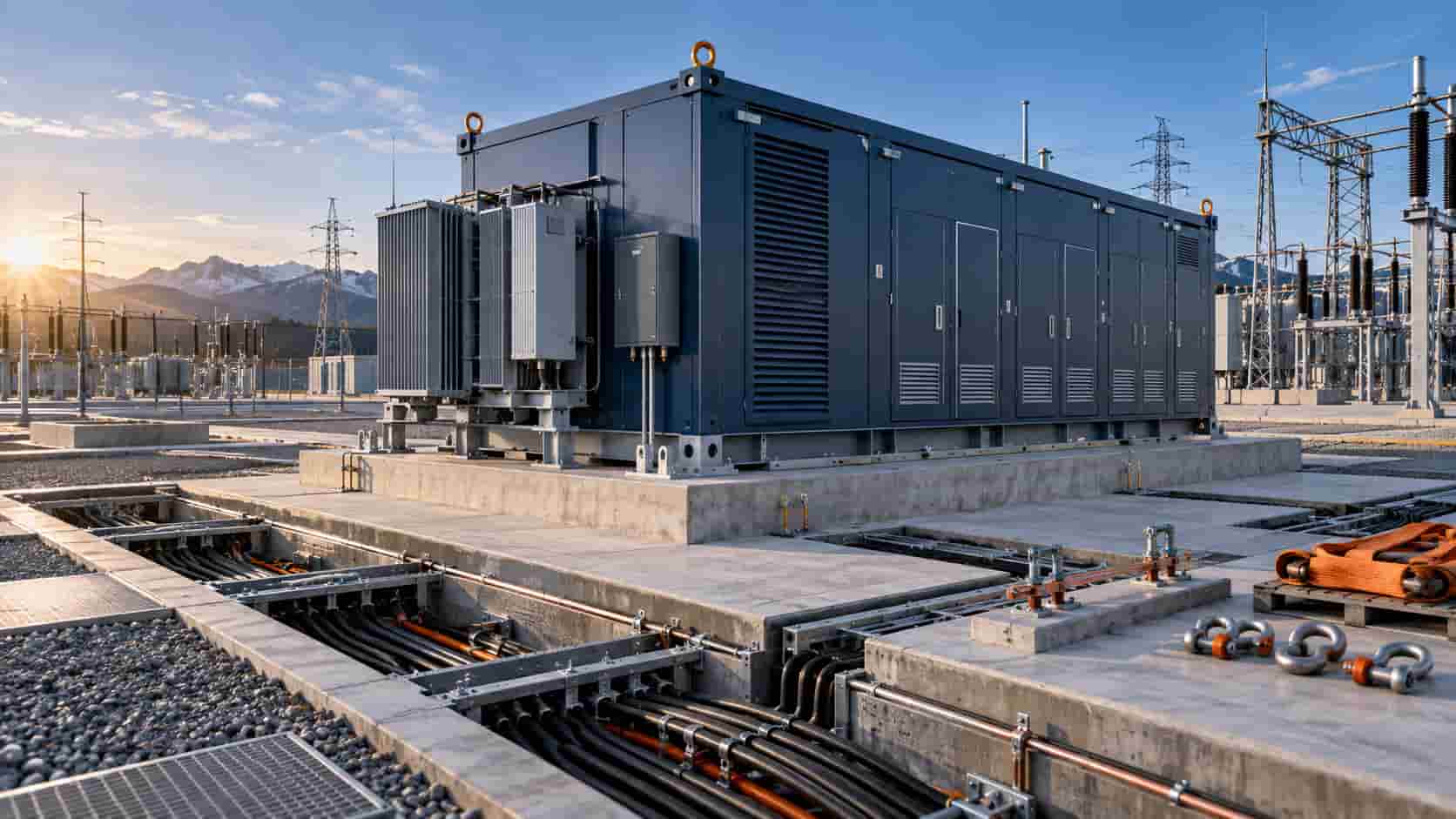
A prefabricated substation is an integrated electrical power package assembled in a factory and delivered to site as one enclosure or several transportable modules. Depending on the project, it can combine medium-voltage switchgear, transformer equipment, low-voltage distribution, protection, metering, controls and auxiliary systems.
Its main schedule advantage is not that every component is manufactured instantly. It is that detailed integration, wiring and testing can proceed in a controlled factory while foundations, grounding and cable infrastructure progress at the site. Less work remains after delivery.
What Is Included in a Prefabricated Substation?
The simplest compact package may contain an incoming MV switching section, a distribution transformer and an LV switchboard. Larger walk-in modules or E-houses can include protection relays, SCADA gateways, DC systems, HVAC, lighting, fire detection, UPS, variable-frequency drives and other project-specific equipment.
The label alone does not define the supply. Buyers must establish battery limits: incoming cable termination, outgoing feeders, grounding connections, external controls, civil works, field cables, commissioning and utility interfaces. Missing boundaries are a common source of change orders.
IEC 62271-202:2022 addresses enclosed AC prefabricated substations above 1 kV and up to and including 52 kV within its stated scope. Other standards apply to the individual switchgear, transformer, LV assembly, protection and local installation. The purchase specification should list every applicable standard and edition.
Why Factory Integration Can Shorten the Schedule
Traditional construction often follows a long sequence: build the room, receive separate equipment, position each item, install interconnections, complete control wiring and then begin integrated testing. A prefabricated approach moves many of those tasks away from the project site.
Factory engineers can coordinate equipment layout, bus or cable interfaces, interlocks, control power and communications before shipment. Production can overlap with foundations, grounding grid, cable trenches and access roads. Once the module arrives, the remaining work is concentrated on placement, module joints, external cables and verification.
This parallel workflow can compress the site critical path and reduce dependence on specialist labor at a remote or congested location. It also limits exposure of sensitive equipment to dust, rain and uncontrolled construction conditions.
Factory Acceptance Testing Reduces Integration Risk
Individual switchgear and transformer tests remain important, but an integrated FAT can also exercise the assembled system. Typical checks may cover wiring continuity, protection and trip logic, mechanical and electrical interlocks, alarms, control power, communication links, meter signals, HVAC and auxiliary systems.
The buyer should approve the FAT procedure before manufacture is complete. The document must distinguish routine tests, type-test evidence, functional tests and any simulated external signals. Witness points, test records, punch-list ownership and re-test requirements should be clear.
FAT does not eliminate site acceptance testing. Transport can loosen connections, modules may be separated for shipping, and external cables, grounding and utility interfaces do not exist in the factory test setup.
| Project activity | Prefabricated approach | Conventional approach | Buyer control point |
|---|---|---|---|
| Engineering | Interfaces and equipment are coordinated as one integrated package. | Multiple equipment packages and building disciplines are coordinated largely around the site design. | Freeze single-line diagram, ratings, cable interfaces, protection and communications early. |
| Manufacturing | Enclosure, switchgear, transformer interfaces, LV equipment and controls can be assembled in a controlled factory. | Equipment is manufactured separately and a larger share of integration occurs on site. | Define exact supply boundary and approved component makes. |
| Testing | Integrated factory acceptance testing can check wiring, interlocks, controls and communications before shipment. | Individual equipment tests are followed by more site integration testing. | Approve FAT procedure, witnesses, punch-list closure and test records. |
| Site work | Foundation, grounding, cable routes and external connections can progress while the module is built. | Building and electrical installation are often more sequential. | Control civil tolerances, anchor points, cable entries and earthing interfaces. |
| Installation | Large preassembled sections are positioned, joined and connected. | More equipment is placed, aligned, wired and terminated individually. | Verify route survey, crane plan, transport split and reassembly scope. |
| Schedule risk | Less site assembly can shorten the critical path, but late design changes are costly. | More site flexibility, but greater exposure to labor, weather and coordination delays. | Use a responsibility matrix and interface register, not a headline lead-time promise. |
What Still Has to Happen on Site
A prefabricated substation still needs a suitable site. Geotechnical review, foundation design, drainage, flood level, grounding grid, trenches, cable ducts, access, security and lifting arrangements remain project responsibilities unless explicitly included.
Civil tolerances matter. Anchor locations, floor level, cable openings and module-to-module joints must match the approved drawings. A route survey should confirm bridge, turning-radius, height, width, axle-load and crane constraints before the final transport split is frozen.
After placement, teams complete bonding and grounding, external power and control cables, weather seals, auxiliary connections and protection interfaces. Pre-energization testing, utility inspection and commissioning must then confirm the installed system.
When Prefabrication Does Not Automatically Save Time
Late design changes can erase the schedule advantage. Once the enclosure, buswork, cable entries and internal wiring are in production, a changed fault level, feeder count, transformer rating or protection philosophy can trigger extensive rework.
Long-lead switchgear or transformers can still control the factory schedule. Grid studies, utility protection approval, permits or customer data may also remain on the critical path. A fast module delivery does not equal a fast energization if the site or approval package is not ready.
Highly unique one-off designs can require more front-end engineering than a standardized configuration. Buyers should judge speed from an integrated project schedule with interface dates, not from a supplier’s headline manufacturing period.
Compact Substation, E-House and Mobile Substation
A compact substation usually describes a tightly packaged MV/transformer/LV distribution unit. It is often non-walk-in and optimized for a small footprint. An E-house is generally a larger walk-in electrical building that can contain multiple switchgear lineups, controls and auxiliary systems.
A mobile substation is engineered for relocation and may be mounted on a trailer or skid for emergency, temporary or phased service. “Prefabricated” describes the factory-built method; “compact,” “E-house” and “mobile” describe different forms and applications.
Procurement Checklist for Buyers
Start with the approved single-line diagram, voltage levels, frequency, transformer MVA, impedance, fault current, feeder ratings, protection philosophy and metering. Add load profile, harmonics, motor starting, power-quality and future-expansion requirements.
Define the site environment: ambient temperature, altitude, solar load, humidity, dust, corrosion, wind, seismic conditions, flood level and public or restricted access. State enclosure class, internal-arc requirements, fire strategy, HVAC redundancy and noise limits.
Conclusion
A prefabricated substation is faster to deploy when factory integration and site construction genuinely run in parallel. Its strongest benefits are reduced site assembly, earlier interface validation, integrated testing and more predictable quality.
The speed is conditional. Early design freeze, complete interface data, approved FAT, transport planning and site readiness are essential. Procurement teams should compare the total path to energization—not simply the date the enclosure leaves the factory.
Frequently Asked Questions
The package may include medium-voltage switchgear or RMU, one or more transformers, low-voltage switchboards, protection and control panels, auxiliary power, metering, communications, HVAC, lighting and fire or security systems. The exact boundary must be stated in the purchase specification.
There is no universal percentage. Time can be saved because factory assembly and testing run in parallel with civil works and because less integration remains on site. Grid approval, long-lead equipment, transport and late design changes can still control the final date.
The terms overlap but are not always interchangeable. A compact MV/LV substation is typically a tightly integrated distribution package, while an E-house may be a larger walk-in electrical building containing switchgear, controls, drives or auxiliary systems. Define the actual functions and enclosure rather than relying on the label.
No. FAT reduces integration risk before shipment, but site checks are still required after transport, placement, cable termination and connection to external systems. Protection, grounding, phase sequence, controls and interfaces must be verified before energization.
Typical work includes geotechnical and civil design, foundations, drainage, grounding grid, cable trenches or ducts, external MV and LV cables, communications, access roads, security, lifting, final connections, inspections and utility approval.
Provide the single-line diagram, voltage levels, frequency, transformer rating, fault level, protection philosophy, metering, cable entry, enclosure and environmental conditions, internal-arc requirement, communications, auxiliary systems, transport limits, standards and project schedule.
Recent Posts
Voltage Stabilizers vs UPS: Do You Need Both?
Voltage Stabilizers vs UPS: Do You Need Both? One device fixes how high or low the voltage is; the other fixes whether there is voltage
Energy Storage for Data Centers: A Growing Backup Power Option
Energy Storage for Data Centers: A Growing Backup Power Option Batteries have always backed up data centers in the form of UPS strings. Grid-scale BESS
Thermal Runaway in Lithium Batteries: What BESS Buyers Should Understand
Thermal Runaway in Lithium Batteries: What BESS Buyers Should Understand How thermal runaway starts, how it propagates, and which evidence buyers should require before approving