Kazakhstan and Central Asia: Grid Expansion Drives Cable Imports
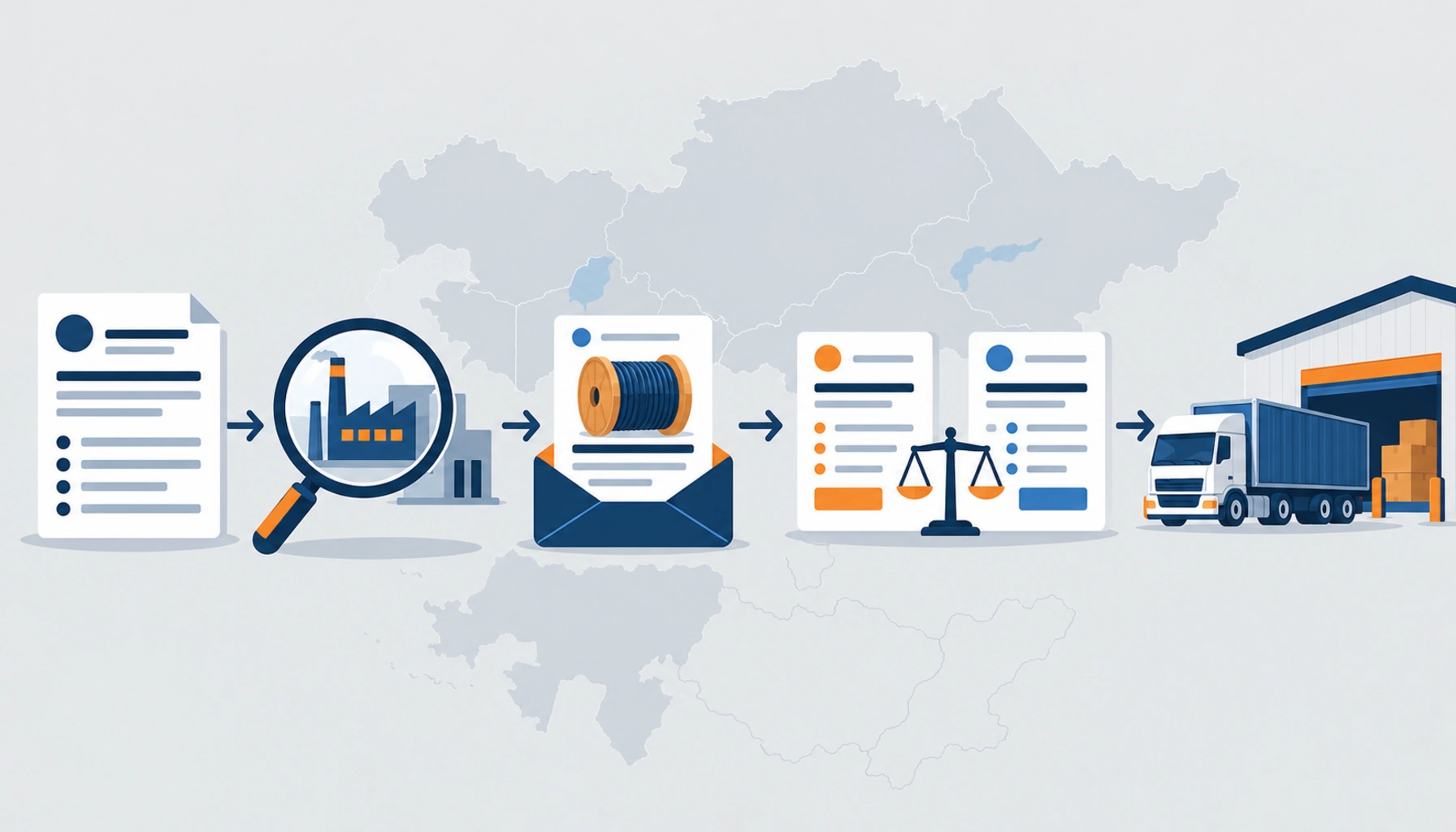
Quick Answer: Kazakhstan and Central Asia import most of their cable because grid expansion outruns local factory capacity — GOST-based specifications and CIS-style paperwork decide who wins the corridor.
Central Asia is the quietest large cable corridor on the map. Kazakhstan, Uzbekistan and their neighbors are running grid programs that stretch across distances most markets never face: generation in the steppe and the mountains, load centers hundreds of kilometers apart, and Soviet-era networks built for a different economy now being replaced. Local cable manufacturing exists but has never matched the volume the programs need, so the corridor imports — from Russia, from China, from Korea and Turkey — with the paperwork culture of the CIS region shaping every shipment. For a cable supplier, Central Asia is a market of long distances, formal documentation and few shortcuts. The standards file matters as much as the price here, and the suppliers who learn the GOST dialect win volume that Western competitors rarely contest.
Introduction
The demand engine is the grid itself: transmission backbone projects, distribution modernization, and the electrification of new industrial and mining developments follow the equipment families of utility grid expansion equipment — MV cable in program volumes, substation wiring, conductor, and the accessories program around them. Layered on the grid are the region’s resource economies. Mining, oil and gas, and the industrial parks both governments use to diversify each buy industrial LV, control and specialized cable on project schedules. The digital layer is thinner than South Asia’s but present: Almaty, Tashkent and Astana carry enterprise and carrier infrastructure that buys the standard hall bill in modest scale. What unifies the corridor is its specification culture. GOST-based standards inherited from the Soviet system get updated and blended with IEC in newer tenders, and everything is enforced through a paperwork discipline that rewards suppliers whose documentation is complete, stamped and exactly as requested.
The Specification Culture: GOST, IEC and the Paper Trail
Central Asian procurement carries the CIS documentation culture: certificates of conformity, factory licenses, hygienic certificates where relevant, and test reports referenced to GOST or to the IEC standards the newer tenders name. Kazakhstan has moved furthest toward IEC alignment, Uzbekistan blends GOST practice with its own certification system, and both enforce the forms with a formality that surprises suppliers used to flexible markets. The technical content isn’t exotic — XLPE insulation, copper and aluminum conductors, the constructions compared in XLPE vs PVC cable — but the expression of it is. A file that proves performance to IEC must often be re-presented in the forms and stamps the customer’s regulations expect, and a shipment whose paperwork is incomplete waits at the border no matter how good the cable is. Every experienced supplier repeats the same lesson: in Central Asia, the document is part of the product.
| Segment | Leading Cable Families | What Decides the Win |
|---|---|---|
| Grid programs | MV XLPE, conductor, substation wiring | GOST/IEC file completeness and program calendar |
| Mining and resources | Industrial LV, flexible and specialized cable | Ruggedization evidence and delivery to remote sites |
| Oil and gas | Control, instrumentation, fire-rated families | Sector certifications and batch traceability |
| Urban and digital | Building wire, LV distribution, hall bill | Price competitiveness and importer relationships |
Logistics: The Distance Is the Difficulty
The corridor’s geography is its second filter. Landlocked markets receive cable over long land routes — through China’s rail corridors, across the Caspian, or through Russian transit — and every route adds weeks and paperwork nodes between the factory and the site. Programs absorb this when suppliers quote honestly: cable that arrives after the substation window has passed saves no money at any price. The calendar discipline matters doubly here because Central Asian programs buy the whole electrical family, and the transformer and switchgear lead times tracked in transformer lead-time shortage planning set milestones the cable must meet. The coordination logic of one-stop power equipment sourcing appeals to buyers juggling the family across borders. Suppliers who quote the corridor price the logistics truthfully, hold batch identity through every transshipment, and treat customs documentation as an engineering deliverable rather than a clerical afterthought.
Competing Where Few Contest
The competitive field is unusual. Russian suppliers hold legacy relationships and GOST fluency; Chinese suppliers hold price and capacity; Korean and Turkish suppliers hold positions in specific projects. Western suppliers contest rarely — the paperwork culture and logistics distance filter them out. For a Chinese factory, the corridor is therefore a genuine opportunity with a specific price: match the GOST-and-IEC dialect in the file, hold the calendar across the long route, and price the program rather than the drum. The recurring failure patterns of international power equipment sourcing mistakes appear here as paperwork nationalism — files complete in one format and useless in another — and as calendar optimism that a border crossing punishes. Suppliers who pass both filters find a market where repeat programs, not one-off tenders, are the norm. Grid modernization in Central Asia is a decade-long story, and the suppliers who enter it early with correct paper compound their position for years.
| Stage | Action | Classic Trap |
|---|---|---|
| Standards mapping | GOST and IEC requirements mapped per country and tender | One IEC file assumed to cover the whole corridor |
| Documentation | Conformity and test files re-presented in expected forms | Correct content in the wrong paperwork format |
| Logistics planning | Route, transit time and border nodes quoted honestly | Calendar optimism that a border crossing punishes |
| Program entry | Family calendar aligned with transformer and switchgear milestones | Cable quoted as an isolated commodity |
| Retention | Repeat-program framework terms with one accountable contact | Treating each tender as a fresh, unconnected sale |
When a Quiet Market Is Not an Easy Market
Two cautions keep the corridor honest. Quiet doesn’t mean undemanding. The paperwork culture enforces standards that flexible markets let slide, and a supplier who treats Central Asia as a place to move surplus product meets the conformity wall at the first customs post. And the corridor’s volume arrives slowly. Programs are large but procurement cycles are long, relationship-driven and formal, so the supplier expecting quarterly wins burns out in the first year. Enter with the file correct and the calendar honest, accept the pace, and the decade-long grid story compounds in the supplier’s favor exactly as it does in the region’s.
RFQ Checklist: Central Asia Lines for the RFQ
Put the market’s questions in writing:
- GOST and IEC requirements mapped per target country and tender
- Conformity and test files listed in the customer’s expected forms
- Route, transit time and border documentation plan per shipment
- Batch identity and marking preserved through every transshipment
- Family calendar aligned with substation and equipment milestones
- Aluminum and copper conductor options priced per tender
- Framework terms for repeat grid and industrial programs
Conclusion
Kazakhstan and Central Asia import cable because their grids are growing faster than their factories, and they buy through a specification culture — GOST forms, CIS paperwork, long logistics — that filters competitors more effectively than any tariff. The market rewards the suppliers who learn the dialect: files complete in the expected forms, calendars that survive the border, and the patience to let decade-long programs compound.
Kexingyu Cable Group (KXYE) serves the corridor with the posture it demands: GOST-and-IEC documentation prepared as an engineering deliverable, batch identity held through every transshipment, and family calendars quoted honestly across the long routes — cable supply for a region where the document is part of the product and the decade is part of the plan.