Coastal Cable Selection: Salt Spray, Corrosion and What to Specify
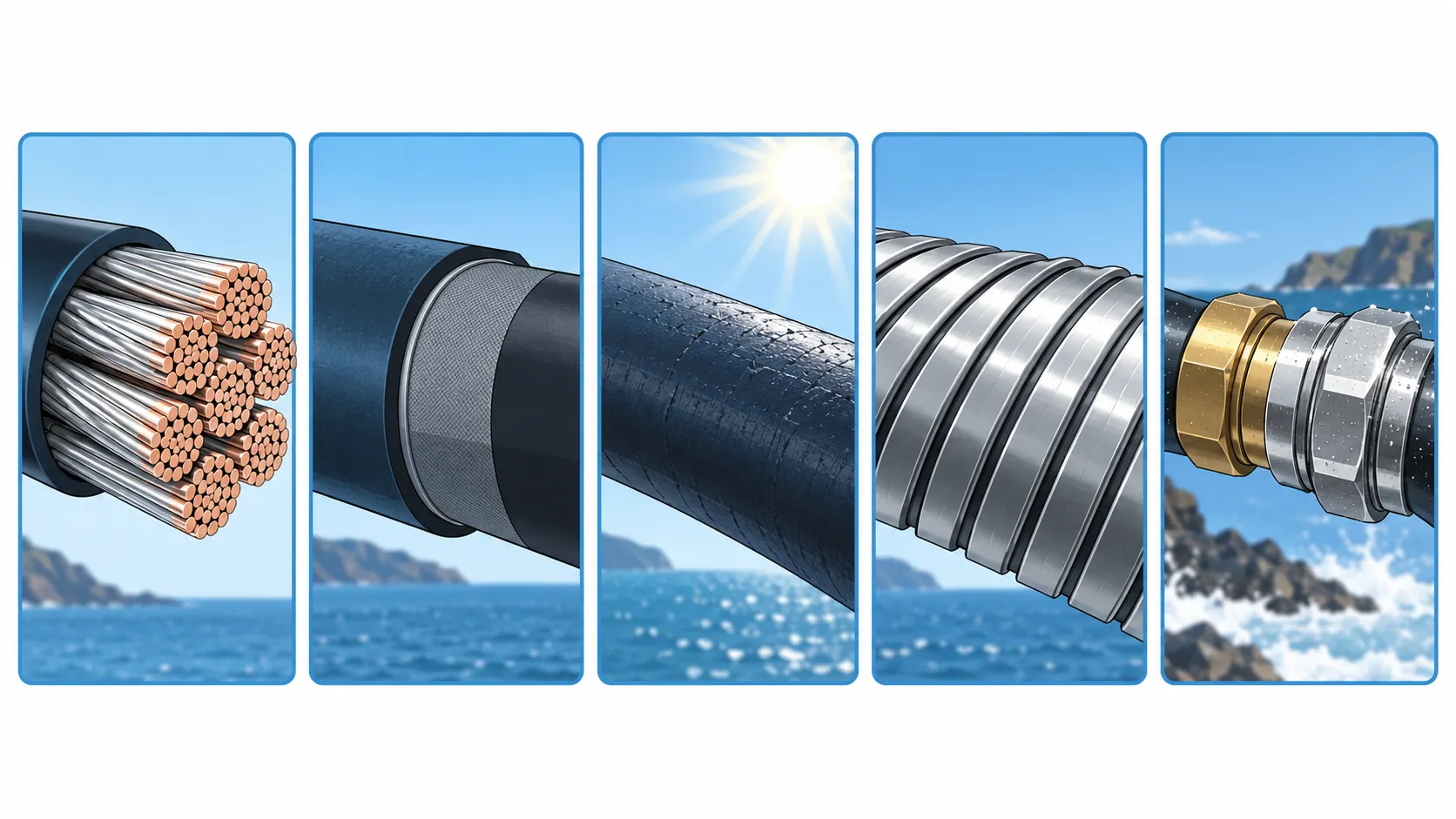
Quick Answer: Coastal cable selection is a metals decision before it is a sheath decision. Salt spray leaves a hygroscopic chloride film that keeps metal surfaces wet, and the parts it attacks first are steel armour, screen wires, glands and terminal metal, not the polymer sheath. The buyer’s job is to set the corrosivity of the site, name the plating or barrier that answers it, and make the supplier show evidence on the construction delivered. Getting it wrong shows up as a rusted armour or a green terminal three years in.
Introduction
A coastal site is not simply a wet site. Salt deposits on every exposed surface, the air keeps them damp, and the combination attacks bare steel far faster than rain does inland. Cable that would last thirty years in a dry plant room can lose its armour in a few seasons within a few hundred metres of the shoreline.
This guide is for the buyer specifying cable for a harbour, a desalination plant, an offshore wind installation or any site within the salt zone. It covers what salt spray actually attacks, the material and barrier options that answer it, the decisions to freeze before the order goes out, and the checks that catch a corroded or wrongly plated delivery. Constructions built for this duty sit in our weather resistant cable range, and the wider corrosion picture is in our note on corrosion in tropical installations.
What Salt Spray Actually Does
It leaves a film that never dries. Chlorides are hygroscopic, so a salt-covered surface stays wet through the humidity cycle instead of drying between showers. That continuous wet time is what drives the corrosion rate, and it is why a coastal site behaves more aggressively than its rainfall suggests.
It attacks galvanising first, then steel. A hot-dip galvanised tray or armour performs well until the zinc is consumed or damaged. Once bare steel is exposed, the salt film takes it quickly, and the corrosion creeps under the remaining zinc so the damage is broader than it looks.
It corrodes aluminium as well as steel. Aluminium forms a protective oxide, but chlorides break it down where water sits, particularly in crevices and under deposits. Aluminium armour or a bare aluminium conductor crimp in a coastal gland is a known weak point.
It chalks and hardens polymers. UV plus salt does not dissolve a sheath, but it hardens and chalks the surface and eventually cracks it, and every crack becomes an entry point to the metal underneath. Sun-facing runs on a tray suffer first.
It creates creepage paths. Salt contaminates insulator and termination surfaces, and the resulting creepage current is a common cause of coastal flashovers that have nothing to do with the cable’s insulation.
Corrosivity Zones and What They Change
Distance from the shoreline sets the category. Standard corrosivity categories run from rural to industrial to marine, and a coastal site is normally in the upper marine categories, with the worst band within a few hundred metres of breaking surf. The category, not the word coastal, is what a supplier can design to.
Wet and dry makes a difference. A run that is washed by rain regularly sheds salt; a sheltered run under a canopy accumulates it. Splash zones and tidal pits are the harshest band, and they belong with immersion rather than atmospheric exposure.
The category applies to the metals, not the polymer. Once the site category is set, the questions become which conductor plating, which armour material, which sheath compound and which gland metal are appropriate. That is where the specification is won or lost.
Materials and Constructions Compared
The table sets out the material choices a coastal buyer actually makes: what each one does, what to specify, the evidence to demand, what drives cost and lead time, and how each one fails when it is chosen on price alone.
| Choice | What it answers | What to Specify | Evidence to Demand | Cost and Lead-Time Driver | How It Fails |
|---|---|---|---|---|---|
| Tinned copper conductor | Corrosion of fine strands where moisture reaches the conductor at a cut end or a poor termination | Tin coating on every strand, not the bundle, with the coating thickness class | Conductor sheet naming the plating, plus a sample cut and inspected on arrival | Plating adds a real percentage to the metal bill; usually a stock option in common sizes | Plating on the bundle only, so strands under it are bare and corrode unseen |
| Barrier sheath or PE oversheath | Radial moisture and vapour reaching the metal layers | Sheath compound, thickness, and whether a metallic barrier is bonded or loose | Thickness record, compound declaration, and the jointing method that keeps the barrier continuous | The longest lead item; barrier constructions are made to order | A barrier broken at a joint or a gland, leaving the armour to the salt air |
| Sheath compound and UV stability | Chalking, hardening and surface cracking under sun and salt | Compound type and a UV exposure statement, plus the coldest and hottest service conditions | Compound data sheet with UV and weathering results to a named standard | Compound choice usually costs little; it changes the grade rather than the quantity | A cheap PVC outer sheath that chalks and cracks over the first hot season |
| Armour material and plating | Corrosion of the steel or aluminium layer that gives the cable its mechanical protection | Armour material, wire or tape form, and the corrosion protection applied to it | Material certificate for the armour plus the plating or coating specification | Non-magnetic and plated armours cost more and may extend the lead time | Plain galvanised armour in a splash zone, rusting through under the sheath |
| Gland and terminal metal | Corrosion at the one point where the cable becomes equipment | Gland material, plating, and the sealing arrangement at both ends | Gland specification sheet with material and plating named | Small cost, but a late substitution here is a common site problem | Dissimilar metals in contact, and a corrosive cell at the gland within a season |
What to Freeze Before the Order Goes Out
Six decisions decide whether a coastal order can be accepted without argument. Each is cheap at specification stage and expensive once the drums are on the quay.
| Decision | What to State | Evidence to Attach | Cost of Leaving It Open |
|---|---|---|---|
| Corrosivity of the site | The exposure zone and category for each run, written by distance to the shoreline | A route schedule marked with exposure and splash zones | A construction chosen for the wrong band, either over-priced or under-protected |
| Conductor plating | Tinned or plain, and for which circuits the plating is required | A cut sample and the conductor specification sheet | Bare strands corroding at terminations in the circuits that matter most |
| Armour material and protection | Armour type, wire or tape, and the coating or plating applied to it | Armour material certificate and the coating specification | Armour rusting through under an intact-looking sheath |
| Sheath compound and UV statement | Compound type with a weathering and UV statement for the hottest and coldest conditions | Compound data sheet with weathering results | A sheath that chalks and cracks in the first hot season |
| Gland and terminal metal | Gland material and plating, with the enclosure metal it will sit against | Gland specification sheet and a compatibility check against the panel | A galvanic cell at the gland and failure at the one accessible joint |
| Sheath damage procedure | Who repairs sheath damage, with what material, and how it is recorded | A repair instruction issued with the delivery | Salt finding every nick left by a dragging pull, for the life of the run |
Installation and Support in Coastal Air
Keep the sheath intact through the pull. A nick that would be harmless inland becomes a corrosion site in salt air, because the exposed armour is small, wet and warm. Pulling speeds, rollers and lubricants belong in the method statement rather than being left to the crew.
Avoid dissimilar metals in contact. A galvanised tray, a stainless gland and an aluminium panel in one assembly create a galvanic pair, and the salt film supplies the electrolyte. Specify the metal of every support and accessory in contact with the cable, and keep the pairings compatible.
Wash or design for salt. Where washdown is practical, hosing a route removes the salt film and extends the life of everything on it. Where it is not, the specification carries the whole duty, which usually means more plating and a better barrier, not more paint.
Bond and earth properly. Corrosion is worse on a circuit where the return path is poor, and coastal sites have a long history of earth faults that begin as corrosion. The checks for the source end are in our note on armoured versus unarmoured cable, which also covers when armour earns its cost at all.
Incoming Inspection and Storage
Check the plating, not the label. Cut a short sample from a drum end and look at the strands. Tin coating on the bundle with bare strands underneath is a real and recurring substitution, and five minutes at goods-in settles it.
Look for transport damage. Coastal deliveries often arrive after a sea leg, and sheath damage from slinging or a shifted drum is common. Photograph the drum and the sheath before the cable is moved, because repair decisions and claims both need that record.
Store it as coastal stock. A drum standing in salt air with an uncapped end takes on contaminated moisture, and the cores are the hardest part to dry afterwards. Drum protection and end caps are covered in our note on cable drum packaging and export.
Check material certificates against the order. Armour type, plating and sheath compound should each appear on the certificate, and a certificate that names only the cable reference does not prove the metals. Where the order is large, a witnessed test or an independent inspection is worth the cost, as set out in our note on third-party cable inspection.
Cost and Lead Time
Plating and barrier choices add a percentage to the material bill and are usually available on a short lead time in standard sizes. Special armour materials and non-standard compounds add weeks, because they run to order and in some cases have to be drawn or compounded for the batch. Independent inspection and witnessed testing is the smallest cost of the three and the one buyers most often skip.
Copper remains the largest single component of the price, and the coating on it is a small fraction of that. On a coastal programme that runs over a year, the movement in copper between tender and purchase order is usually larger than the whole corrosion premium, so ask how the copper element is calculated and how long the quotation holds. That mechanism is covered in our note on copper price and cable procurement.
When a Coastal Specification Is Not the Answer
When the site is inland and dry. Tinned conductor and barrier sheaths on an air-conditioned plant room 200 km from the sea pay for a duty that does not exist, and the cable gets stiffer and more expensive to install.
When the failure is at the panel, not the cable. Green terminals and rusted enclosure metal are an enclosure problem. Specifying a better cable does nothing for a panel that is not protected.
When the tray is the weak link. A cable that depends on a galvanised tray for its mechanical support will not outlast the tray. Where the support is the first thing to go, fix the support and re-think the route before buying a more expensive cable.
When there is no damage-control procedure. The best coastal construction still has to survive handling. Without a repair instruction and a record of sheath damage, the site will consume the premium in the first pull.
RFQ Checklist
- Exposure zone and corrosivity category per run, by distance to the shoreline and shelter
- Which circuits need tinned conductor, and the coating class that applies
- Armour material and form, with the plating or coating applied to it
- Sheath compound, its UV and weathering statement, and the coldest and hottest service conditions
- Whether a metallic barrier is required, and how it stays continuous at glands and joints
- Gland material and plating, checked against the enclosure metal it will touch
- Termination system, and whether it is sealed to the same exposure band as the cable
- Route supports and their material, kept compatible with the cable and the glands
- Sheath damage repair material and the procedure to be issued with the delivery
- Drum protection, end caps and the storage instruction for a salt-air yard
- Material certificates for conductor, armour and compound, plus any witnessed tests
- Copper basis and the validity window of the quoted price
Conclusion
Coastal duty is settled by metals and by the salt film that keeps them wet. Set the corrosivity category for each run, plate the conductor where moisture can reach a strand, choose an armour and a sheath that can sit in salt air, and keep the glands compatible with the panel. Most coastal cable failures are a bare steel or a bare strand that was never specified, not a shortage of polymer.
Kexingyu Cable Group (KXYE) has manufactured cable in Quanzhou since 1996, including tinned conductor, plated armour and weather-resistant sheath constructions for harbour, desalination and offshore duties, with material certificates that name the metals on the order. Send us the route schedule with the exposure zones and the enclosure metals, and we will come back with the constructions, the plating options and the evidence that applies. A request for quotation is the fastest route.