
Cable Accessories Checklist: Terminations, Joints and Trays
The parts of a cable specification that are easy to overlook — until an installation gets held up waiting for the right gland or lug.
Introduction
Cable specifications tend to focus heavily on the cable itself — insulation type, conductor size, voltage rating — and treat accessories as an afterthought to be sorted out on-site. That approach causes real delays. A correctly specified cable sitting on-site with the wrong gland size or a termination kit rated for the wrong voltage class is just as stuck as a cable that hasn’t arrived yet.
Why accessories matter as much as the cable itself
A cable installation is only as reliable as its weakest connection point, and connection points are exactly where accessories do their job. A mismatched or poorly rated accessory can undermine an otherwise correctly specified cable — causing overheating at a termination, water ingress at a gland, or mechanical failure at an unsupported cable run. Specifying accessories with the same care as the cable itself avoids these entirely preventable issues.
Terminations and lugs
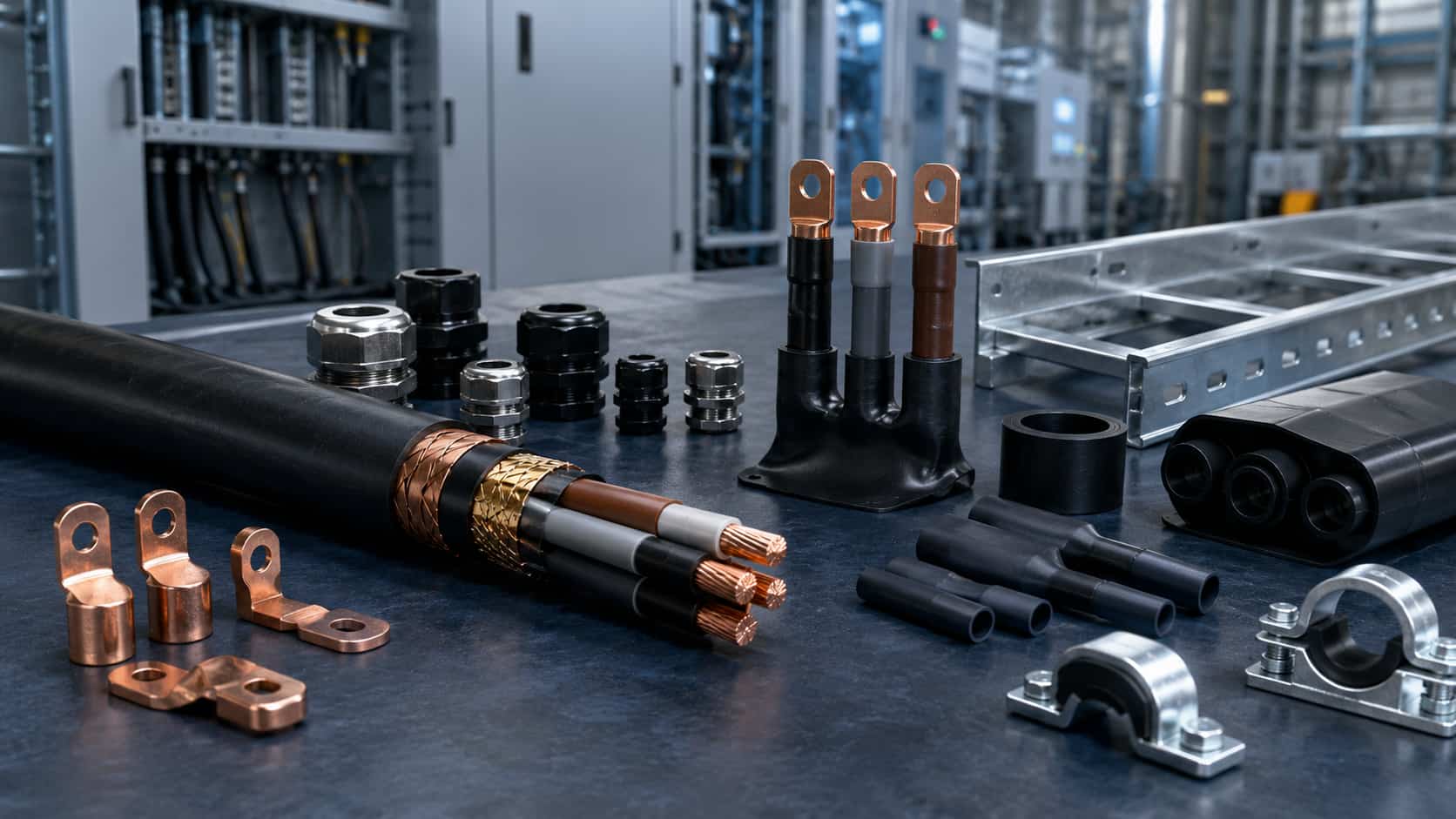
Cable lugs connect the conductor to equipment terminals, busbars, or other cable ends, and need to match the conductor material (copper or aluminum), the conductor cross-sectional area, and the current rating of the connection. Using a lug rated for a smaller conductor size than the actual cable, or mismatching lug and conductor material without proper bimetallic connectors, is a common cause of high-resistance connections that generate heat over time.
Cable joints
Joints connect two cable ends — straight joints for extending a run, branch joints for tapping off a main feeder. For medium voltage cable specifically, joints need to be rated for the same voltage class and insulation type as the cable itself, and are typically supplied as a complete kit engineered for that specific cable construction rather than assembled from generic parts. Getting the joint kit wrong for the cable type is one of the more expensive mistakes to discover mid-installation.
Cable glands
Glands seal and secure the cable where it enters equipment or an enclosure, providing both mechanical strain relief and environmental sealing. For armored cable specifically, the gland also needs to properly terminate and ground the armor layer — a detail covered in more depth in our armored vs unarmored cable guide. Using a standard gland designed for unarmored cable on an armored cable run means the armor isn’t properly grounded, undermining the safety benefit the armor was specified for in the first place.
Cable trays and ladders
Trays and ladders support and route cable through a facility, and need to be sized for both the current cable load and reasonable future capacity — undersizing a tray early in a project is a common cause of expensive rework later. Material and coating (galvanized steel, stainless steel, or fiberglass depending on the environment) should match the installation’s exposure conditions, particularly for outdoor or corrosive environments.
Cable ties, cleats and supports
Smaller but still important: cable cleats and supports need to be rated for the cable’s weight and, for higher current installations, for the mechanical forces generated during a short-circuit event. Standard plastic cable ties are not a substitute for properly rated cleats on power cable installations, particularly at medium voltage.
A simple accessories checklist by project type
Confirm lug material and size match the actual conductor; confirm joint kits are matched to cable type and voltage class, not generic; confirm glands are rated correctly for armored vs unarmored cable and the installation’s ingress protection requirements; size trays and ladders with reasonable margin for future capacity; and verify accessory certifications match the same standard family your cable is certified to, following the same verification approach in our cable certifications checklist.
Where Kexingyu Power fits in
We supply cable accessories — terminations, joints, glands, and tray systems — matched to the cable we manufacture, so accessory compatibility isn’t left to be sorted out on-site. Browse the full range on our Cables & Wiring Systems page.
Cable Accessories
Common questions from installers, engineers and project buyers specifying cable terminations, joints, glands, trays and support systems.
01 Can I use a generic cable joint kit instead of a matched kit?
This is not recommended, especially for medium-voltage cable. Joint kits are selected according to the cable voltage class, conductor size, insulation diameter, screen construction and outer sheath. A mismatched kit may create poor stress control, inadequate sealing or incorrect component fit, increasing the risk of partial discharge, moisture ingress and premature joint failure.
02 Does gland type matter when the cable is not armored?
Yes. Even for unarmored cable, the gland must provide the required sealing, ingress protection, strain relief and environmental resistance. Armored cable requires a gland specifically designed to grip and electrically bond the armor layer. Using an unarmored-cable gland on armored cable may leave the armor improperly terminated and compromise the installation's mechanical and earthing arrangement.
03 Should cable tray be sized only for the current cable load?
No. Cable tray selection should account for the present cable load, allowable tray fill, cable spacing, heat dissipation, support span, weight and reasonable future expansion. Providing additional capacity during the initial installation is usually more economical than replacing trays or adding parallel support systems when new circuits are installed later.
04 Are plastic cable ties acceptable for power cable installations?
Plastic cable ties may be suitable for light-duty organization or temporary positioning when permitted by the installation standard, but they are not a substitute for properly rated cable cleats or supports. Power cables, particularly medium-voltage and high-current circuits, may generate significant electromechanical forces during a short circuit. The support system must be selected to withstand those forces and the expected environmental conditions.
Recent Posts

Voltage Stabilizers vs UPS: Do You Need Both?
Voltage Stabilizers vs UPS: Do You Need Both? One device fixes how high or low the voltage is; the other fixes whether there is voltage

Energy Storage for Data Centers: A Growing Backup Power Option
Energy Storage for Data Centers: A Growing Backup Power Option Batteries have always backed up data centers in the form of UPS strings. Grid-scale BESS
Thermal Runaway in Lithium Batteries: What BESS Buyers Should Understand
Thermal Runaway in Lithium Batteries: What BESS Buyers Should Understand How thermal runaway starts, how it propagates, and which evidence buyers should require before approving