
IEC 62271 Switchgear Standard Explained
IEC 62271 isn't a single document — it's a family of standards, and knowing which part applies to your equipment matters more than citing the number alone.
Introduction
“IEC 62271 compliant” shows up on switchgear datasheets constantly, often without specifying which part of the standard is actually being referenced. That distinction matters — IEC 62271 is a large family of standards covering different equipment types and test requirements, not a single unified document, and a vague reference to it doesn’t tell you much on its own.
What IEC 62271 actually covers
IEC 62271 is the international standard series for high-voltage switchgear and controlgear, published in dozens of parts, each addressing a specific equipment category or test requirement. It ranges from general common specifications that apply across the whole family, through equipment-specific parts covering circuit breakers, disconnectors, and complete switchgear assemblies.
Key parts relevant to buyers
A few parts come up most often in switchgear specifications: IEC 62271-1 covers common specifications that apply across the broader IEC 62271 family; IEC 62271-100 covers high-voltage alternating-current circuit breakers specifically; IEC 62271-200 covers metal-enclosed switchgear for rated voltages above 1kV up to 52kV, and is the specific part that defines the metal-clad classification discussed in our metal-clad vs metal-enclosed guide; and IEC 62271-102 covers disconnectors and earthing switches. Knowing which part is relevant to the specific equipment you’re buying is what makes a compliance claim actually meaningful.
What testing under IEC 62271 actually verifies
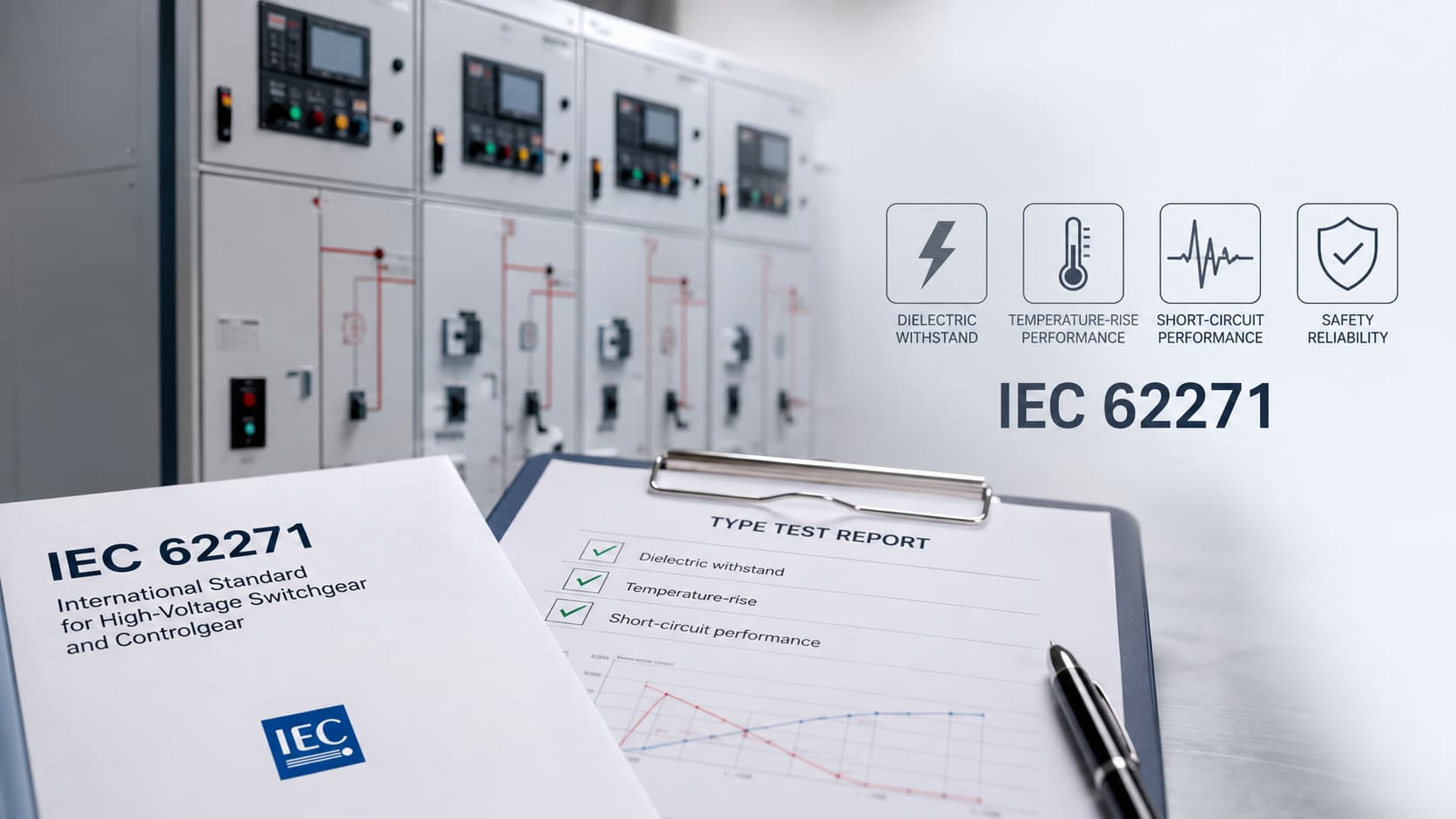
Type testing under the relevant IEC 62271 part typically verifies dielectric withstand (the equipment’s ability to withstand overvoltage without breakdown), temperature-rise performance (confirming the equipment doesn’t overheat under rated current), and short-circuit performance (confirming the equipment can safely interrupt or withstand fault current at its rated level). These are the core safety-critical properties the standard is designed to confirm.
Common misconceptions
A general statement of “IEC 62271 compliance” without a specific part number is not sufficient documentation — ask specifically which part(s) apply and request the corresponding type test report. It’s also worth noting that IEC 62271 compliance and metal-clad classification are related but not identical concepts — see our switchgear basics and metal-clad comparison guides for how these concepts fit together.
What to ask a supplier for
Request the specific IEC 62271 part number relevant to your equipment type, the type test report from an accredited testing lab referencing that specific part, and confirmation that your specific voltage and current rating falls within the tested range covered by that report — a type test conducted at a different rating than what you’re ordering doesn’t automatically cover your specific equipment.
Where Kexingyu Power fits in
Our switchgear is type-tested to the relevant parts of IEC 62271, with test reports available for review before you order. Browse the full range on our Switchgear & Distribution page.
IEC 62271 Standard
Common questions from engineers and project buyers verifying switchgear compliance, type-test reports and equipment classifications against the IEC 62271 family.
01 Is IEC 62271-200 compliance the same as being “metal-clad certified”?
No. IEC 62271-200 applies to prefabricated AC metal-enclosed switchgear and controlgear rated above 1kV and up to 52kV. It uses classifications such as loss of service continuity, partition class and internal arc classification. “Metal-clad” is primarily an IEEE classification defined by IEEE C37.20.2, so buyers should confirm which standard and construction requirements the project actually specifies.
02 Does the IEC 62271 series apply to low-voltage switchgear?
Generally no. The IEC 62271 family applies to high-voltage switchgear and controlgear with rated voltages above 1,000V. Low-voltage switchgear and controlgear assemblies are generally designed and verified under the IEC 61439 series. The correct standard part should be identified according to the equipment type, voltage rating and application.
03 Can one switchgear type-test report cover multiple voltage and current ratings?
Not automatically. Buyers should confirm the exact rated voltage, continuous current, short-circuit rating, construction and functional units covered by the report. Extension of type-test validity to related designs or ratings must follow recognized technical rules, such as the guidance in IEC TR 62271-307, rather than being assumed from one tested configuration.
04 Who can perform or issue IEC 62271 type-test reports?
IEC 62271 defines the applicable test requirements and acceptance criteria, but buyers should still verify who performed, witnessed and issued the report. For projects requiring independent evidence, request a report from a recognized accredited laboratory or certification body and confirm its accreditation scope, report number, tested assembly, ratings and manufacturer details. A manufacturer declaration alone should not be treated as equivalent to an independently verified type-test report.
Recent Posts
Voltage Stabilizers vs UPS: Do You Need Both?
Voltage Stabilizers vs UPS: Do You Need Both? One device fixes how high or low the voltage is; the other fixes whether there is voltage
Energy Storage for Data Centers: A Growing Backup Power Option
Energy Storage for Data Centers: A Growing Backup Power Option Batteries have always backed up data centers in the form of UPS strings. Grid-scale BESS
Thermal Runaway in Lithium Batteries: What BESS Buyers Should Understand
Thermal Runaway in Lithium Batteries: What BESS Buyers Should Understand How thermal runaway starts, how it propagates, and which evidence buyers should require before approving