
Ring Main Unit (RMU) vs Traditional Switchgear: When to Use Each
RMUs and metal-clad switchgear both distribute and protect medium voltage circuits — but they're built for different network layouts and site constraints.
Introduction
Ring Main Units and traditional metal-clad switchgear both perform the same fundamental job — controlling and protecting medium voltage circuits — but they’re built around different assumptions about network layout, space, and access. If you’re not sure which one fits your project, this comes down mostly to network topology and site constraints rather than a simple better-or-worse comparison. For background on switchgear fundamentals generally, see our switchgear basics guide.
What a Ring Main Unit actually is
An RMU is a compact, typically sealed switchgear unit designed specifically for ring-topology distribution networks — where power can flow to a load point from two directions around a loop, providing built-in redundancy if one section of the ring is out of service. RMUs usually combine two ring switches plus a transformer feeder switch or fused unit in a single compact enclosure, often gas-insulated for a smaller footprint.
What "traditional switchgear" means in this comparison
For this comparison, traditional switchgear refers to modular, panel-based metal-clad or metal-enclosed switchgear — the kind covered in our metal-clad vs metal-enclosed guide — assembled from multiple individual feeder panels rather than a single compact sealed unit.
Key differences
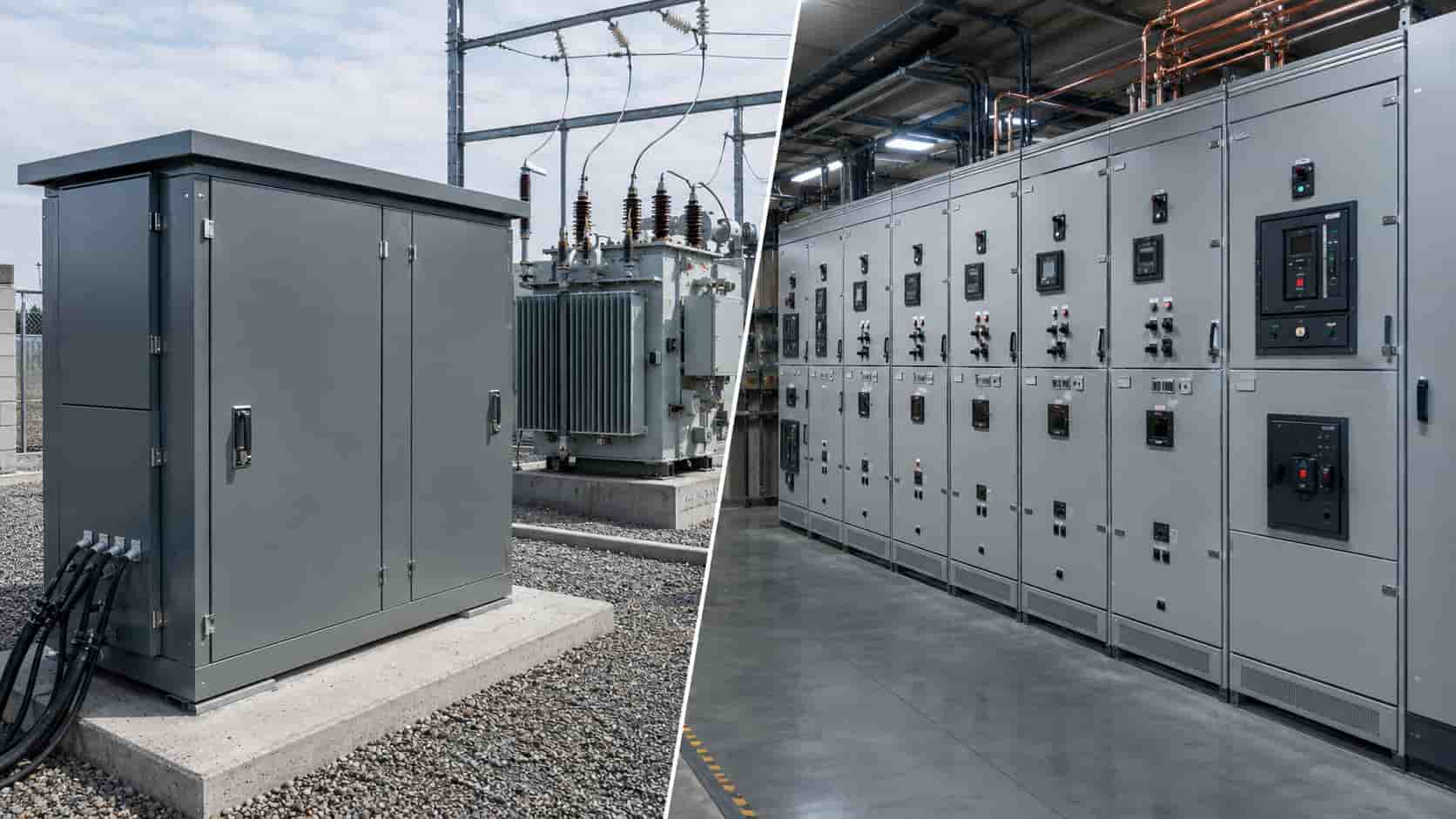
RMUs are compact and often sealed for outdoor or space-constrained installation, with a fixed, factory-configured number of ways (typically 2-4 switch positions). Traditional panel-based switchgear is modular and scalable — additional feeder panels can be added to expand the number of circuits — but requires significantly more installation space and is generally installed indoors in a dedicated switchroom.
Where RMUs are typically used
RMUs are the standard choice for urban and suburban ring-topology distribution networks, compact substations feeding a small number of transformers, and any site where installation space is limited — including outdoor kiosk-style installations. Utility distribution networks in dense urban areas rely heavily on RMUs specifically because of their compact footprint and sealed, low-maintenance design.
Where traditional switchgear makes more sense
Traditional panel-based switchgear fits better where a facility needs more than a handful of circuits, where future expansion is likely and modular panel addition is valuable, or where a facility has an indoor switchroom and doesn’t face the same space constraints that make an RMU’s compact design attractive. Larger industrial facilities, data centers, and substations feeding multiple transformers typically use traditional switchgear rather than RMUs for this reason.
Gas-insulated vs air-insulated RMU considerations
Many modern RMUs use SF6 or alternative insulating gas to achieve their compact size, though air-insulated designs also exist. Gas-insulated units generally offer a smaller footprint and lower maintenance requirements, but environmental regulations around SF6 specifically are tightening in some regions, making it worth confirming which insulation medium your project’s environmental requirements or local regulations call for.
Where Kexingyu Power fits in
We manufacture both compact ring main units and modular metal-clad switchgear, so the equipment can be matched to your network topology rather than defaulting to whichever type happens to be in stock. Browse the full range on our Switchgear & Distribution page.
RMU vs Traditional Switchgear
Common questions from engineers and project buyers deciding between a compact ring main unit and conventional panel-based medium-voltage switchgear.
01 Can an RMU be expanded later if I need more circuits?
It depends on the RMU design. Many compact RMUs are supplied as fixed, non-extensible assemblies with a predetermined number of functional units, while modular or extensible RMUs can allow additional sections to be connected later. If significant future expansion is expected, specify an extensible RMU system from the beginning or consider modular panel-based switchgear with greater long-term configuration flexibility.
02 Are RMUs suitable for indoor installation?
Yes. RMUs are widely used in indoor substations, electrical rooms, commercial buildings and compact distribution stations. Outdoor versions are also available when the enclosure and environmental ratings are suitable. Their relatively small footprint and sealed primary components make RMUs particularly useful where installation space, maintenance access or environmental exposure must be carefully controlled.
03 Is SF6 gas-insulated RMU technology being phased out?
Restrictions on SF6 equipment are becoming stricter in some markets because SF6 has a very high global-warming potential. As a result, manufacturers increasingly offer alternative-gas, solid-insulated and air-insulated RMU technologies. Requirements are not identical worldwide, so buyers should confirm the current environmental and equipment regulations in the project's destination country before specifying an SF6-based RMU.
04 Does a ring distribution network always require an RMU?
No. A ring distribution network can be implemented using other suitable medium-voltage switching arrangements. However, RMUs are specifically optimized for ring networks because they combine ring switching, isolation and transformer or feeder protection in a compact assembly. This makes them a common choice for urban distribution systems, commercial developments and compact secondary substations.
Recent Posts
Energy Storage for Data Centers: A Growing Backup Power Option
Energy Storage for Data Centers: A Growing Backup Power Option Batteries have always backed up data centers in the form of UPS strings. Grid-scale BESS
Thermal Runaway in Lithium Batteries: What BESS Buyers Should Understand
Thermal Runaway in Lithium Batteries: What BESS Buyers Should Understand How thermal runaway starts, how it propagates, and which evidence buyers should require before approving

What Cables Does a Data Center Need? The Complete Cable List
What Cables Does a Data Center Need? The Complete Cable List Quick Answer: A data center needs eight cable families — medium voltage feeders, low