
Switchgear Manufacturer China: What to Verify Before You Order
Switchgear carries a higher stakes verification checklist than most equipment categories — here's what to confirm before you commit to an order.
Introduction
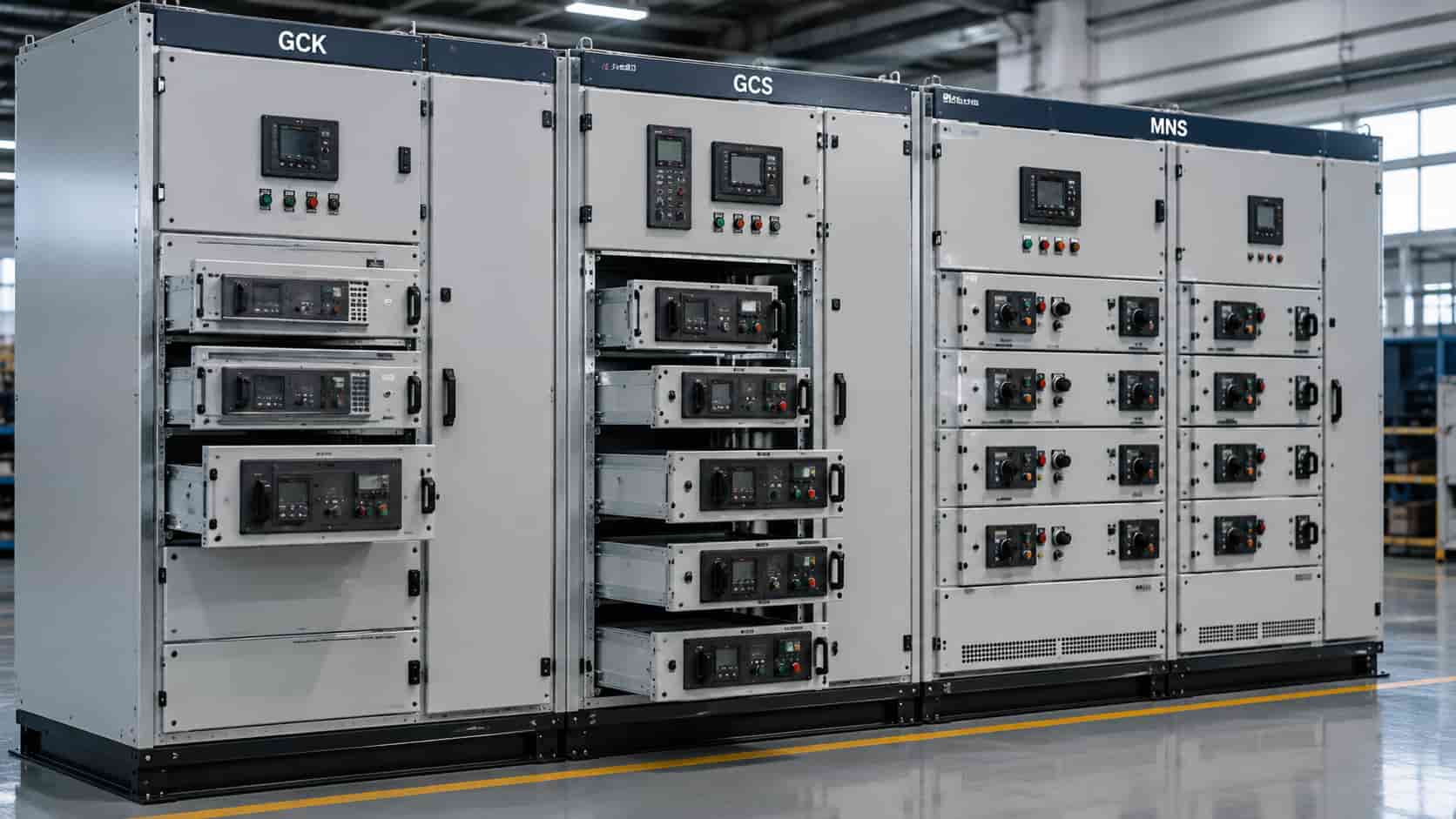
GCK, GCS, and MNS are three of the most frequently specified low voltage withdrawable switchgear designations on projects sourcing equipment from China, and buyers new to the market often assume they’re roughly interchangeable. They share the same fundamental purpose — withdrawable functional units for low voltage distribution, covered generally in our switchgear basics guide — but differ in structural design and module standardization in ways worth understanding before you specify one over another.
What these three types have in common
All three are low voltage (typically up to 1kV) withdrawable-type switchgear, meaning individual functional units — breakers, contactors, or feeder modules — can be racked out for maintenance without de-energizing the entire assembly. All three are widely manufactured in China and commonly specified on industrial and commercial projects sourcing equipment from Chinese suppliers.
GCK switchgear
GCK is a drawer-type (cassette-style) withdrawable switchgear design, generally recognized for a relatively compact structure compared to some alternatives. Functional units are housed in individual drawer modules that can be withdrawn horizontally, and the design is commonly used across general industrial and commercial low voltage distribution applications.
GCS switchgear
GCS is one of the most widely produced and specified low voltage switchgear types in the Chinese market, using a fixed structural frame with vertically mounted, withdrawable functional units and a horizontal busbar arrangement typically at the rear of the assembly. Its widespread adoption means strong parts availability and manufacturing familiarity across many suppliers, which is part of why it remains a common default specification.
MNS switchgear
MNS traces its design lineage to an internationally established modular low voltage switchgear system, and Chinese-manufactured MNS-type switchgear generally follows a highly standardized modular sizing approach for functional units. This standardization can simplify future expansion and component replacement, provided the specific manufacturer’s module dimensions and interfaces are confirmed to match what your project may need to source later.
Key differences to weigh
The practical differences center on module standardization (MNS generally offers the most standardized module sizing), structural compactness (GCK is often the more compact option), and manufacturing familiarity in your target market (GCS has particularly wide production and service familiarity in China). None of the three is universally “better” — the right choice depends on your project’s expansion plans, available installation space, and which type your maintenance team or local market is most familiar servicing.
How to decide which fits your project
As with any switchgear selection, start from the framework in our switchgear selection guide — voltage, current rating, and maintenance philosophy — and then narrow between GCK, GCS, and MNS based on future expansion needs, available panel space, and which type your local electrical contractors and maintenance team have the most experience servicing, since familiarity affects long-term maintenance cost and speed as much as the equipment itself.
Where Kexingyu Power fits in
We manufacture GCK, GCS, and MNS-type low voltage switchgear, and can help match the right structural type to your project’s specific requirements. Browse the full range on our Switchgear & Distribution page.
GCK, GCS & MNS Switchgear
Common questions from engineers and project buyers comparing GCK, GCS and MNS low-voltage withdrawable switchgear systems for industrial and commercial power distribution.
01 Are GCK, GCS and MNS switchgear interchangeable?
Not directly. Although all three can perform similar low-voltage distribution and motor-control functions, their cabinet structures, drawer systems, module dimensions, busbar arrangements and mechanical interfaces can differ. Replacement drawers, internal components and future extension panels should therefore be matched to the specific switchgear system and manufacturer's approved design rather than assumed to be interchangeable.
02 Which type is most widely available from Chinese switchgear manufacturers?
GCK, GCS and MNS-type systems are all widely available from Chinese manufacturers, but availability varies by factory, project sector and required configuration. Rather than selecting a system only because it is common in the market, buyers should confirm the manufacturer's production experience, spare-parts support, tested ratings and ability to supply compatible replacement modules over the expected service life.
03 Does module standardization matter if I do not plan to expand the system?
It matters less when the installation is expected to remain fixed, but standardization can still simplify maintenance and replacement of feeders, drawers and internal components. Its value becomes greater when future capacity expansion, rapid module replacement or minimizing shutdown time is important. Buyers should consider the complete maintenance strategy rather than only the initial number of outgoing circuits.
04 Should I choose between GCK, GCS and MNS based on price alone?
No. Initial price should be considered together with rated current, short-circuit performance, form of separation, drawer configuration, maintenance access, component brands, spare-parts availability and the experience of the local maintenance team. For long-service-life equipment, compatibility and support over the next several years may be more important than a relatively small difference in initial purchase price.
Recent Posts

Energy Storage for Data Centers: A Growing Backup Power Option
Energy Storage for Data Centers: A Growing Backup Power Option Batteries have always backed up data centers in the form of UPS strings. Grid-scale BESS
Thermal Runaway in Lithium Batteries: What BESS Buyers Should Understand
Thermal Runaway in Lithium Batteries: What BESS Buyers Should Understand How thermal runaway starts, how it propagates, and which evidence buyers should require before approving

What Cables Does a Data Center Need? The Complete Cable List
What Cables Does a Data Center Need? The Complete Cable List Quick Answer: A data center needs eight cable families — medium voltage feeders, low