
Commercial vs Utility-Scale Energy Storage: Key Differences
The batteries may look similar, but the interconnection point, operating objective, project scope and procurement risk are fundamentally different.
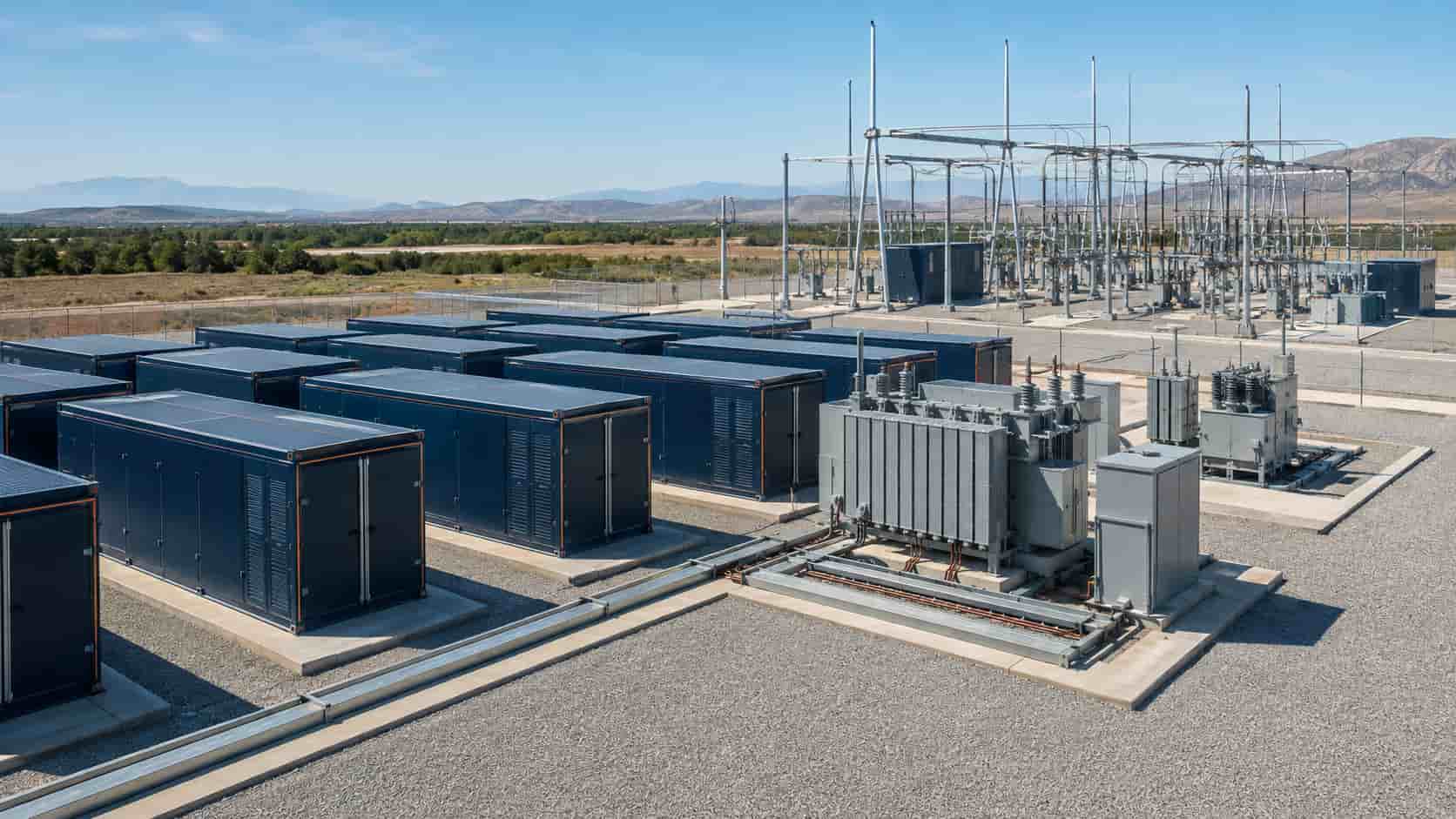
Commercial and utility-scale battery energy storage systems (BESS) can use the same core technologies—lithium-ion battery racks, a power conversion system (PCS), battery management system (BMS), energy management system (EMS), thermal management and fire protection. The distinction is not simply cabinet versus container, or small versus large. It is mainly about where the system connects, whose load or grid need it serves, how it earns value and who controls its operation.
For procurement teams, this classification affects the electrical design, permitting path, control interfaces, contractual guarantees, testing plan and supplier scope. A large behind-the-meter system at an industrial campus can still be a commercial and industrial (C&I) project, while a smaller front-of-meter system can be treated as a utility asset.
Commercial and Industrial Energy Storage
C&I storage is normally installed behind a customer meter and optimized around a facility or campus. Common objectives include demand-charge reduction, time-of-use energy shifting, solar self-consumption, resilience, power-quality support and participation in demand-response or distributed-energy programs where local rules allow.
Systems range from compact outdoor cabinets to multi-megawatt containerized plants. Capacity alone is therefore a poor classifier. The defining questions are whether the system is tied to a host load, who controls dispatch and whether the business case is based primarily on the customer tariff and avoided site costs.
Typical equipment and project scope
- Integrated battery cabinets or containers with battery racks, BMS, HVAC and fire protection
- Bidirectional PCS, often connected at low voltage or through a dedicated step-up transformer
- Site EMS integrated with the facility meter, solar inverter, generator, building management system or microgrid controller
- Protection, switchgear, metering and communications designed around the existing facility electrical system
- Civil works, permitting, commissioning and utility approval coordinated with the host site
Utility-Scale Energy Storage
Utility-scale storage is generally front of the meter and developed as a grid-connected generating and load resource. It may provide energy arbitrage, renewable firming, frequency response, reserve, capacity, congestion relief or transmission and distribution support, depending on the market and grid operator.
These projects commonly use many containerized battery blocks, PCS units, medium-voltage transformers, a collection network, plant controller, substation and high-voltage grid connection. The battery containers are only one package within a much larger balance-of-plant scope.
Typical equipment and project scope
- Modular battery enclosures arranged in blocks to meet the required MW and MWh
- Central or string PCS architecture with medium-voltage transformer stations
- Plant power controller, SCADA, revenue metering, telecommunications and grid-operator interfaces
- Substation, protection and control, harmonic studies, grounding and grid-code compliance
- Long-duration development work covering land, environmental review, interconnection studies, permits, financing, construction and acceptance testing
Commercial vs Utility-Scale BESS: Procurement Comparison
The following table is a practical classification guide, not a universal regulatory definition. Local utilities, market operators and authorities having jurisdiction may apply different thresholds and terminology.
| Procurement factor | Commercial & industrial BESS | Utility-scale BESS |
|---|---|---|
| Primary classification | Usually behind the customer meter and tied to a facility or campus load | Usually front of the meter and operated as a grid or market resource |
| Typical objectives | Demand management, tariff arbitrage, solar self-consumption, resilience and microgrid support | Energy shifting, ancillary services, capacity, renewable firming and grid support |
| Physical format | Cabinets or containers; architecture depends on site size and constraints | Multiple containerized blocks plus PCS, MV collection, SCADA and substation equipment |
| Connection | Existing LV or MV facility bus, subject to the serving utility's approval | Dedicated distribution, substation or transmission interconnection |
| Control priority | Site load, tariff, solar production and backup reserve | Market schedule, plant controller and grid-operator commands |
| Commercial model | Direct purchase, lease, energy-as-a-service or shared-savings structure | Utility ownership, merchant project, tolling agreement, capacity contract or other market-specific structure |
| Development focus | Site survey, utility approval, permits, electrical integration and operating savings | Land, interconnection studies, permits, offtake, financing, substation and market qualification |
| Key RFQ risk | Using nameplate capacity without a validated load profile and tariff model | Buying battery containers before grid studies and balance-of-plant responsibilities are defined |
The Technical Differences That Matter Most
1. Power, energy and duration
Specify both power (MW) and usable energy (MWh) at the contractual point of measurement. A 10 MW/20 MWh system is nominally a two-hour system, but deliverable duration depends on the guaranteed state-of-charge window, auxiliary loads, temperature, degradation, conversion losses and end-of-life condition. Buyers should not compare quotations using nameplate cell energy alone.
2. Interconnection and voltage level
A C&I system may connect to an existing low- or medium-voltage bus behind the meter. A utility project typically requires a dedicated medium- or high-voltage interconnection, formal system-impact studies and utility-grade protection, controls and telemetry. The interconnection point should be fixed early because it determines transformer ratios, fault duties, metering, protection and responsibility boundaries.
3. Controls and dispatch
C&I control logic is often tariff- and load-driven: cap site demand, charge from surplus solar or maintain a backup reserve. Utility-scale dispatch may follow a market schedule, automatic generation control, grid-operator commands or a renewable plant controller. Define response time, ramp rate, active and reactive power capability, communications protocol, cybersecurity responsibilities and loss-of-communications behavior.
4. Safety, codes and permitting
Both categories require a site-specific hazard assessment and compliance with the codes adopted in the destination market. Requirements can cover product certification, fire propagation testing, separation distances, ventilation, gas detection, emergency shutdown, firefighting strategy and responder access. Do not assume a certificate for an individual battery module certifies the complete installed system.
5. Guarantees and operating profile
A meaningful proposal should state usable energy, net power, round-trip efficiency, auxiliary consumption, availability, capacity retention and permitted operating conditions at clearly defined measurement points. The warranty must also match the expected duty cycle: cycles per day, depth of discharge, temperature, C-rate, state-of-charge limits and calendar life.
What Buyers Should Include in an RFQ
A supplier cannot produce a technically comparable offer from a capacity target alone. Include the following information in the request for quotation:
- Required net power, usable energy and discharge duration at beginning and end of life
- Operating use cases and expected dispatch profile, including cycles per day
- Grid frequency, connection voltage, single-line diagram, fault level and earthing arrangement
- Ambient temperature, altitude, humidity, corrosion category and seismic or wind requirements
- Applicable grid code, product standards, fire code and authority requirements
- Required PCS functions, EMS/SCADA interfaces and communications protocols
- Battery chemistry preference and restrictions on cell, module or PCS suppliers
- Scope split for transformers, switchgear, cables, civil works, installation and commissioning
- Required FAT, site acceptance tests, performance tests and documentation
- Warranty term, performance-liquidated-damages expectations and long-term service scope
How to Classify Your Project
Start with the point of interconnection and commercial objective. If the system primarily serves a named facility behind its meter, it is usually a C&I project. If it connects as a standalone grid resource and is dispatched for utility or wholesale-market services, it is usually utility-scale.
Hybrid cases need closer review. A large industrial microgrid can include utility-style medium-voltage equipment while remaining behind the meter. A distribution-connected community battery may be relatively small but operate as a utility asset. Classify the project before selecting the product architecture—not after receiving a cabinet or container quotation.
Where KEXINGYU E-POWER GROUP Fits In
KEXINGYU E-POWER GROUP supplies integrated C&I cabinet systems and containerized BESS packages, together with PCS, switchgear, transformers and related balance-of-system equipment. Buyers can review our Energy Storage Systems (https://kxy-group.com/energy-storage-systems/) range and our published guide to BESS fundamentals (https://kxy-group.com/what-is-bess-guide/) before submitting project data for technical selection.
For either category, final equipment selection should follow a review of the single-line diagram, load or dispatch profile, local interconnection rules, environmental conditions and required guarantees.
Commercial vs Utility-Scale BESS FAQs
Practical answers for buyers defining project scope, performance and interconnection requirements.
No universal capacity threshold applies in every market. Classification depends more reliably on the point of interconnection, meter position, host load, ownership, dispatch authority and regulatory treatment. A large industrial system can remain behind the meter, while a smaller distribution-connected system can be a utility asset.
Yes. Cabinets are common for smaller installations, but large factories, campuses and microgrids may use one or more containers. The enclosure format should follow capacity, transport, access, fire separation, maintenance and expansion requirements rather than the commercial label alone.
Provide net MW, usable MWh, operating use case, load or dispatch profile, connection voltage, single-line diagram, environmental conditions, applicable standards, required interfaces and the intended project scope. These inputs are more useful than a nameplate capacity target by itself.
Nameplate energy does not account for the permitted state-of-charge window, auxiliary loads, conversion losses, temperature effects or degradation. A contract should define usable energy and net output at a stated measurement point and operating condition, at both beginning and end of the agreed warranty period.
Not automatically. Some offers cover only battery and PCS blocks, while others include medium-voltage stations, collection switchgear, SCADA, substation equipment, civil works or commissioning. The RFQ should define battery limits, responsibility interfaces, exclusions and performance measurement points.
Recent Posts
Energy Storage for Data Centers: A Growing Backup Power Option
Energy Storage for Data Centers: A Growing Backup Power Option Batteries have always backed up data centers in the form of UPS strings. Grid-scale BESS
Thermal Runaway in Lithium Batteries: What BESS Buyers Should Understand
Thermal Runaway in Lithium Batteries: What BESS Buyers Should Understand How thermal runaway starts, how it propagates, and which evidence buyers should require before approving
Switchgear Lead Times in 2026: A Buyer’s Planning Guide
Switchgear Lead Times in 2026: A Buyer’s Planning Guide Realistic timelines vary significantly by voltage class and type — here’s how to plan procurement without