
Oil-Immersed vs Dry-Type Transformer: Which One Fits Your Project?
The right transformer depends on installation location, fire strategy, load profile, environmental exposure, maintenance resources and total lifecycle cost—not one universal rule.
Introduction
Oil-immersed and dry-type transformers perform the same fundamental job, but they manage insulation and heat differently. That construction choice changes installation requirements, fire and environmental planning, maintenance, footprint and lifecycle cost.
There is no universally superior type. The correct decision starts with the electrical duty and then tests both options against the site, load profile, authority requirements and operating resources.
How the Two Transformer Types Differ
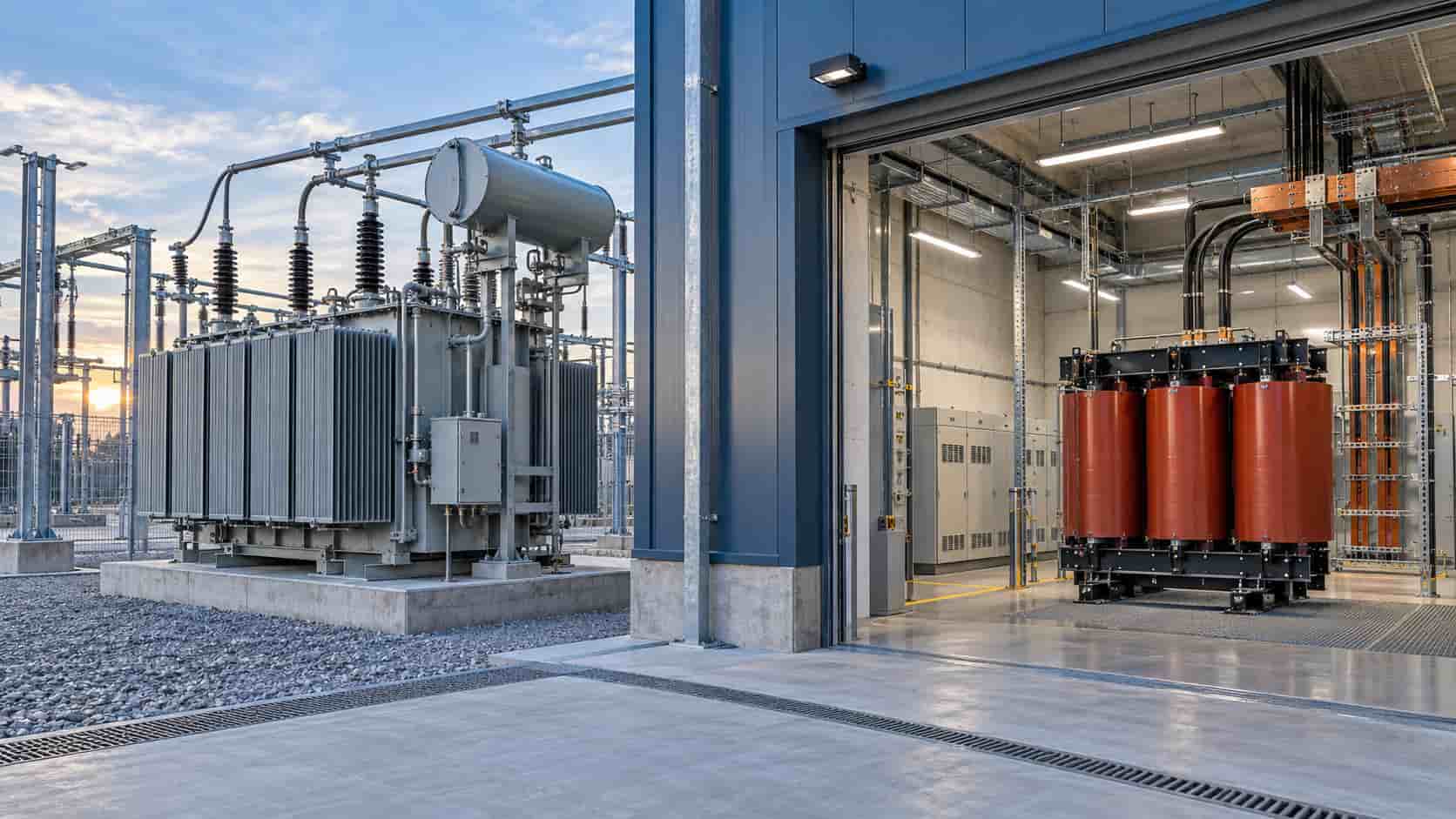
In a liquid-immersed transformer, the core and windings are immersed in an insulating liquid that transfers heat to the tank, radiators or other cooling equipment. Mineral oil is common, while alternative liquids may be specified for particular fire or environmental objectives. The exact liquid properties and approvals must be documented.
A dry-type transformer does not use insulating liquid for cooling. Ventilated, vacuum-pressure-impregnated and cast-resin designs are not identical. Cast-resin windings provide a solid insulation system, while cooling remains dependent on air movement and the declared thermal design.
The IEC 60076 family treats general transformer requirements, liquid-immersed temperature rise and dry-type transformers in dedicated parts. Procurement specifications should identify the applicable edition and project standard rather than writing only “IEC transformer.”
Installation Location and Fire Strategy
Dry-type equipment is frequently considered for indoor commercial buildings, industrial plants and data centers because there is no cooling liquid to leak. It may also allow placement closer to the load, reducing secondary cable length. However, it still needs adequate ventilation, working clearances, fire and smoke assessment, and protection from dust, moisture and corrosive contamination.
Oil-immersed units are widely used outdoors and in substations. Indoor installation may be possible when the approved design provides appropriate fire separation, liquid containment, drainage, detection, ventilation and access. Requirements vary by jurisdiction, liquid type, rating and building use.
Neither “oil-filled is dangerous” nor “dry-type is fireproof” is an acceptable engineering conclusion. Ask the fire consultant and authority having jurisdiction to evaluate the actual equipment, insulation system and room.
Capacity, Loading and Thermal Performance
Rated kVA or MVA alone does not describe thermal performance. Ambient temperature, altitude, enclosure, ventilation, harmonic current, load cycle and cooling mode all affect temperature rise and usable loading capability.
Oil circulation can transfer heat effectively, while dry-type designs rely on natural or forced air. Fans may provide an additional rating on some dry-type units, but buyers should verify whether that rating is continuous, what happens after fan failure, and whether controls and spare fans are included.
Short-duration overload capability must come from the manufacturer’s approved loading guidance and thermal model. It should not be inferred from transformer category. Critical projects should define the normal, emergency and cyclic duty cases in the inquiry.
Efficiency and Lifecycle Cost
Both oil-immersed and dry-type distribution transformers can be designed to meet applicable efficiency rules. Efficiency is not a permanent single number: no-load loss is present whenever the transformer is energized, while load loss changes with current and temperature.
Compare guaranteed no-load loss, load loss at the specified reference temperature and any auxiliary fan or pump consumption. Then apply the project load profile and electricity cost. A lower purchase price can be offset by higher lifetime losses; a premium low-loss design may pay back at a continuously energized site.
For regulated markets, confirm that the proposed model falls within the relevant product scope and certification procedure. In the United States, for example, DOE rules distinguish liquid-immersed, low-voltage dry-type and medium-voltage dry-type distribution transformers.
| Decision factor | Oil-immersed transformer | Dry-type transformer | Buyer verification |
|---|---|---|---|
| Typical location | Common outdoors, in substations or dedicated rooms with liquid-containment and fire provisions. | Common indoors near load centers when the specified enclosure, ventilation and fire strategy permit. | Local code, room classification, clearances, access and environmental rating. |
| Cooling medium | Insulating liquid transfers heat from core and windings to the tank and cooling surfaces. | Air cools exposed or resin-encapsulated windings; forced-air options may increase rating. | Rated cooling class, ambient assumptions, altitude and fan redundancy. |
| Fire/environment | Requires evaluation of liquid type, fire point, leakage, bunding and spill response. | No cooling liquid to leak, but still requires fire, smoke, ventilation and insulation-system review. | Approved fire assessment—not a generic “fireproof” claim. |
| Efficiency and losses | Can be highly efficient; actual result depends on design, rating and load point. | Can also meet applicable efficiency requirements; losses must be compared at the real load profile. | Guaranteed no-load/load losses, test method and capitalization of losses. |
| Maintenance | May involve liquid level, sealing, sampling and dissolved-gas or moisture analysis where applicable. | Focuses on cleanliness, ventilation, temperature, connections and insulation condition. | Service interval, access, skills, spares and monitoring scope. |
| Noise and space | Tank, cooling surfaces and accessories affect footprint and acoustic behavior. | May be placed closer to loads, but needs airflow and can still produce significant hum. | Guaranteed sound level, measurement standard, dimensions and service clearances. |
| Best-fit question | Often favored for outdoor, higher-capacity or utility-style installations. | Often favored for indoor commercial, industrial and critical-facility applications. | Confirm using project-specific electrical, civil, fire and lifecycle analysis. |
Maintenance and Condition Monitoring
Oil-immersed maintenance can include checking seals, liquid level, breathers and cooling equipment. Depending on rating and criticality, liquid testing may assess moisture, dielectric strength and dissolved gases. A sealed distribution unit and a large conservator-type power transformer do not require the same program.
Dry-type maintenance focuses on cleanliness, airflow, enclosure condition, terminations, temperature and fans when fitted. Dust or blocked ventilation can raise winding temperature, while humidity or conductive contamination may reduce insulation reliability.
For both types, specify temperature sensors, alarms, monitoring interfaces, inspection access and spare-parts expectations. Thermal scanning and torque checks should follow approved procedures and outage rules.
Noise, Footprint and Building Integration
All transformers produce audible hum, and cooling equipment can add noise. Do not assume dry-type automatically means quiet. Request a guaranteed sound level and the applicable measurement method, then account for reflections, walls, ventilation openings and structural transmission at the site.
Indoor dry-type placement may reduce low-voltage cable length but consumes valuable floor area and requires air paths. An outdoor oil-immersed unit may free building space but adds civil works, security, cable routing, weather exposure and possibly containment. Compare the complete installed arrangement.
Which Type Fits Common Projects?
Oil-immersed transformers are often a strong candidate for outdoor substations, utility distribution, renewable interconnection and higher-capacity industrial projects where space, containment and maintenance provisions are available.
Dry-type transformers are often a strong candidate inside commercial buildings, factories, hospitals and data centers where proximity to the load and elimination of cooling-liquid leakage are important. Harsh, wet, dusty or corrosive locations require an enclosure and insulation system explicitly suited to them.
Transformer Procurement Checklist
Send suppliers the primary and secondary voltages, frequency, rated power, phases, vector group, impedance, tap range, grounding arrangement and insulation level. Add the real load profile, motor starting, harmonics, fault level and parallel-operation requirements.
State indoor or outdoor location, ambient range, altitude, humidity, pollution, seismic or wind conditions, enclosure/IP class, cooling method, sound limit, loss limits and required accessories. Provide the governing standards and local approval requirements.
Conclusion
Choose between oil-immersed and dry-type transformers by comparing the entire installed system. Fire strategy, liquid containment, ventilation, loading, losses, noise, environment, maintenance and lifecycle cost matter more than a generic preference.
A strong procurement specification makes both suppliers price the same duty and clearly exposes assumptions. That is the most reliable way to identify which transformer fits the project—and to avoid moving hidden costs from equipment purchase into civil works or long-term operation.
Frequently Asked Questions
Dry-type transformers are often selected indoors because they contain no cooling oil, but they are not automatically suitable for every room. Enclosure, ventilation, fire rating, smoke strategy, clearances and local code approval still apply.
No. Both categories can be designed to meet applicable efficiency requirements. Compare guaranteed no-load and load losses at the project’s expected load profile rather than relying on transformer type alone.
No. They still need inspection of ventilation paths, dust and contamination, terminations, temperature, fans where fitted, enclosure condition and insulation health.
It may be possible, but the design can require a dedicated room, fire separation, liquid containment, ventilation and other measures set by local regulations and the approved fire strategy.
Overload capability depends on the specific thermal design, insulation system, ambient conditions, starting temperature and cooling arrangement. Use the manufacturer’s loading guide and project study; do not assume one category always performs better.
Provide primary and secondary voltage, kVA/MVA, frequency, vector group, impedance, tap range, load profile, harmonics, installation location, ambient temperature, altitude, enclosure/IP requirement, standards, loss limits, sound limit and accessories.
Recent Posts
Energy Storage for Data Centers: A Growing Backup Power Option
Energy Storage for Data Centers: A Growing Backup Power Option Batteries have always backed up data centers in the form of UPS strings. Grid-scale BESS
Thermal Runaway in Lithium Batteries: What BESS Buyers Should Understand
Thermal Runaway in Lithium Batteries: What BESS Buyers Should Understand How thermal runaway starts, how it propagates, and which evidence buyers should require before approving
Switchgear Lead Times in 2026: A Buyer’s Planning Guide
Switchgear Lead Times in 2026: A Buyer’s Planning Guide Realistic timelines vary significantly by voltage class and type — here’s how to plan procurement without