
Mobile Substations: When Temporary Power Infrastructure Makes Sense
A practical guide to emergency restoration, planned outages, remote projects, moving loads, transport limits, site interfaces, testing, and procurement decisions
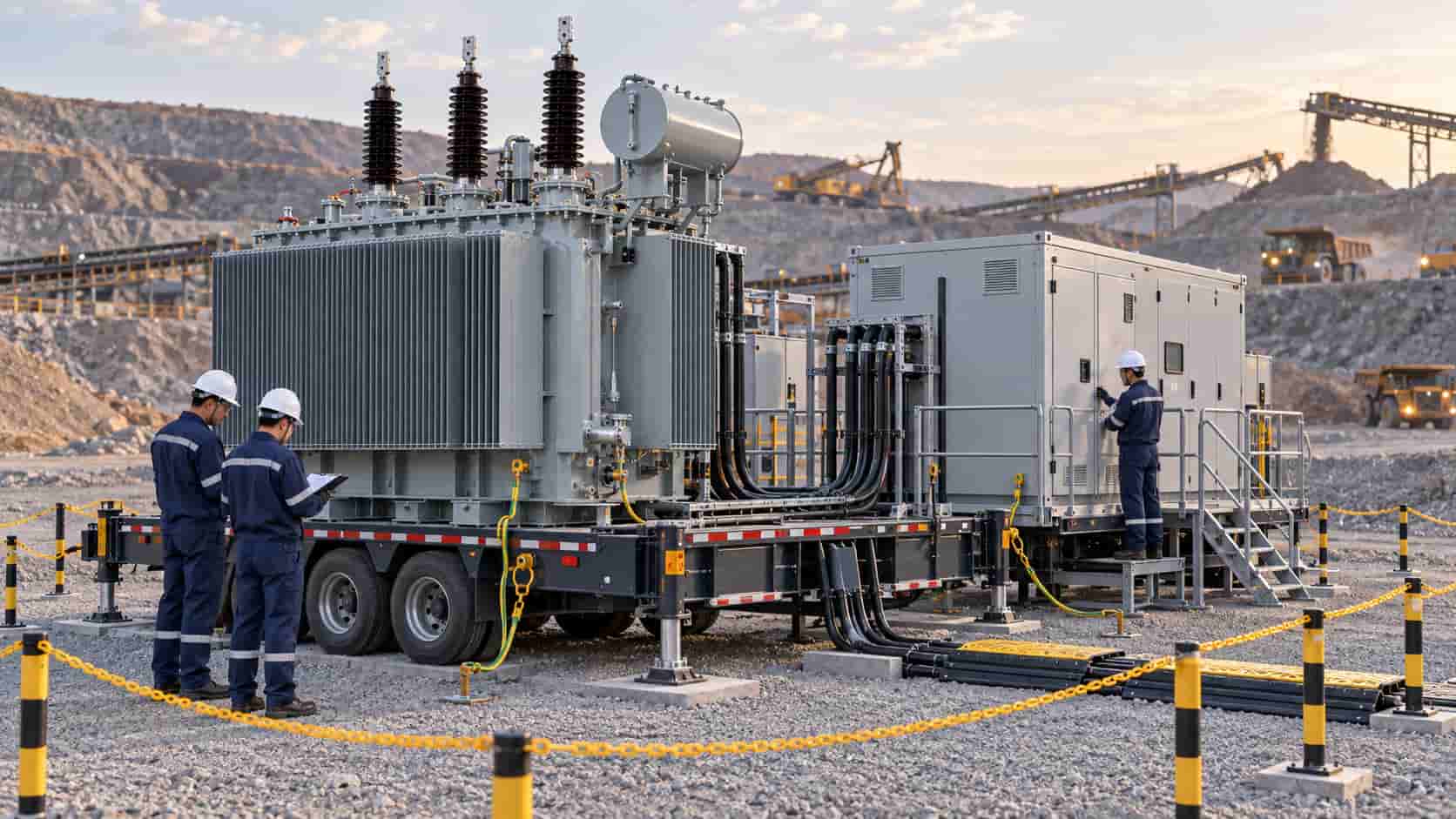
A mobile substation use case makes sense when a project needs a complete, temporary transformation and switching point faster or more flexibly than permanent civil and electrical infrastructure can be delivered. Typical reasons include emergency restoration, planned maintenance, mining loads that move, staged construction, delayed grid reinforcement and seasonal capacity. The decision should be based on system compatibility and total deployment risk—not on the assumption that any trailer can be connected quickly anywhere.
A properly engineered mobile substation can reduce field assembly because major equipment is integrated, wired and tested before shipment. It does not remove the need for network studies, protection coordination, grounding, transport planning, utility approval, site preparation or commissioning. Those interfaces determine whether the temporary solution actually shortens the outage.
What Counts as a Mobile Substation?
A mobile substation is a transportable assembly that performs specified substation functions. Hitachi Energy describes mobile substations as solutions for interim grid connections and temporary power, including emergency and planned outages, moving loads and distributed generation. The project scope may be mounted on trailers, semi-trailers, skids or containers and may require one or several transport units.
The term must be defined in the RFQ. A mobile transformer normally provides voltage transformation but may rely on existing switchgear, protection, control power and site connections. A complete mobile substation may include the transformer, high-voltage switching, medium-voltage switchgear, protection and control, metering, surge arresters, station-service supply, batteries and chargers, communication equipment, cables and accessories.
Transportable does not always mean road-mobile. Eaton’s modular integrated transportable substation can be assembled on a self-supporting transformer skid or trailer. A skid may be the better choice when the system moves only a few times, travels within a mine or plant, or must fit a modular construction strategy rather than public-road rules.
Mobile Substation Use Case 1: Emergency Restoration
A failed transformer, damaged switchyard, flood, fire or other contingency can leave a utility or industrial site without a usable transformation and protection point. A compatible mobile substation can bypass the damaged asset while investigation, repair or replacement proceeds.
This works best when contingency engineering was completed before the event. The owner should know candidate connection points, route and axle limits, required voltage ratios, fault levels, grounding, protection files, cable inventory, oil or spill controls and responsible crews. Without these preparations, the electrical and civil interfaces—not the mobile unit—can dominate restoration time.
Mobile Substation Use Case 2: Planned Maintenance and Retrofit
A mobile substation can maintain essential loads while permanent transformers, switchgear, protection or buswork are isolated for replacement or uprating. It can also create a safer work window by transferring load away from the equipment under construction.
The temporary arrangement needs its own approved single-line diagram, operating sequence, protection study, grounding plan and return-to-normal procedure. Temporary does not mean informal. Switching responsibilities, lockout/tagout boundaries, cable ratings and failure contingencies should be reviewed with the same discipline used for the permanent installation.
Mobile Substation Use Case 3: Remote Mining and Moving Loads
Mining loads can migrate as pits, dewatering systems, crushers and conveyors change location. A relocatable substation can shorten feeder lengths, reduce repeated permanent civil construction and move the supply point closer to the load.
The design should reflect how often it will move. Repeated relocation affects bushings, connectors, cable handling, oil systems, fasteners, vibration exposure and inspection frequency. Dust, altitude, temperature, corrosive atmosphere, poor roads and limited lifting resources must be stated. The lowest-cost stationary design is rarely the lowest-risk design for a unit expected to move many times.
Mobile Substation Use Case 4: Construction and Staged Energization
Large industrial, infrastructure and data projects may need construction power or early energization before the permanent substation is complete. A mobile unit can bridge the gap and later move to another project or become part of a resilience fleet.
Define the temporary load profile, motor starting, harmonics, future load steps and transfer milestones. If the requirement is only a small isolated low-voltage load, generator sets or a compact package substation may be simpler. A full mobile substation is justified when network connection, voltage transformation, switching and protection must be coordinated as one temporary system.
Mobile Substation Use Case 5: Grid Delay, Seasonal Capacity, and Renewable Connections
A transportable substation may bridge a delayed permanent grid connection, supply a predictable seasonal peak, or support phased commissioning of generation and storage. These uses are commercially attractive only when the temporary operating period, energy losses, maintenance, rental or ownership cost, demobilization and transition to the final network are considered together.
Generation connections add requirements for grid-code compliance, anti-islanding or transfer-trip functions, export/import metering, power quality, reactive power, communications and dispatch control. A temporary connection still requires approval from the relevant utility and authority.
Mobile Substation Use Case Decision Table
| Use Case | Why a Mobile Substation Can Fit | Conditions for Success | When to Consider an Alternative |
|---|---|---|---|
| Emergency asset failure | Restores a compatible transformation and switching point while the failed transformer or substation is repaired or replaced | Known connection points, fault duty, protection settings, grounding, access route and an emergency deployment plan | A spare transformer may be enough if existing switchgear, protection and auxiliaries remain serviceable |
| Planned maintenance or retrofit | Maintains supply while permanent equipment is isolated, replaced or uprated | Approved outage and transfer sequence, temporary protection study, cable interfaces and operating procedures | Temporary feeders or load transfer may cost less when only a small load block must remain online |
| Remote mining or moving load | Allows the supply point to follow mine development, crushing, pumping or dewatering loads | Roadworthy or relocatable design, frequent-move inspection plan, dust/altitude/temperature duty and flexible cable strategy | A skid or modular E-house may be better when moves are infrequent and road transport is not required |
| Construction and staged energization | Provides power before the permanent substation or final grid connection is complete | Defined temporary operating period, load-growth plan, utility approval, civil works and final removal plan | Generators or a smaller package substation may be more economical for low or isolated loads |
| Grid reinforcement delay | Bridges a schedule gap when permanent transformers, switchgear or civil works have long lead times | Temporary network study, acceptable losses, contract duration, maintenance access and transition plan | Accelerating a permanent modular substation can be better if temporary use will be long |
| Seasonal or event load | Adds transformation and switching capacity for a predictable temporary peak | Duty cycle, load profile, connection ownership, public safety, noise and security controls | Rental generation or demand management may be simpler for short low-voltage peaks |
| Renewable or distributed generation connection | Creates an interim grid interface during phased commissioning or network works | Grid-code study, export/import protection, metering, power-quality and communication requirements | A dedicated collector or compact substation is preferable when the connection will become permanent |
| Disaster recovery and resilience fleet | Provides a pre-engineered replacement resource across several compatible substations | Standardized interfaces, transport permits, storage maintenance, trained crews and periodic deployment exercises | A unit bought without interface standardization can become an expensive asset that fits few sites |
Use the table to screen whether mobility creates real value. The strongest cases combine a high cost of outage or delay with repeatable interfaces and a defined temporary period. The weakest cases use a complex mobile asset where a transformer spare, temporary feeder, generator, compact substation or accelerated permanent solution would meet the need more simply.
When a Mobile Substation Does Not Make Sense
Mobility is not automatically faster or cheaper. A mobile unit may be a poor fit when road or bridge limits prevent transport, the receiving site lacks clearance and load-bearing access, fault duty exceeds the equipment rating, voltage or grounding is incompatible, environmental conditions exceed the design, or utility approvals cannot be obtained within the required window.
It may also be uneconomic for long continuous service. Trailer geometry can constrain equipment layout and maintenance access; temporary cables and connections need protection; and a mobile design may carry unused flexibility. Compare the full cost of engineering, permits, transport, setup, losses, inspection, maintenance, security, demobilization and downtime—not only the equipment price.
Specify the Electrical Architecture Before Requesting a Price
Voltage, rating, and transformer duty
Provide source and load voltages, frequency, phase arrangement, maximum demand, load profile, future steps, motor starting, harmonics, overload expectations, cooling, tap range, vector group, impedance and loss requirements. Multi-ratio capability can improve fleet utilization but may add size, cost and operating complexity.
Insulation coordination and environment
Equipment withstand levels should come from the network and site study. IEC 60071-1 provides a procedure for selecting rated withstand voltages for systems above 1 kV. Altitude, pollution, humidity, temperature, lightning exposure and switching surges can change insulation, clearance and surge-protection requirements.
For enclosed equipment, specify the required degree of protection and service environment. IEC 60529 classifies enclosure protection using the IP Code, but an IP rating alone does not address condensation, cooling, corrosion, solar heat gain, internal arc behavior or maintainability.
Fault duty, switching, and protection
State the maximum and minimum short-circuit levels at each candidate site, X/R assumptions, clearing times and source configurations. Switchgear interrupting and short-time withstand ratings, transformer mechanical withstand, CT ratios, relay functions and settings must match the temporary network.
For applicable AC metal-enclosed switchgear above 1 kV and up to 52 kV, IEC 62271-200 addresses rated characteristics and assembly requirements. The project must still select the relevant standard, classification, internal-arc requirements, accessibility and destination rules.
Grounding and neutral treatment
Define source neutral, transformer vector group, system grounding method, grounding-resistor or reactor requirements, earth-fault protection and bonding points. The site grounding system must limit touch and step hazards for the actual fault current and clearing time. Do not treat a temporary ground lead as a substitute for an engineered grounding design.
Control, auxiliary power, and communications
Specify station-service AC, DC system voltage, batteries, charger autonomy, trip and close supplies, heating and cooling, lighting, annunciation, SCADA protocol, time synchronization, cybersecurity responsibilities and remote-control boundaries. Loss of auxiliary power can disable protection, communications or switching even when the main transformer is healthy.
Choose Trailer, Skid, or Container Around the Move Strategy
A road trailer supports rapid regional deployment but must comply with local axle, mass, width, height, turning, braking and permit rules. A skid can reduce transport hardware and fit mine or plant relocation. Containerized modules can protect sensitive control and switchgear in dust, humidity or severe weather, but thermal management and cable interfaces require attention.
The transport configuration must identify what ships installed and what is removed, drained or separately packed. Record transport acceleration limits, shipping braces, fluid condition, nitrogen or dry-air arrangements where applicable, center of gravity, lifting and jacking points, tire and brake maintenance, stabilizers, leveling and post-transport inspection requirements.
Plan the Receiving Site Before Dispatch
Confirm route surveys, gate and turning geometry, bridge and culvert capacity, slope, soil bearing capacity, drainage, flood level, pad flatness, crane or tractor access, electrical clearances, fencing, security, lighting, fire separation, spill containment, noise limits, cable routes and emergency access.
Prepare connection drawings and interface schedules before the unit leaves the factory. Incoming and outgoing conductor type, termination height, phase spacing, cable bend radius, pulling tension, connector make, control plugs, fiber links and grounding points should be known. Adaptors designed during an outage are a common source of delay and risk.
Standards and Compliance Need a Project Matrix
No single standard covers every mobile substation at every voltage. IEC 62271-202:2022 covers specified AC prefabricated substations above 1 kV and up to 52 kV that fall within its scope. A mobile assembly may also invoke transformer, switchgear, insulation-coordination, cable, protection, enclosure, structural, road-transport, fire, environmental and local grid requirements.
Create a compliance matrix listing each item, edition, applicable clause or requirement, supplier evidence, buyer responsibility and deviation. Avoid the blanket phrase ‘IEC compliant’ when different assemblies have different scopes and tests. Roadworthiness and electrical conformity should be controlled separately but coordinated at system level.
Test the System in Four Stages
1. Design and interface review
Review the single-line diagram, ratings, studies, protection logic, interlocks, schematics, terminal plans, trailer loads, transport envelope, civil interfaces and deployment method before manufacturing release.
2. Factory inspection and testing
Complete applicable transformer and switchgear routine tests, wiring and functional tests, relay secondary injection, interlock checks, metering, communications, auxiliary supplies, alarms and integrated control sequences. The FAT should record measured results and unresolved items, not only pass/fail ticks.
3. Arrival and post-transport inspection
Check impact indicators, restraints, oil level and leakage, pressure, bushings, connectors, fasteners, tires, brakes, stabilizers, wiring, batteries and accessories. Perform the inspections and diagnostic tests specified by the manufacturer before assembly or energization.
4. Site acceptance and energization
Verify grounding, phasing, insulation condition, ratio or connection checks as applicable, protection settings and trips, CT and VT circuits, interlocks, auxiliary supplies, communications, cable tests, oil or fluid condition where required and the approved energization sequence. Obtain authorization from the responsible utility or electrical authority.
Build a Deployment Pack, Not Just an Equipment Manual
A reusable unit needs site-specific and fleet-level documents: compatibility matrix, transport permits and route data, loading drawings, setup sequence, stabilization and leveling instructions, grounding plan, cable and adaptor inventory, relay-setting files, FAT and SAT forms, switching procedures, spare parts, maintenance schedule, storage checks and emergency contacts.
Train crews and conduct periodic deployment exercises for resilience fleets. A unit that has remained in storage for years may have battery, tire, seal, moisture, oil, corrosion, relay-firmware or accessory problems. Readiness must be measured and maintained.
What to Include in a Mobile Substation RFQ
Provide the system single-line and candidate site data; source and load voltage, frequency and grounding; maximum demand, load profile and starting duty; maximum and minimum fault levels; insulation and environmental conditions; transformer, switching and protection requirements; metering, SCADA and auxiliary power; transport envelope and number of moves; site interfaces; applicable standards; FAT, SAT and witness points; documentation; spares; commissioning; training; warranty; Incoterm and required deployment milestone.
Ask bidders to return a completed compliance matrix, deviation list, preliminary arrangement and transport split, guaranteed ratings and losses, test plan, site-work boundary, schedule assumptions and lifecycle support proposal. Compare complete systems and responsibilities, not headline MVA and price.
Conclusion
The right mobile substation use case is one where speed, relocation or resilience has measurable value and the receiving interfaces can be engineered in advance. Emergency restoration, planned outages, moving mining loads and staged projects are strong candidates. Poor site access, incompatible networks, weak protection and grounding plans, or long indefinite operation can erase the expected advantage.
KEXINGYU E-POWER GROUP provides transformer and substation solutions and coordinated power-equipment packages for utility and industrial projects. Buyers can also review the company’s industry solution overview when defining temporary, mining or infrastructure requirements. Final ratings, mobility format, standards, site works, testing and deployment commitments should be agreed against the actual network and destination regulations before order.
Recent Posts
Voltage Stabilizers vs UPS: Do You Need Both?
Voltage Stabilizers vs UPS: Do You Need Both? One device fixes how high or low the voltage is; the other fixes whether there is voltage
Energy Storage for Data Centers: A Growing Backup Power Option
Energy Storage for Data Centers: A Growing Backup Power Option Batteries have always backed up data centers in the form of UPS strings. Grid-scale BESS
Thermal Runaway in Lithium Batteries: What BESS Buyers Should Understand
Thermal Runaway in Lithium Batteries: What BESS Buyers Should Understand How thermal runaway starts, how it propagates, and which evidence buyers should require before approving