
WDZN-YJY Fire-Resistant Cable: What the N Means and Why It Matters
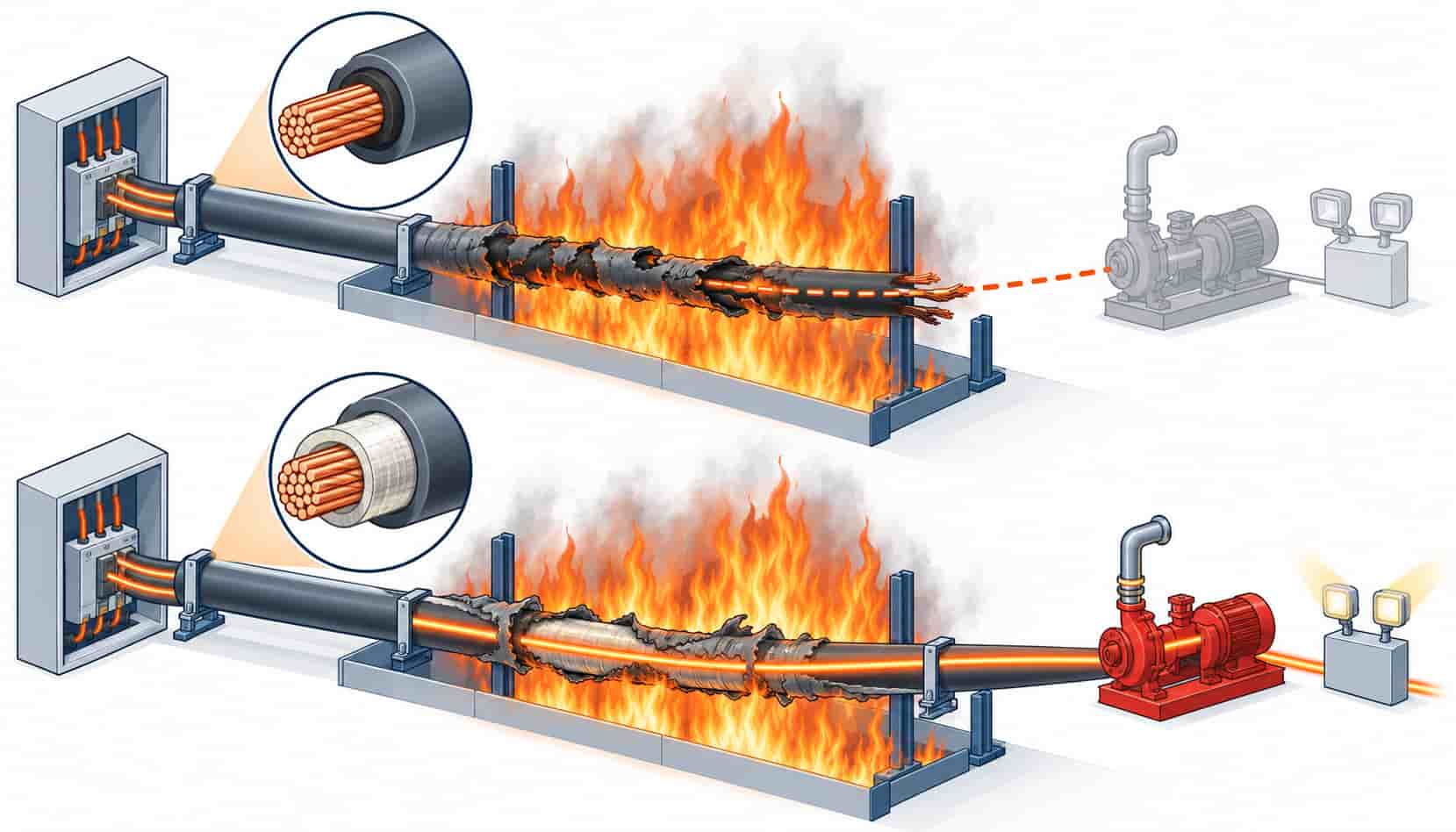
Quick Answer: The N in WDZN-YJY stands for fire resistance: a mica-glass tape under the XLPE insulation that keeps carrying current at flame temperature. One letter separates two cables that behave completely differently in a fire. WDZ-YJY stops fire from spreading; WDZN-YJY keeps working while the building burns around it. For the circuits that make evacuation possible — fire pumps, smoke extraction, emergency lighting, alarms — that letter is the whole specification.
Introduction
International buyers who meet WDZN-YJY in a Chinese tender usually ask two questions: what does the N change physically, and how does it translate into the IEC fire-resistance language their inspectors read? Both have precise answers, and both matter — fire-resistant cable is one of the few products where a specification error hides quietly until the one day it can’t. This article decodes the designation, explains the mica-tape mechanism, draws the flame-retardant-versus-fire-resistant line the whole Chinese system rests on, and maps the construction onto export documentation. The shared LSZH platform it builds on is decoded in our LSZH versus fire-retardant guide, and the base insulation in our XLPE primer.
The Designation: One Letter Changes the Cable
WDZN-YJY inherits everything from WDZ-YJY — halogen-free (W), low smoke (D), flame retardant (Z), XLPE insulation (YJ), PE sheath (Y) — and inserts N for nai huo, fire resistance. Physically, the N is a tape of mica glass wound around each conductor, under the XLPE insulation. Mica is a mineral that doesn’t burn. When the organic layers around it combust, the sintered mica wrap remains as a working dielectric barrier, and the conductor keeps delivering power at flame temperature.
| Element | Meaning | What It Changes |
|---|---|---|
| W + D | Halogen-free, low smoke | Thin, non-corrosive smoke in fire â evacuation stays possible |
| Z | Flame retardant | Fire does not spread along the tray |
| N | Fire resistant (nai huo) | Mica-glass tape keeps circuit live through flame â the whole point |
| YJ | XLPE insulation | 90°C continuous rating over the mica layer |
| Y | PE outer sheath | Moisture resistance for normal service |
Flame Retardant vs Fire Resistant: The Line That Decides Circuits
The distinction is worth pressing, because the words sound interchangeable and aren’t. Flame-retardant cable limits what fire does to itself — it won’t feed the fire or spread it. Fire-resistant cable does a different job entirely: it keeps carrying current during the fire, for a defined time at a defined temperature, so the systems people depend on to escape keep operating. The Chinese test behind the N requires the cable to hold insulation integrity at around 750°C with flame applied directly, for a specified duration; the internationally known equivalents are IEC 60331 and the British BS 6387 survival curves, all mapped in our standards comparison guide.
A practical reading rule for any schedule: every circuit with a life-safety job gets the N. Fire pump feeders, smoke extraction fans, emergency and evacuation lighting, fire alarm and control loops, elevator supplies. Everything else can usually stay flame-retardant. Paying fire-resistance prices across the whole tray is a budget error in the opposite direction.
What the Mica Layer Costs and Buys
The N layer adds material, diameter and modest cost — plus one handling note: mica tape has limited flexibility compared with bare insulation, so minimum bend radii deserve respect during pulling and termination. In return, the cable gains a fire-resistance property no sheath or compound upgrade can imitate, in a construction that otherwise installs exactly like the WDZ-YJY site crews already know. Aging behavior of the organic layers still follows XLPE norms; the failure mechanisms that condition monitoring catches are the usual ones, catalogued in our cable failure causes guide.
For buyers comparing options: fire resistance comes in three Chinese construction families — mica-tape XLPE (WDZN), rigid mineral insulated (BTTZ) and the flexible mineral family (NG-A/BTLY) — each trading cost, installability and fire endurance differently. The two mineral families have their own guides; this article stays with the mica-tape workhorse.
Export Mapping: Making the N Legible Abroad
Three documentation moves make WDZN-YJY portable. First, state the fire-resistance test target in international terms: IEC 60331 (or BS 6387 categories where the destination market recognizes them), with duration and temperature spelled out. Second, keep the LSZH behavior claims attached — W and D survive the border too, verified per IEC 60754 and IEC 61034, with the certification paperwork organized per our power cable certifications checklist. Third, mark fire-resistant circuits distinctly in the cable schedule and on drum labels, so site crews don’t unknowingly substitute plain WDZ-YJY from a mixed delivery. That substitution passes every routine test and fails only the one that matters.
| Check Item | Requirement | Why It Matters |
|---|---|---|
| N on the right circuits | Life-safety circuits only, listed by name | Fire resistance is bought where it has a job |
| Fire test stated | IEC 60331 / BS 6387 target with duration | "Fire resistant" without a test is a word |
| LSZH claims attached | 60754 / 61034 reports per batch | W and D must survive the border too |
| Bend radius respected | Mica layer handled per manufacturer limits | Damaged tape quietly voids the N |
| Distinct labeling | Fire-resistant runs marked at both ends | Prevents silent substitution from mixed stock |
| Verification reports | Batch fire tests keyed to drum IDs | The one test that matters must be provable |
When WDZN-YJY Is Not the Answer
The mica-tape construction is the right answer for most life-safety circuits, but it has limits. Where fire endurance must be near-absolute — the cable surviving mechanical impact and water spray during the fire, as some high-hazard specs demand — rigid mineral insulated BTTZ or the flexible mineral families outperform mica tape, at their own cost and installation price. And where a circuit has no life-safety role, the N is money spent on a property nothing uses; plain WDZ-YJY is the honest choice. Decide circuit by circuit, not by habit.
Upstream coordination matters too: fire-resistant feeders only deliver value if the switchgear and transformers they land on stay inside the protected envelope — the electrical-room protection question follows the logic in our transformers and substations collection.
RFQ Checklist: Ordering Fire-Resistant Cable
Make the N enforceable by writing these into the RFQ:
- Fire-resistant circuits listed by name, with the N construction assigned
- Fire test target: IEC 60331 or BS 6387 category, temperature and duration
- LSZH behavior: IEC 60754 and 61034 batch reports alongside
- Flame-retardant grade for the non-N circuits on the same project
- Mica-tape bend radius and pulling limits in the installation notes
- Distinct drum labeling and end-marking for fire-resistant runs
- Batch fire-test certificates keyed to drum IDs
- Copper price linkage across the delivery calendar
- Termination kits matched to landing equipment
- Destination-market acceptance path stated up front
Conclusion
One letter, one layer of mica, and the cable crosses from “will not feed a fire” to “will run a fire pump through one.” WDZN-YJY earns its place on every life-safety circuit in the building — and nowhere else. Specify it where evacuation depends on the circuit, demand the fire test behind the N, and label it so it reaches site unchanged.
Kexingyu Cable Group (KXYE) supplies WDZN-YJY with batch fire-resistance certificates, LSZH reports to IEC 60754 and 61034, and export-ready documentation — so the letter N arrives with proof attached.
Recent Posts
Thermal Runaway in Lithium Batteries: What BESS Buyers Should Understand
Thermal Runaway in Lithium Batteries: What BESS Buyers Should Understand How thermal runaway starts, how it propagates, and which evidence buyers should require before approving
Energy Storage for Data Centers: A Growing Backup Power Option
Energy Storage for Data Centers: A Growing Backup Power Option Batteries have always backed up data centers in the form of UPS strings. Grid-scale BESS
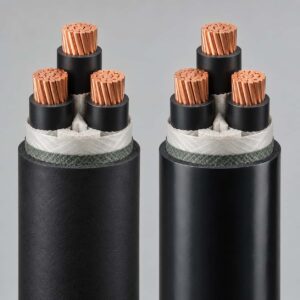
YJV vs YJY: Reading Chinese Cable Designations Like a Local
YJV vs YJY: Reading Chinese Cable Designations Like a Local YJV vs YJY: Reading Chinese Cable Designations Like a Local Quick Answer: YJV and YJY