KVV Control Cable: Specs, Applications and Export Guide
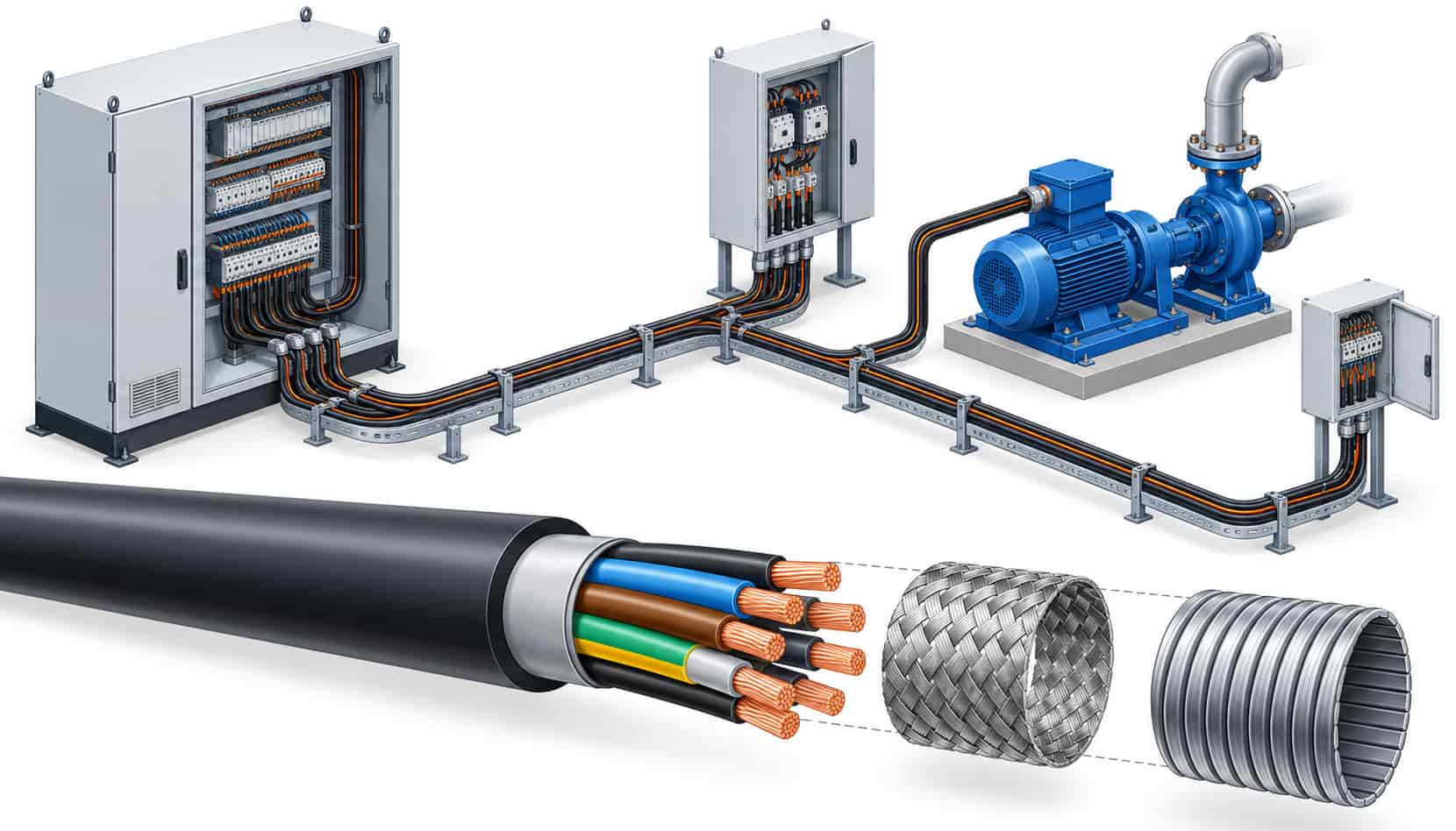
Quick Answer: KVV is China's standard multi-core control cable — copper, PVC insulation and sheath, 450/750 V — running start, stop and interlock signals between panels and motors. A power cable moves kilowatts; a control cable moves decisions. Between every motor starter, valve actuator and PLC rack in a plant runs a modest bundle of small copper cores whose whole job is to carry commands and confirmations — and in Chinese procurement that bundle is specified with four letters: KVV. This guide decodes the letters, maps the family around them, and turns the part number into an export-ready specification.
Introduction
Control cable is the least glamorous line in an electrical bill of quantities and one of the most consequential when it goes wrong: a failed control core stops a process as completely as a failed feeder, but it fails quietly, one intermittent break at a time. Buyers meet KVV in Chinese plant schedules and panel quotations, where it is the default answer to “multi-core, small cross-section, panel-to-field.” Understanding what the letters promise — and what they leave to the specification writer — keeps the control scope quotable and inspectable alongside the power scope it serves.
The Letters, Decoded
KVV reads in two steps. K is kong zhi — control cable, the family designation for multi-core small-conductor signal cable in the Chinese system. The two Vs name the polymer pair: PVC insulation on each core, PVC outer sheath. So KVV is literally “control, PVC, PVC.” The voltage class rides alongside at 450/750 V, generous for the 24 to 230 V signals the cores usually carry, and deliberately so — control cables share routes with power circuits whose induced voltages and fault conditions the insulation margin must shrug off.
| Route Condition | Variant | Why It Fits |
|---|---|---|
| Panel-to-panel in clean cable rooms | KVV | Baseline: cheap, many cores, easy terminations |
| Sharing trays with VFD or power circuits | KVVP | Braid shield tames induced noise on discrete signals |
| Direct buried or external walls | KVV22 | Steel tape armor handles soil, rodents and impact |
| Moving or frequently flexed connections | KVV(R) / RVV | Flexible class 5 conductors survive repeated bending |
| Hot environments, high ambient | KYJV | XLPE insulation raises the temperature ceiling to 90°C |
| Analog instrumentation loops | Not KVV â shielded pair cable | KVV has no per-pair shielding; specify instrumentation cable |
Sizing and Installation Notes
Control cores are sized by voltage drop and mechanical robustness more than ampacity — a 24 V solenoid at the end of a long run cares about millivolts, not amps. Cores below 1 mm² suffer at terminations; 0.75 mm² is the practical floor for field wiring and 1.5 mm² the comfortable default. Installation discipline matters more than the datasheet admits: control cable shares trays with power circuits, so segregation distances and, where noise is a concern, shield grounding at one end only, decide whether the signals arrive clean. The failure mechanisms that sloppy installation seeds — insulation damage, joint stress, intermittent breaks — are the usual suspects catalogued in our cable failure causes guide.
Export Mapping: Translating KVV
KVV translates to “300/500 or 450/750 V PVC-insulated, PVC-sheathed multi-core control cable” — a construction international catalogs recognize instantly. State the core count and cross-section explicitly (KVV, 12 × 1.5 mm²), the conductor class, and the variant letters: braid shield for KVVP, steel tape armor for KVV22 — the armor decision framework is the same one in our armored versus unarmored guide. Where the destination market requires certifications, attach them per the checklist discipline in our power cable certifications checklist, and size every core through the voltage-drop arithmetic in our cable size selection guide before the schedule freezes.
When KVV Is Not the Answer
KVV is not instrumentation cable, however often schedules confuse them: analog loops, thermocouple circuits and pulse signals need individually shielded pairs that KVV’s construction cannot provide. It is not a power cable either — control cores carry signals, and a feeder hiding in a KVV schedule will fail its first thermal review. And it is not a data cable: network and communication runs belong to their own families with their own geometry. Forcing KVV outside its lane buys a cable that technically exists and functionally fails.
RFQ Checklist: Ordering KVV
Make the control scope quotable, so include:
- Full designation: KVV / KVVP / KVV22 / KYJV with voltage class 450/750 V
- Core count and cross-section per run, e.g. 12 × 1.5 mm²
- Conductor class stated: solid, stranded or flexible
- Core identification: numbered printing or color coding
- Shield requirements and grounding scheme where KVVP is specified
- Armor and corrosion over-jacket for buried or exposed routes
- Flame-retardant prefix (ZR) where codes require it
- Ambient conditions: temperature range, UV, chemical exposure
- Segregation plan against power circuits sharing the same trays
- Batch test reports and copper certificates keyed to drum IDs
Conclusion
KVV is the quiet workhorse of Chinese plant wiring: a simple PVC-on-PVC multi-core construction that carries the decisions a facility runs on. Decode the letters, respect the family boundaries — shielded when noise threatens, armored when the route is rough, instrumentation cable where signals demand pairs — and the control scope quotes and inspects as cleanly as the power scope beside it.
Kexingyu Cable Group (KXYE) supplies the full KVV family — shielded, armored and XLPE variants — with numbered-core printing, batch test reports and export-ready documentation, so the control signals arrive on evidence-backed copper.