RVV vs RVVP Flexible Cables: Shielding, Uses and Buying Tips
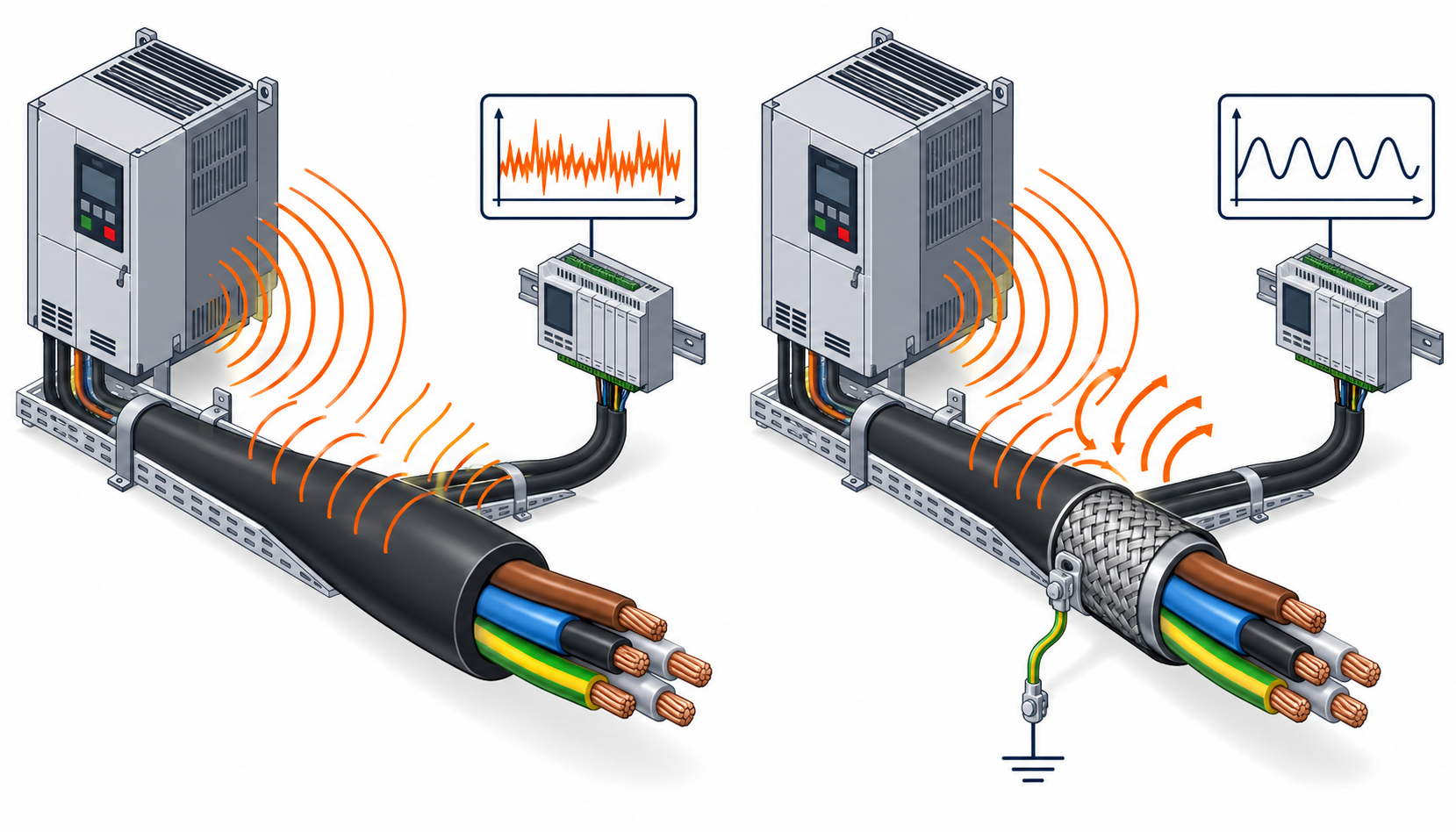
Quick Answer: RVV is flexible PVC multicore for general connections; RVVP adds a braid shield — one letter that decides whether electrical noise rides into your signals. Two cables, identical to the eye, identical in copper, identical in flexibility — separated by a single woven layer that changes what they can be trusted with. In Chinese schedules the pair is RVV and RVVP, and the difference between them is the difference between a signal that arrives clean and one that arrives decorated with everything the switchboard radiated at it. This guide separates the two, and the wider letter system behind them is decoded in the designation decoders of this series, while the polymer platform beneath is compared in our XLPE versus PVC guide.
Introduction
Flexible multicore cable is the connective tissue of every finished installation: appliance cords, panel interconnections, gate and shutter motors, PA and intercom runs, temporary event wiring. It is also, unfortunately, the category where noise problems hide longest — an unshielded cable works perfectly in the shop and misbehaves in the plant, and the diagnosis circles for weeks before anyone looks at the tray it shares with a VFD feeder. The RVV-versus-RVVP decision, made correctly at specification time, is the cheapest noise insurance in the entire electrical scope.
The Letters, Decoded
R is ruan — flexible: the conductors are fine-stranded class 5 copper, built to bend and re-bend without work-hardening to failure. The two Vs are the PVC pair, insulation and sheath, as across the whole Chinese system. So RVV is “flexible, PVC, PVC” — a light, pliable multicore cable. Add P and you have RVVP, where P is ping bi — shield: a tinned copper braid wound over the insulated cores and under the sheath, typically 70 to 90 percent optical coverage. The braid is the entire product difference and the entire price difference, and everything else in this article is a consequence of it.
| Environment | Choice | Reasoning |
|---|---|---|
| Office and clean commercial fit-out | RVV | No significant noise sources; shield is unused insurance |
| Inside or beside switchboards and MCCs | RVVP | Contactors and busbars radiate; signals need the braid |
| Sharing conduit or tray with VFD circuits | RVVP | Drive switching noise corrupts unshielded signals reliably |
| Long intercom, PA or access-control runs | RVVP | Run length multiplies coupled noise; braid drains it |
| Appliance and equipment power cords | RVV | Power duty, short length, no signal to protect |
| Outdoor or UV-exposed routes | Either, with UV-grade sheath stated | Standard PVC weathers; specify the outdoor compound |
Sizing, Specification and Quality Points
The RVV family spans roughly 0.5 to 6 mm² in 2 to 24 cores, with 0.75 and 1.0 mm² the panel-work staples. Specify the full string — RVVP, 8 × 0.75 mm², braid coverage percentage where noise is critical — because “RVVP” alone leaves braid coverage open, and coverage is where marginal factories save copper: an 80 percent braid and a 60 percent braid wear the same letters. Verify the strand count on the conductor when flexibility matters; true class 5 stranding costs more than the visually similar compromises, and the difference shows up as breaks at the gland after a year of movement. The failure modes of under-specified flexible cable — strand fatigue at terminations, insulation cracking at the bend point — are among the routine entries in our cable failure causes guide.
Export Mapping: Translating RVV and RVVP
Internationally, RVV translates to a “flexible PVC-insulated PVC-sheathed multicore cord-type cable” and RVVP to the same “with overall copper braid screen.” State class 5 conductors per IEC 60228, the core count and cross-section, the voltage class (300/500 V typical), and for RVVP the braid coverage and the intended grounding scheme. Attach the certification paperwork the destination market expects per the discipline in our power cable certifications checklist, and where the application is a cord subject to flex cycles, state the duty so the factory can confirm the stranding.
When Flexible Multicore Is Not the Answer
RVV and RVVP are not instrumentation cable: individually shielded pairs, pair-by-pair geometry and tight impedance control belong to the instrumentation family, and analog loops through a plant deserve that construction, not an overall braid. They are not data cables either — Ethernet and structured cabling have their own geometry, and forcing RVVP into that duty fails at the first bandwidth test. And neither is a power cable for fixed installation: when the run stops moving, the cheaper and tougher answer is the fixed multi-core control family rather than a flexible cord doing a fixed cable’s job. The control-versus-instrumentation boundary is the one to respect when signals get serious.
RFQ Checklist: Ordering RVV / RVVP
Make the flexible scope quotable, so include:
- Full designation: RVV or RVVP, voltage class stated (300/500 V typical)
- Core count and cross-section, e.g. 8 × 0.75 mm²
- Conductor class 5 flexible stranding confirmed in writing
- Braid coverage percentage for RVVP (80% or better where noise is critical)
- Shield termination and grounding scheme recorded in the installation drawings
- Sheath grade: standard, low-temperature, UV-stabilized or oil-resistant as the route demands
- Flame-retardant prefix (ZR) where codes require it
- Flex-cycle duty stated for moving applications
- Batch test reports and copper certificates keyed to drum IDs
- Destination-market certification needs stated up front
Conclusion
RVV and RVVP are the same excellent flexible cable until the moment noise enters the picture, and then one letter makes the difference between a system that works and one that hums, drops and misbehaves. Read the environment honestly, pay for the braid where the company is hostile, ground it properly, and the cheapest insurance in the electrical scope pays out for the life of the installation.
Kexingyu Cable Group (KXYE) supplies the RVV family in both constructions with verified class 5 stranding, braid coverage to specification and batch test reports, so the letters on the drum describe a shield that actually shields.