IEC 60754 and IEC 61034: Halogen Content and Smoke Density Testing
Quick Answer: IEC 60754 measures corrosive acid gas, IEC 61034 smoke density — the two tests that turn a 'low smoke zero halogen' claim into numbers. The most dangerous parts of a cable fire are often invisible: the acid gases that corrode electronics and lungs, and the smoke that blinds the people trying to leave. That's why modern codes in tunnels, data halls and high-rise buildings demand "low smoke zero halogen" cables — and why the claim is worthless until two specific tests put numbers behind it. IEC 60754 weighs the acid gas; IEC 61034 measures the darkness. This guide reads both tests the way a specifier should: what each measures, what the pass values mean, and how the results justify the LSZH premium in your schedule.
Introduction
Conventional PVC cable compounds contain chlorine, and when they burn that chlorine leaves as hydrogen chloride — an acid gas that attacks metal equipment, concrete and human airways alike. Burning polymers also emit smoke, and smoke density decides whether occupants can find an exit and whether firefighters can work. The fire-safety community learned these lessons through tunnel and high-rise fires, and the response was a pair of measurement standards: one for what the fire’s gases contain, one for what its smoke does to visibility. Together with the flame-spread tests covered in the bundled-flame guide, they define the three axes a modern fire specification manages — spread, chemistry and visibility. A cable that passes all three earns the LSZH label honestly. A datasheet that cites none of them is asking you to take the label on faith.
IEC 60754: Measuring the Acid Gas
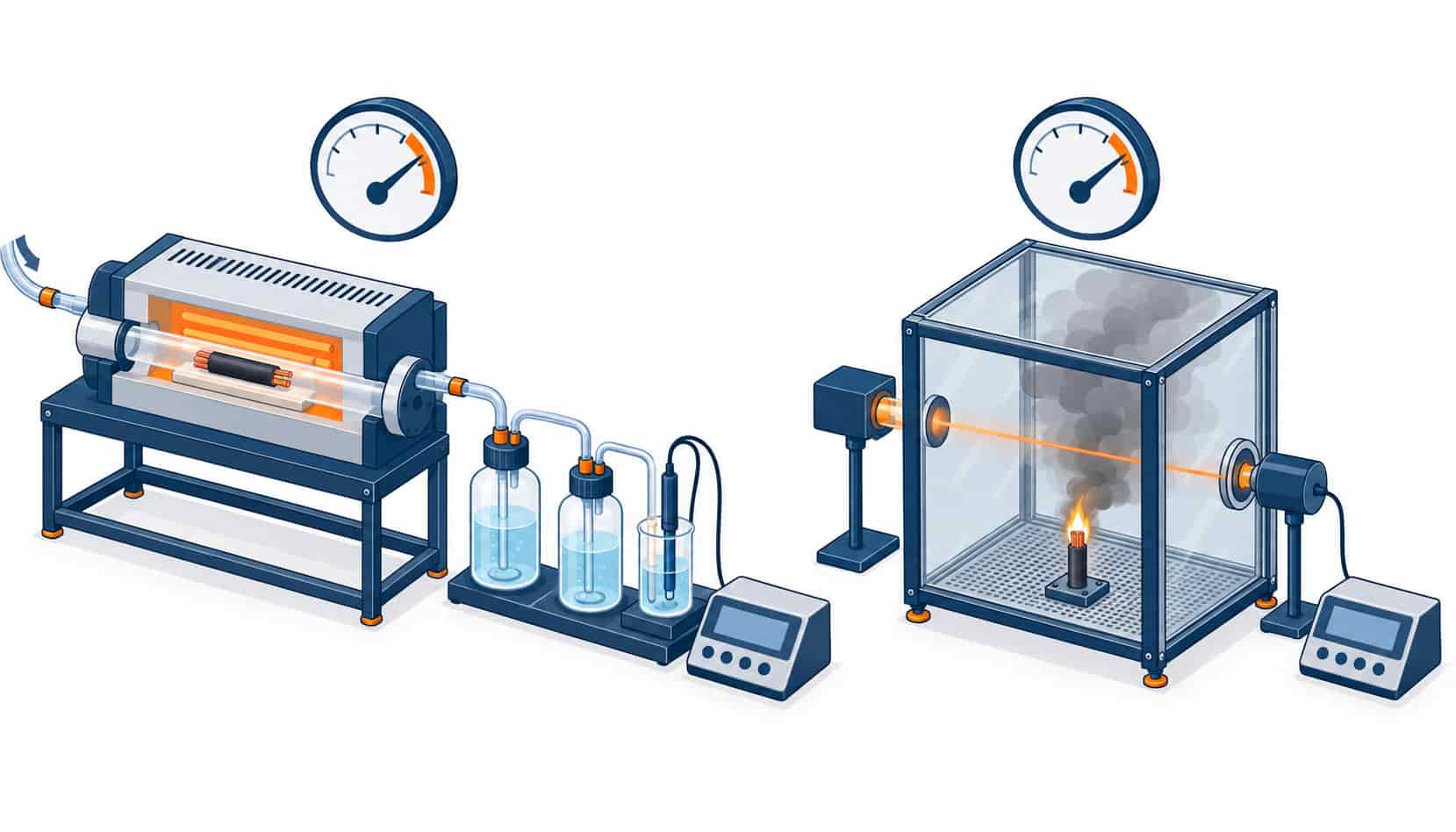
IEC 60754 comes in parts that evolved with measurement technique. Part 1 established the classic method — burn a sample in a tube furnace, scrub the evolved gases through water, and titrate the solution to quantify the halogen acid released. Part 2 refined the procedure with a more controlled combustion and a pH-plus-conductivity readout, answering the question buyers actually ask: when this cable burns, how acidic is the atmosphere? The reporting has two levels. The evolved gas equivalent can be expressed as a percentage of hydrochloric acid by weight of the original sample — and the widely accepted halogen-free threshold is 0.5 percent — or, under Part 2, the combustion atmosphere’s acidity is reported through pH, with halogen-free formulations typically holding the solution near neutral. The practical buyer rule is simple: demand the test report and the number, because “halogen-free” without a 60754 report is a marketing sentence, not a specification.
| Aspect | IEC 60754 (Halogen) | IEC 61034 (Smoke) |
|---|---|---|
| What it measures | Acid gas (HCl equivalent) evolved during combustion | Light transmittance through smoke in a closed chamber |
| Method | Tube furnace combustion, gas absorption, titration or pH | 1 m³ chamber, standardized burner, photocell beam |
| Key pass values | HCl equivalent ⤠0.5% defines halogen-free; Part 2 pH near neutral | Transmittance ⥠60% (general); ⥠20% minimum for LSZH claims |
| What it protects | People's airways, electronics, concrete â corrosion axis | Escape visibility, firefighting â visibility axis |
| Where demanded | Tunnels, data halls, high-rise, marine, transit | Same venues â the two travel together |
| Common weakness | Tested compound â offered compound without evidence link | Small-chamber result â real-scale fire, but it is the arbiter codes cite |
IEC 61034: Measuring the Smoke
IEC 61034 burns a cable sample in a sealed one-cubic-meter chamber under a standardized flame, while a photocell measures how much of a light beam crossing the chamber survives the smoke. The result is transmittance — the percentage of light getting through — and it maps directly to the human question: can you see through what this fire makes? The accepted benchmarks are transmittance of at least 60 percent for genuinely low-smoke performance in demanding specifications, with a floor around 20 percent where minimum smoke control is enforced; conventional PVC compounds can fall far below these values in the same chamber. The test’s weakness is honest and known: a cubic-meter chamber is not a burning corridor, and real-scale behavior differs. But it is the standard’s controlled arbiter — repeatable, comparable across factories and decades — and every smoke-related code requirement ultimately cites it or its national equivalent.
Why the Two Tests Travel Together
Halogen content and smoke density correlate imperfectly, and neither substitutes for the other — which is why the pair, not either alone, defines the LSZH claim. A halogen-free compound can still smoke heavily if its formulation is smoke-prone: zero acid gas doesn’t mean clear air. Conversely, a low-smoke result says nothing about corrosivity: some flame-retardant formulations cut visibility while emitting significant HCl. The venues that mandate LSZH — tunnels, data halls, transit systems, high-rises — mandate it for both reasons at once: people must see to escape, and the electronics and structure must survive the atmosphere. The corrosion that acid gas seeds in switchgear and joints keeps generating failures long after the flames, the slow variants of which are catalogued in our cable failure causes guide. A specification therefore cites both standards with their pass values, and the material-level choices that satisfy them are compared in our LSZH and flame-retardant guide, with their place in the wider IEC, GB and BS framework mapped in our MV and LV standards guide.
The Evidence Chain: Making the Numbers Count
Both tests are type tests on compounds and constructions — they qualify a design, and their reports carry the same verification questions as any fire evidence. The tested compound must be the compound in the offered cable: a 60754 pass on one sheath formulation does not transfer to a different jacket, so the report’s material identity matters as much as its number. The laboratory must be accredited for the specific test method and part. And where the destination market runs its own national equivalents — most major markets do — the mapping between the IEC test and the local one should be stated so the inspector can verify without translation. The report-evaluation discipline is the same one used for any certification claim, and it is laid out in our power cable certifications checklist. Batch-level production adds no smoke or halogen tests, so the type-test report with the named compound is the document to demand and file.
Specifying the Chemistry and Visibility Axes
In an RFQ, the two axes need their own lines, separate from the flame-spread category and the electrical construction. A complete fire section reads like this: flame spread per the bundled test at the category matched to tray density; halogen content per IEC 60754 with the halogen-free value or pH requirement stated; smoke density per IEC 61034 with the transmittance floor stated; and circuit integrity per the fire-resistance standard where any circuit must survive. Each line then has its own evidence requirement and its own report to file. Where the installation concentrates electronics — data halls above all — the halogen axis often gets the tighter value, because the corrosive gas that destroys servers and trays during a fire keeps destroying them after it; the power-dense halls behind that concern are covered in our data center power guide.
| Axis | Standard | Pass Value to State | Evidence to File |
|---|---|---|---|
| Halogen content | IEC 60754 (Part 1/2) | HCl equivalent ⤠0.5%, or pH basis | Accredited type test naming the compound |
| Smoke density | IEC 61034 | Transmittance ⥠60% (or stated floor) | Chamber type test on the offered construction |
| Flame spread | IEC 60332-3 | Category matched to tray density | Category type test, named size and build |
| Circuit integrity | Fire-resistance standard | Duration and function per design | Separate survival test report |
When These Tests Are Not the Answer
The pair measures combustion chemistry and visibility, and neither claims more. They don’t measure flame spread — a halogen-free cable can still carry flame merrily if its base polymer burns; the spread axis needs its own category. They don’t measure circuit integrity — passing both tests while dead in the first minute is entirely possible; survival circuits need the fire-resistance regime. They don’t certify real-scale fire performance — the chamber is a controlled proxy, and the fire design document remains the governing text. And they don’t apply to cables whose venue doesn’t demand the chemistry axes; ordinary industrial buildings with good egress may rationally stay with conventional compounds. The tests are instruments for specific questions, and the specification that cites them where they answer something real is the one that buys protection rather than paperwork.
RFQ Checklist: Specifying Halogen and Smoke
Make the chemistry and visibility axes auditable, so include:
- Halogen requirement per IEC 60754 with the pass value stated (0.5% HCl or pH basis)
- Smoke requirement per IEC 61034 with the transmittance floor stated
- Both tests cited separately from the flame-spread category
- Type-test reports required naming the tested compound and construction
- Laboratory accreditation stated on each report
- Material identity confirmed: report’s compound matches the offered jacket
- National equivalent tests mapped for the destination market
- Circuit-integrity requirement cited separately where the design demands it
- Flame-spread category cited from its own standard at the matched density
- Reports filed in the handover documentation with the batch records
Conclusion
IEC 60754 and IEC 61034 turn the fire’s invisible threats into pass-fail numbers: the acid gas weighed, the smoke measured against a light beam. Together with the flame-spread tests they complete the three-axis fire story — spread, chemistry, visibility — and a specification that cites each axis with its own standard and pass value buys cables whose LSZH label means what the tunnel, the data hall and the stairwell need it to mean.
Kexingyu Cable Group (KXYE) manufactures its LSZH range with accredited IEC 60754 and IEC 61034 type-test evidence on the offered compounds, so the chemistry and visibility axes in your schedule arrive with the numbers behind them — tested and export-ready.