GYXTW and GYTS Outdoor Fiber: Armored Cable for Campus Backbones
Quick Answer: GYXTW is the slim central-tube armored cable for ducts and short direct runs; GYTS is the stranded loose-tube armored cable for longer spans and bigger fiber counts. Both are steel-tape armored outdoor constructions — the difference is geometry.
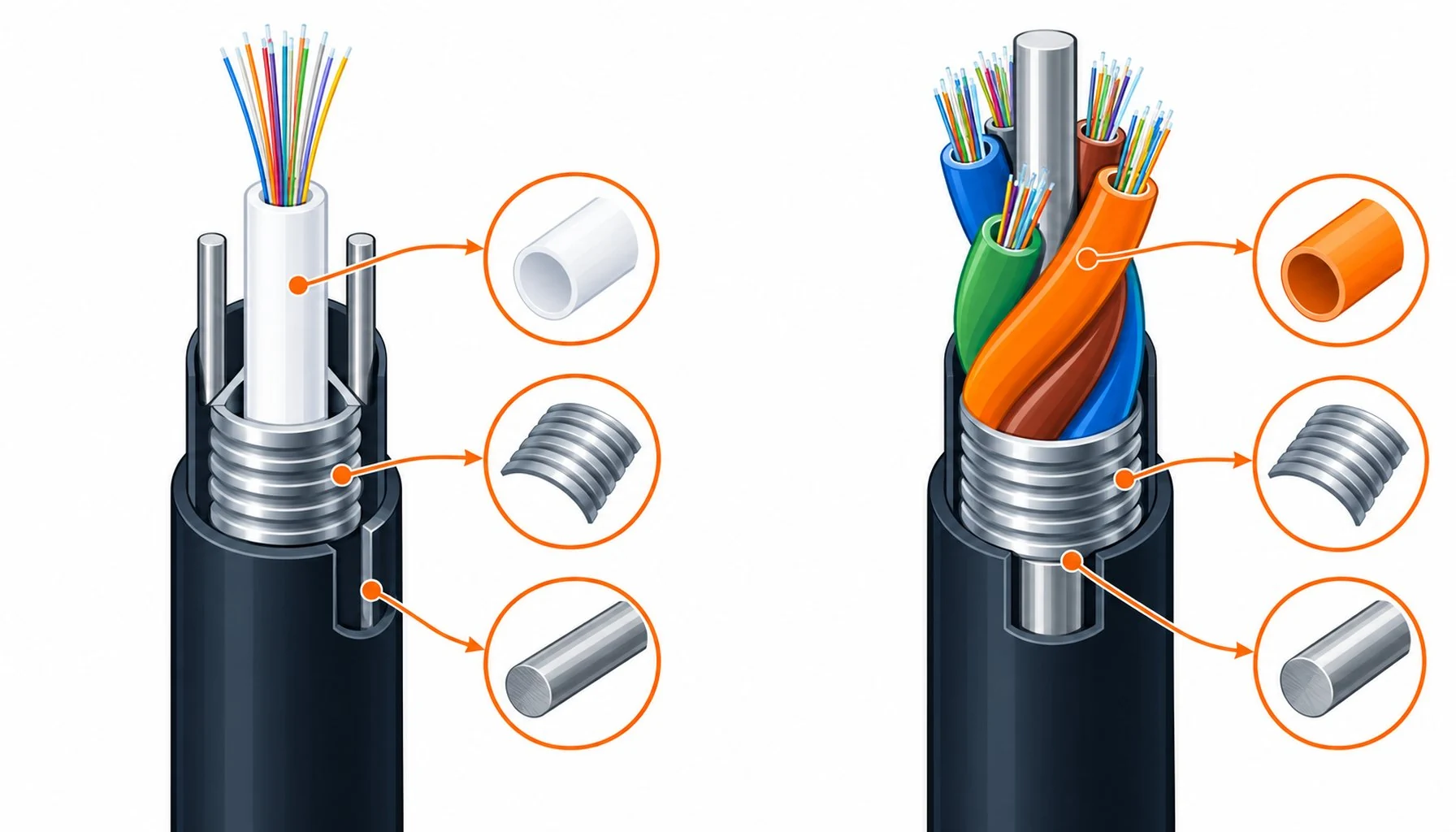
The designations GYXTW and GYTS look like ciphertext, and they encode the two constructions that carry most of the world’s outdoor fiber backbones. The letters are a Chinese standard naming system — GY for outdoor field cable, then the geometry and armor read in sequence — and once decoded, the choice between them becomes geometric rather than mysterious: GYXTW puts all its fibers in one central tube and wraps the assembly in corrugated steel tape between two polyethylene layers with parallel steel wires, producing a slim, crush-resistant cable for ducts and moderate direct runs. GYTS strands several loose tubes around a central strength member and armors with steel tape, producing a cable that tolerates stretch, carries higher fiber counts and behaves better over long undulating routes. Both are armored outdoor constructions; neither is interchangeable with indoor cable; and choosing by regime — duct or trench, fiber count, route profile — is most of the decision. This guide decodes both designations and maps each to its backbone routes.
Introduction
Model-number cabling exists because outdoor fiber’s requirements repeat so reliably that they became standard products: water blocking for decades of moisture, armor for rodents and trench mechanics, strength members for pulling tension, and polyethylene sheaths for UV and soil contact. The Chinese GB naming system labels these answers in sequence, and the reason the two models dominate campus backbones is that they pack the standard answer set into two geometries — slim and central, stranded and stretch-tolerant. The buyer’s advantage in knowing the code is that quotations become comparable at a glance: a GYXTW-8B1 or a GYTS-48B1 states its construction, fiber count and fiber class in the designation, the way power cable model numbers state voltage and insulation right on the drum print. The armor logic is the same across cable families: the route’s threats — rodents, trench backfill, duct abrasion — decide the metal, and the geometry decides how the cable behaves in motion. The decodings:
GYXTW Decoded: The Central-Tube Workhorse
Read the designation in parts. GY — outdoor field cable (the family). X — central tube construction: all fibers in one loose tube at the core, gel-filled or dry water-blocked. T — corrugated steel tape armor, longitudinally applied and bonded. W — the double polyethylene sheath with two parallel steel wires embedded flanking the core, adding crush resistance and pulling strength. The result is a cable of small diameter and high mechanical toughness: the central tube makes it slim and cheap per fiber at low counts, the steel tape and wires make it rodent-resistant and duct-pullable, and the compact core handles moderate bends well. GYXTW’s natural territory: duct routes between buildings, short direct-burial segments where trench depth is controlled, campus backbones at 2 to 24 fibers, and any route where a slim, tough cable outperforms a bigger one. Its geometry limits show at scale: a single central tube becomes crowded at higher fiber counts, and the central-tube design tolerates less stretch than stranded construction — which is exactly what the GYTS geometry answers.
GYTS Decoded: The Stranded Loose-Tube Answer
Read the same way. GY — outdoor field cable. T — stranded loose-tube construction: several tubes helically wound around a central strength member, each tube carrying a share of the fibers. S — steel tape armor, with polyethylene inner and outer sheaths. The stranded geometry is the point: the helical lay gives each tube slack, so temperature movement and cable stretch along long routes are absorbed by the geometry rather than by the glass — the same principle that lets stranded conductors outperform solid ones in motion-heavy routes on the power side. Fiber counts scale naturally: 24, 48, 96 and beyond, organized per tube for splicing logic. GYTS’s natural territory: longer campus and metropolitan backbones, higher fiber counts, routes with elevation change or thermal swing, and direct-burial spans where the steel tape armor meets trench reality. The trade against GYXTW is diameter and cost at low counts — for a 12-fiber duct run between two buildings, the stranded construction is more cable than the route needs.
| Element | GYXTW | GYTS |
|---|---|---|
| Geometry | Central tube — all fibers in one core tube | Stranded loose tubes around a strength member |
| Armor | Corrugated steel tape (T) | Steel tape (S) |
| Strength extras | Two parallel steel wires (W) | Central strength member |
| Fiber counts | Best 2-24 | Natural 24-144 and up |
| Stretch tolerance | Moderate | High — helical slack per tube |
| Home routes | Ducts, short burial, slim campus runs | Long backbones, big counts, buried spans |
Choosing by Route: The Campus Backbone Survey
The route survey answers the model choice in four questions. How many fibers? Low counts favor GYXTW’s slim economics; counts past 24 favor GYTS’s tube organization — splicing a 48-fiber GYTS is a structured job, splicing a hypothetical 48-fiber central tube is not. Duct or trench? Both carry steel tape armor, but direct burial adds depth and backfill considerations where the stranded construction’s crush distribution helps. How long and how moving? Routes with thermal swing, elevation change or long unrepeated spans reward GYTS’s stretch tolerance; short level ducts are GYXTW’s home. What pulls it? GYXTW’s steel wires give it excellent duct-pulling behavior at small diameter. The same survey discipline that chooses power cable armor per route — documented in the armored versus unarmored guide — decides here, and the campus context frames it: backbones that feed halls alongside their power infrastructure, mapped in the data center power hub, cross the same construction sites the power routes do. Industrial-park backbones — the growth pattern documented in the Vietnam industrial park demand analysis — are GYXTW and GYTS country in the purest form: ducts between plants, buried crossings, rodent-rich margins.
When the Model Number Is Not the Answer
Two cautions keep the designation honest. The first is counterfeit construction: the model number is a claim, and drums labeled GYXTW have been found with thinner steel tape, missing water-blocking gel or aluminum standing in for steel — the verification habit is a sample cut at the dock, checking the tape, the gel and the steel wires against the designation, the same dock-level check the certification checklist prescribes for any cable batch. The second is scope creep in the other direction: the designation says nothing about fiber class — B1.3 single-mode, OM4 multimode, bend-insensitive variants — and two GYTS-24 drums can hold different glass; the full order code states construction, fiber count and fiber class together. Where the route leaves the standard products’ envelope — aerial spans, high-rodent pressure, extreme cold — the answer is a different family (ADSS, heavier armor, cold-rated sheath) rather than a stretched interpretation of these two. Off-grid and rural backbones that cross entirely unmanaged territory, the context described in the rural electrification equipment guide, are exactly where the heavier constructions earn their premium.
| Route | Model | Why |
|---|---|---|
| Duct run, 12 fibers, between buildings | GYXTW | Slim, crush-resistant, duct-pullable |
| Direct burial crossing, 24 fibers | GYXTW or GYTS by depth | Steel tape armor both; geometry by route |
| Long backbone, 48-96 fibers | GYTS | Tube organization, stretch tolerance |
| Thermal swing, elevation change | GYTS | Helical slack absorbs movement |
| Rodent-heavy margins | Either + verified steel tape | Armor is the answer; verify it exists |
| Aerial span | ADSS / figure-8 — not these | Leave the family when the regime changes |
RFQ Checklist: Backbone Lines for the RFQ
Put the designation in writing:
- Model per route: GYXTW or GYTS by survey, not habit
- Full order code: construction, fiber count, fiber class
- Armor verified at dock: tape, gel, wires sampled
- Water blocking type stated: gel or dry
- Tensile and crush ratings per the route’s pulling plan
- Drum lengths matched to splice-point spacing
- Test requirements: attenuation per span at acceptance
Conclusion
GYXTW and GYTS are the two geometries of the armored outdoor backbone: central-tube slim for ducts and modest counts, stranded loose-tube for long routes and large counts. Decode the designation, survey the route, verify the armor at the dock — and the campus backbone is specified in one line of letters that actually means what it says.
Kexingyu Cable Group (KXYE) manufactures GYXTW and GYTS to the full designation: corrugated steel tape where the code says T, parallel steel wires where it says W, gel or dry water blocking per environment, and full order codes that state fiber class alongside construction — backbone cable whose model number works as a specification rather than a suggestion.