Lithium Battery Production Lines: Why They Eat Standard Cable Alive
Quick Answer: Battery plants combine 24/7 high-cycle motion, solvent and electrolyte chemistry, conductive dust and formation-stage electrical loads — a combination that standard cable survives for months and purpose-specified cable survives for years.
Lithium battery manufacturing has become the fastest-growing downstream market for drag chain and motion cable — market researchers tracking the sector consistently name battery plant equipment as the segment pulling demand hardest. The reason is simple arithmetic: gigafactories pack thousands of moving axes into buildings that run around the clock, in an environment that is quietly hostile to every polymer and every conductor in it. Solvent vapors from electrode coating, electrolyte chemistry in cell assembly, conductive powder dust everywhere in the dry room, formation halls full of high-current DC electronics — none of these attacks cable the way a grinding wheel or a weld arc does. They attack slowly, chemically, and at every joint. Standard cable specified from a general catalog lasts months in a good battery plant; the same cable in the wrong zone lasts weeks. This guide walks the production line stage by stage, shows what each one does to cable, and lists the specification decisions that keep a gigafactory’s wiring alive for the plant’s actual life.
Introduction
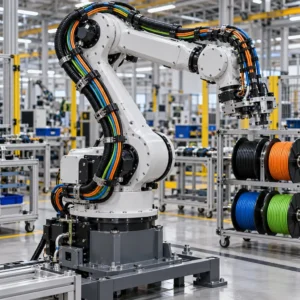
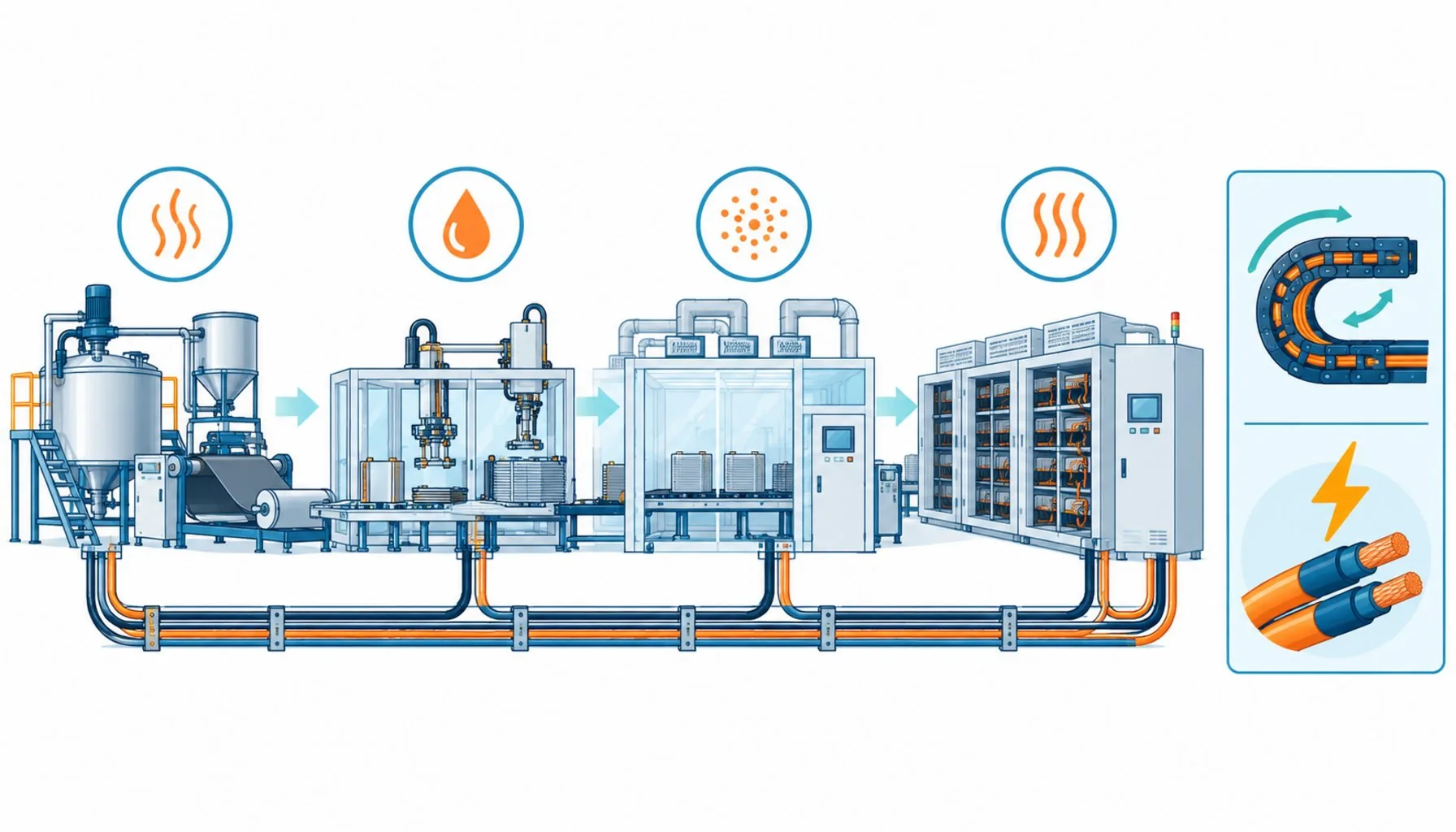
A battery plant is a chemistry factory wearing an automation costume. The front end mixes, coats and calenders electrode material using solvent systems and powder handling; the cell assembly end stacks, winds and fills with electrolyte; the formation end charges and cycles every cell with precision electronics. Between and within these stages run conveyor systems, robotic handling, stacker cranes and coating heads — all of them flexing cable continuously, 24 hours a day, because the economics of a gigafactory are built on uptime. The equipment market data behind this buildout is the same story told from the demand side: researchers following the drag chain cable sector consistently report lithium battery equipment as its fastest-growing downstream application, ahead of the traditional machine tool base.
The cable failures that follow are rarely dramatic. A jacket swells until it jams a chain divider; a shield corrodes until an encoder signal drifts; a conductor fatigues at the four-millionth cycle instead of the ten-millionth. In a plant scheduled at 95 percent utilization, every one of those is a line stop, and the maintenance team’s fix — replace and move on — repeats until someone specifies the cable against the environment instead of the catalog. The failure mechanics behind those repeats are the ones documented in the common causes of cable failure, accelerated by chemistry that most factories never see.
Stage by Stage: What Each Production Area Does to Cable
Battery production divides into distinct stages, and the cable environment changes completely from one to the next. Specifying one cable for the whole plant is the root error; specifying by stage is the fix.
| Stage | Environment the Cable Lives In | What Kills Standard Cable | Specification Response |
|---|---|---|---|
| Mixing and coating | Solvent vapors (NMP-based systems), powder dust, continuous coater motion | Jacket softening and swelling in solvent; dust packing into chains | Solvent-resistant jackets; sealed chains with dust management; high flex life for coater axes |
| Calendering and slitting | Conductive electrode dust, heavy vibration, high-cycle motion | Dust ingress abrading jackets; conductive powder bridging unprotected circuits | Abrasion-resistant jackets, enclosed chains, dust-sealed connectors |
| Cell assembly (stack/wind/fill) | Dry room conditions, electrolyte chemistry, precision motion everywhere | Electrolyte contact corroding shields and jackets; low humidity embrittling compounds | Electrolyte-resistant jackets, dry-room-rated compounds, motion-grade construction throughout |
| Formation and aging | Halls of high-current DC chargers and cycling electronics, heat buildup | Thermal aging near electronics; undersized DC bus conductors heating at duty | Temperature-rated insulation, honest DC current sizing, ventilation-aware derating |
The Chemistry Problem: Solvents and Electrolyte
Two chemicals drive most battery plant cable damage. The first is the coating solvent system — NMP in many electrode lines — whose vapors permeate production areas and soften conventional jacket compounds over months of exposure. A jacket chosen for abrasion and flex may still lose its temper in a coater hall; solvent resistance has to be verified against the actual chemistry, not assumed. The second is the electrolyte itself — the lithium saltorganic carrier system that makes the cell work. It is aggressive toward many polymers, and where filling equipment handles it, splash and vapor exposure reaches nearby cabling. Cable in electrolyte-adjacent zones needs compounds with demonstrated resistance, and the connections need sealing, because electrolyte that wicks into a gland corrodes from the inside out. The compound-selection discipline here is the same one that decides sheath chemistry choices elsewhere: name the chemical, then choose the material, never the reverse.
The Dust Problem: Conductive Powder Everywhere
Electrode materials — graphite, lithium compounds, conductive carbon additives — are fine, dry and in many cases electrically conductive. That combination makes powder dust a cable problem, not just a housekeeping one. Dust packs into cable chains and abrades jackets with every cycle; it works into connectors and creates leakage paths; conductive dust on insulating surfaces is a tracking risk that ordinary plants never face. Dry rooms make it worse from another direction: the very low humidity that protects the cells from moisture also embrittles some jacket compounds and eliminates the ambient moisture that would otherwise settle dust. Cable specification for dusty stages therefore emphasizes abrasion-resistant smooth jackets, enclosed or managed chains with dust extraction, and sealed connectors — with inspection schedules that treat chain cleaning as a cable-life item, not a tidiness item.
The Duty Problem: 24/7 Changes the Math
The third killer is time. A machine running one shift has logged a third of the cycles of a plant running three, and battery plants run flat out — the business case depends on it. Flex life budgets that look generous on a datasheet are consumed in a couple of years at gigafactory duty. Every motion specification therefore needs the duty stated in cycles per hour and hours per day, with flex life targets set against total plant life, not a year of operation. High-cycle axes — coater carriages, stacking robots, conveyor elevators — deserve the short-lay, strain-cored constructions that motion cable exists to provide, and their chains need the fill and radius discipline that keeps cable from being the bottleneck. Where DC bus and formation circuits are concerned, honest current sizing matters as much; the thermal logic is the same as any high-duty power run, and undersizing shows up as accelerated aging of everything in the raceway — a pattern familiar from conductor sizing practice. Formation halls concentrate another hazard too: hundreds of cells under charge raise both fire risk and the importance of the safety wiring around the thermal runaway mechanisms that battery plants manage as a core risk.
| Check | What to Pin Down | Why It Decides the Outcome |
|---|---|---|
| Stage zoning | Which cable runs serve which production stage | Chemistry and duty differ completely stage to stage |
| Chemistry list | Solvents, electrolyte exposure paths, cleaning agents, by stage | Jacket compounds are chosen against named chemicals |
| Dust management | Chain type, enclosure, extraction, connector sealing in dusty zones | Conductive dust creates abrasion and tracking risks both |
| Duty data | Cycles per hour and hours per day, honestly stated per axis | 24/7 operation consumes flex budgets at triple rate |
| Electrical loading | DC bus and formation currents with ventilation and derating | Formation halls run hot; undersized conductors age everything nearby |
| Spares strategy | Pre-terminated sets for the highest-cycle axes, batch traceability | Line stops are priced in minutes; replacement speed is part of the spec |
When Battery Plant Rules Are Not the Answer
Honesty about scope keeps this guide useful. The requirements here address cabling on the moving and process equipment inside battery production — chains, robot harnesses, conveyor and handling systems, formation-stage wiring on the equipment side. They do not cover the plant’s electrical infrastructure: MV distribution, transformer and switchgear engineering, and the facility’s grounding and protection design follow utility and industrial power practice. Cell design and battery management belong to cell engineers; the cable carries current and signals, it does not shape the charge profile. And other demanding environments — welding cells, cleanrooms, washdown plants — have their own specification logic, which overlaps but does not substitute. Zone by stage, name the chemistry, count the cycles, and the cable system becomes one less thing the plant’s OEE dashboard has to explain.
RFQ Checklist: What to Send the Cable Supplier
Put the line’s reality in writing before quotes come back:
- Stage map: which equipment and cable runs serve each production stage
- Chemistry: solvents in use, electrolyte exposure paths, cleaning agents per zone
- Dust and dry room conditions: particle types, humidity levels, chain management approach
- Duty per axis: cycles per hour, hours per day, target plant life in years
- Electrical data: DC bus and formation currents, voltage levels, ambient temperatures
- Required flex life with test method, plus documentation and traceability expectations
- Spares plan: pre-terminated replacement sets and lead times for critical axes
Conclusion
Battery plants eat standard cable not through any single villain but through the combination of nonstop duty, solvent and electrolyte chemistry, conductive dust and formation-stage heat — each one boring alone, brutal together. Equipment builders and plant teams that specify cable by production stage, against named chemistry and honest cycle counts, get harnesses that last the plant’s life instead of its first quarterly review. In a business priced by uptime, that specification discipline is part of the production strategy.
Kexingyu Cable Group (KXYE) supplies motion and power cable constructions for demanding automation environments and supports battery equipment builders with stage-based specifications, chemical resistance evidence and batch traceability. Describe your line stages and duty profile through the RFQ page, and we will respond with constructions matched to each stage rather than one quote for the building.