Shielding for Moving Cables: Braided vs Foil vs Combination Shields
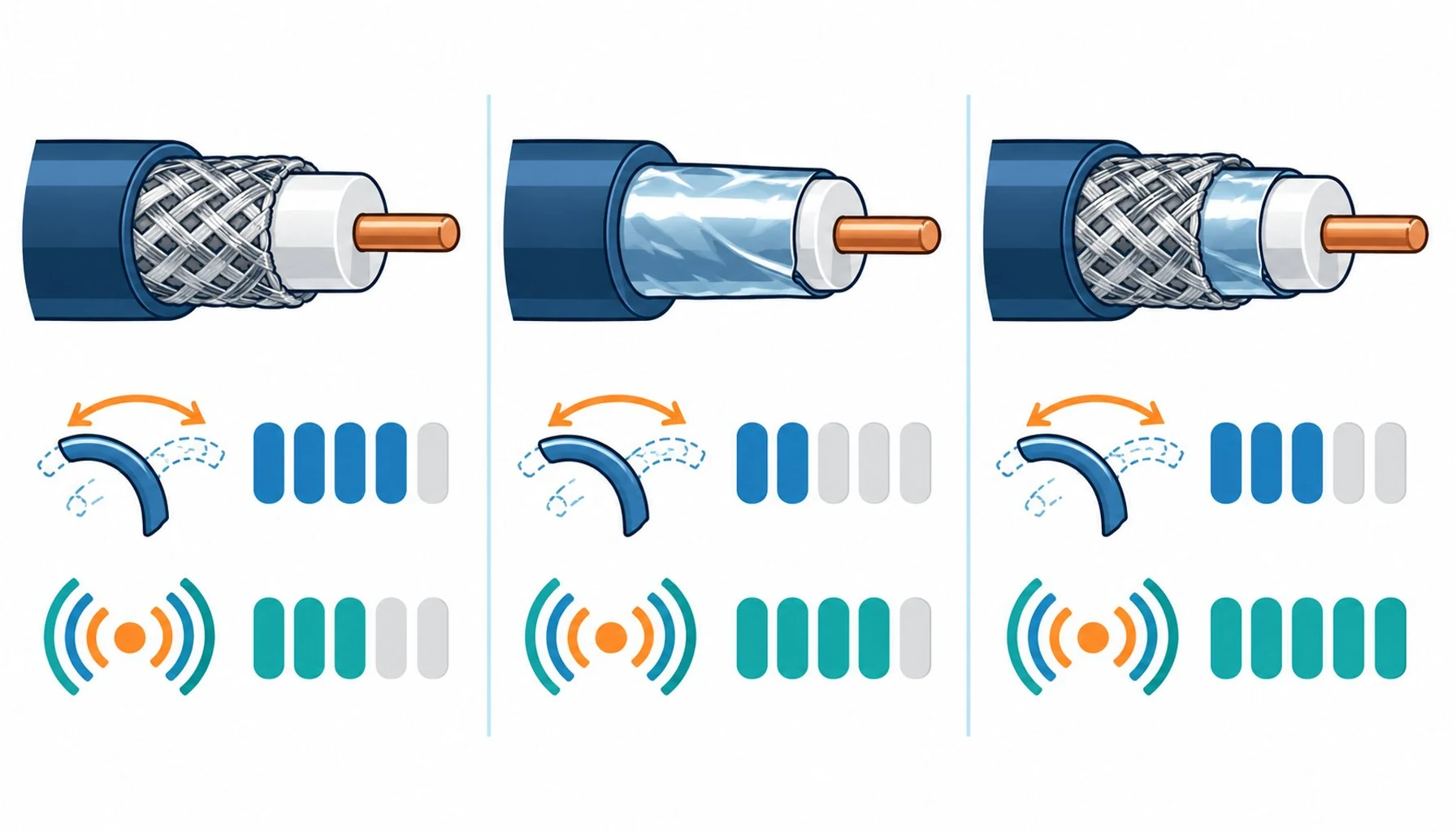
Quick Answer: Foil shields crack under flexing within weeks, braid survives motion, and combination builds earn their cost on high-speed buses; the moving machine never gets a stationary shield.
Shielding failures on moving cable are the strangest faults in automation, because the cable looks fine. Continuity holds, insulation tests pass, and yet the machine throws intermittent position errors, communication dropouts and noise faults that come and go with axis position. The cause is usually a shield that has quietly opened: a foil cracked by flexing, a braid worn through at a transition, a shield whose coverage survived the bench but not the chain. On a static run, shielding choice is mostly an EMC calculation. On moving cable, it is first a mechanical question, because the shield is a conductor that has to survive being bent a million times while still doing its electrical job. This guide compares the three shield families honestly: where braid wins, why foil fails in motion, what combination builds actually buy, and the grounding and termination habits that decide whether any shield works. The signal faults this prevents are the quiet cousins of the failures in the general failure catalog, and the noise environment they face is set by the drives described in the VFD versus soft starter comparison.
Introduction
Why the shield is the first layer to die under motion is pure geometry. A shield sits at the outside of the cable, where bending strain is highest; every cycle stretches its outer surface and compresses its inner one. Aluminum foil, a few tens of microns thick, tolerates very few such cycles before cracking, and a cracked foil is worse than no foil in some respects, because it can become an antenna with a slot. Braid, a weave of fine copper wires, survives because the wires slide and redistribute as the cable flexes, and a dense braid keeps electrical continuity even when individual wires fatigue. That mechanical asymmetry is the whole foundation of motion shielding, and it is why a shield specification that ignores flexing is answering a question the machine did not ask. The sections below treat each shield type on its own terms, then combine them into a selection logic that matches shield to duty rather than to habit.
Braid: The Motion Standard
Tinned copper braid is the default answer for moving cable, and the reasoning is mechanical before it is electrical. A braided shield flexes with the cable, its wires redistributing strain instead of concentrating it, and a quality motion braid retains shield continuity across millions of cycles at motion radii. Electrically it performs well too: braid provides low-frequency coverage and, with adequate density and good termination, handles the bulk of the EMC job on servo and encoder circuits. Its honest weaknesses are coverage gaps at high frequencies, where the weave’s openings let through what a solid barrier would block, and cost plus stiffness relative to foil, which matters in very small or very flexible builds. Braid quality varies more than buyers expect, and the variables that matter are coverage percentage, strand fineness and whether the braid was designed for flex or merely included for the datasheet. A worn braid at a transition point presents exactly like a bad gland: local damage that ages the whole cable, which is why the hardware discipline around shields is the same one applied to the accessories in the cable accessories checklist.
| Property | Braid | Foil | Combination |
|---|---|---|---|
| Flex endurance | Excellent, the motion benchmark | Poor, cracks within weeks of chain duty | Good, braid carries the mechanical load |
| High-frequency coverage | Moderate, weave gaps limit it | Excellent when intact | Excellent, foil fills the gaps |
| Low-frequency coverage | Good with adequate density | Good when intact | Good |
| Termination | Robust, easy to terminate and pigtail | Fragile, drain wire required | Terminate the braid; foil rides along |
| Cost and stiffness | Higher cost, stiffer | Cheapest, most flexible | Highest |
| Best use on moving cable | Servo, encoder, general motion signal duty | Stationary runs and inner elements only | High-speed buses in chains, demanding EMC |
Foil: Know Exactly Where It Belongs
Foil shielding is not a bad product; it is a stationary product. Its 100 percent coverage, light weight, low cost and small diameter make it the right choice for fixed runs, for inner elements inside a multi-element cable, and for the high-frequency coverage that braid alone lacks. What foil cannot survive is repeated flexing, and the failure is fast: a foil-wrapped cable in genuine chain duty can crack its shield within weeks, long before any other layer shows distress. The diagnostic signature is distinctive and worth knowing: a machine whose communication and feedback faults worsen over the first month of operation, track axis position, and disappear when the cable is held still, is describing a cracked foil. Combination builds resolve the tension by layering: foil for coverage, braid for endurance, with the braid carrying the mechanical duty so the foil is never the only barrier. Buyers should read combination claims with the same skepticism applied elsewhere: a foil-plus-thin-braid build is not automatically a motion shield, and the braid’s density and flex rating decide whether the combination is real or decorative.
| Your Duty | Shield Call | Why |
|---|---|---|
| Servo power and feedback in a chain | Braid, flex-rated density | Endurance first; coverage adequate |
| High-speed bus in a chain, heavy EMC | Combination, braid flex-rated | Foil coverage plus braid endurance |
| Encoder pairs, high cycle counts | Braid, individual pair shields where needed | Per-pair isolation plus motion survival |
| Stationary runs near drives | Foil, properly grounded | Coverage at minimum cost, no flex duty |
| Inner elements in hybrid cable | Foil on elements, overall shield per duty | Foil never the outer barrier in motion |
Termination and Grounding: Where Shields Actually Die
The best braid in the world does nothing if its ends are handled like decoration, and shield termination is where motion EMC is won or lost. The rules are old and honored mostly in the breach: terminate the braid at both ends for low-frequency noise or at one end plus a capacitive bond where ground loops threaten, keep pigtails short enough that they do not become antennas, use EMC glands that clamp the braid 360 degrees rather than twisting it into a wire, and maintain that termination quality at every break in the route. On moving cable the stakes are higher, because the termination point is also a flex point, and a braid clamped hard at the gland exit will fatigue exactly there. Separation from power runs, crossing at right angles where crossing is unavoidable, and the grounding discipline of the cabinet all stack on top of the cable’s construction, and the cabinet-side habits are covered in custom control cabinet building. A plant that polishes shield construction while ignoring shield termination has polished the part of the system that was already working.
When Shield Selection Rules Are Not the Answer
Honest limits: not every moving cable needs a shield at all, and not every noise fault is a shield fault. Digital I/O in a clean machine can run unshielded; and a noise problem that traces to a broken drive filter, a bad ground bond or a shared return does not care what is wrapped around the signal wires. Diagnosis before specification: measure, scope, and only then buy. The rules here also assume the noise environment of a conventional machine; exotic EMC environments, high-power welders, induction heating, may need engineering beyond catalog shields. And the shield can never compensate for pair geometry that flexing has destroyed, which is why the conductor and lay decisions in the neighboring guides precede the shield decision in every serious build.
RFQ Checklist: Specifying Shields That Survive Motion
Put these lines in the request and the quotes will sort themselves:
- Motion duty per route: flex cycles, radius, torsion if any, with shield continuity required after test
- Shield construction stated per circuit: braid density, foil placement, combination build details
- Transfer impedance or coverage data, at your frequency range, not a generic claim
- Termination plan: EMC glands, 360-degree clamping, pigtail rules, end-to-end grounding scheme
- Separation and routing rules stated alongside, since they share the EMC job
- Evidence of system-level test in chain geometry for the demanding buses
Conclusion
On moving cable, shielding is a mechanical product with an electrical job. Braid survives the motion and handles most duties; foil covers frequencies but cannot survive the ride and belongs on stationary runs and inner elements; combination builds earn their cost where coverage and endurance must both be real. Specify the shield for the cycles it must survive, terminate it like the engineering component it is, and the intermittent faults that haunt motion machines stop being mysterious.
Kexingyu Cable Group (KXYE) builds motion cable with flex-rated braids and honest combination constructions, publishes continuity-after-flex evidence, and supports the gland and grounding plan around the cable. Send your bus types and noise environment through the RFQ page, and we will match shields to the duty, including the ones that do not need one.