Flexible Cable for Cold Environments: Temperature Ratings in Practice
Quick Answer: At low temperature the insulation usually survives long after the flexibility dies; cold-rated cable is specified by bend behavior at the lowest service temperature, not by a single number on the temperature line of a datasheet.
Cold is a specialist topic that masquerades as a simple one. A datasheet line reading minus 40 degrees looks like a complete answer, but it hides the question that actually matters: minus 40 for what? A cable that sits stiff but intact in deep cold, carrying current through a fixed run, is a different product from a cable that must bend around a chain radius at minus 30 every few seconds in a frozen warehouse. The first needs temperature endurance; the second needs cold flexibility, and they are tested differently, built differently and purchased differently. This guide separates the two, explains what really happens to cable materials as temperature drops, and turns the difference into specification language you can put in an RFQ for cold stores, outdoor automation, logistics equipment and winter-exposed machinery.
Introduction
The cold-cable market is growing on the back of automated cold storage, outdoor mobile robots, agricultural automation and infrastructure in genuinely cold climates, and most buyers meet it for the first time with the same mistake: they read the temperature rating as a flexibility guarantee. The mistake is understandable. Datasheets compress everything into one column, and the words cold resistant are printed on cables whose only cold virtue is that they do not shatter while hanging still. The failure appears weeks into winter, when the moving axis starts and the jacket cracks at the first tight bend, or when the cable simply becomes too stiff for the carrier and the drive faults on cable tension.
The sections below give you the material physics in plain terms, the difference between static cold endurance and dynamic cold flex, the compound choices that matter, the tests behind honest cold ratings, and a specification checklist that turns all of it into a purchasable document.
What Cold Actually Does to Cable Materials
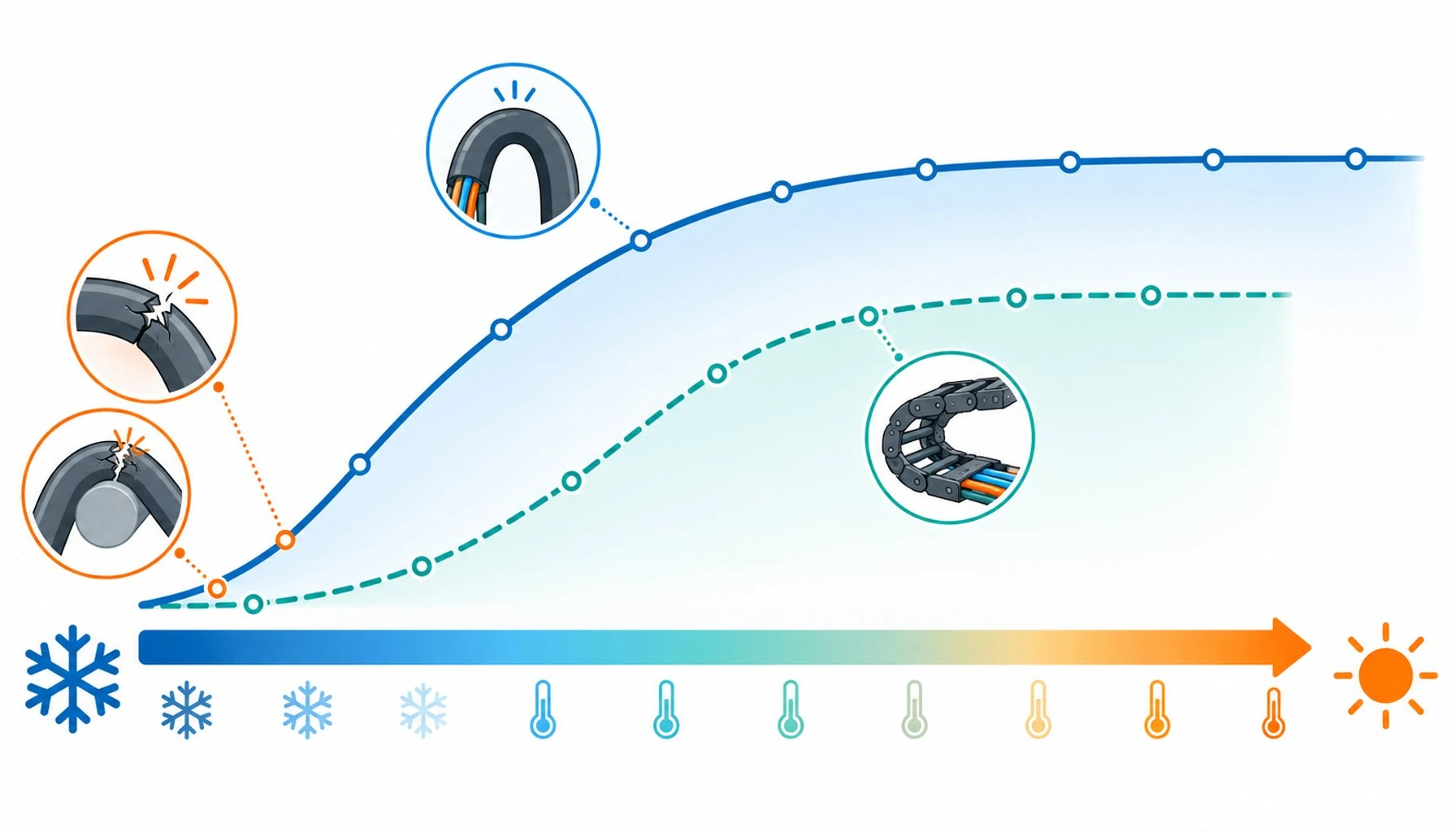
Polymer flexibility comes from molecular mobility: long chain molecules that slide past each other when the material bends. Temperature is molecular motion, and cold removes it. As temperature drops, every polymer passes through ranges where it stiffens, then where it becomes glassy and brittle. Two numbers describe the transition region rather than one point, and the useful number for cable buyers is the one where the material still tolerates bending, not the one where it finally shatters.
Different compounds shift their transitions differently. PVC stiffens early because its plasticizer mobility collapses; a PVC cable that feels limp at room temperature can be close to rigid at minus 20. Standard PUR keeps useful flexibility well below that, with specialized formulations reaching deeper. TPE compounds are engineered for exactly this window and often hold the best bendability at extreme cold, which is why winter-rated motion cable frequently carries a TPE or special elastomer jacket. Copper does not care about cold in this range, but the stranded conductor’s geometry, covered in most discussions of mechanical protection choices, still decides how the stiffened cable distributes bending stress.
Static Endurance Versus Dynamic Cold Flex
The two cold properties get confused because datasheets merge them into one temperature figure. Static cold endurance asks whether the cable survives being cold: installed, energized, left alone. It is tested with cold conditioning followed by a modest bend or impact, and most decent cables pass at meaningful depths. Dynamic cold flex asks whether the cable survives being cold and moving: bending to its working radius, repeatedly, at the lowest service temperature. This is a far harder test, and it is the one that separates winter-rated motion cable from cold-tolerant stationary cable.
The practical rule: if the cable moves even occasionally while cold, specify dynamic cold flex at your minimum temperature. A loading dock roller door that cycles ten times a day at minus 25 is a dynamic application; a sensor run along a frozen wall is static. Between them sits every automated cold-store crane, every outdoor robot and every winter yard vehicle, all dynamic, all requiring the harder property.
Choosing Compounds and Constructions for Cold Motion
Compound choice leads. TPE and cold-flex PUR formulations dominate genuine cold-motion cable; PVC appears only in dry, mildly cold, static positions. The jacket also wants a formulation that stays abrasion resistant when cold, because a jacket can pass a bend test and still powder off against a chain divider at minus 30. Inside, insulation follows the same logic, and the fillers and binders are chosen so the core stays compact without freezing into a stiff rod. Short-lay stranding, the geometry covered in the conductor-focused guides, matters double in cold service: strain sharing is the only defense when the material itself has less give.
Construction details finish the job. Cables intended for cold chains often run slightly larger bend-radius recommendations, acknowledging the stiffer material, and their terminations deserve attention because glands and connector bodies have their own cold ratings that are routinely overlooked. A winterized cable on a summer-rated gland is a specification gap, not a cable failure.
The decision below compresses the compound and duty logic into the cases a buyer actually meets. It assumes the motion question has already been answered honestly, because every row depends on whether the cable truly moves while cold.
| Test | Method in brief | What it proves | What it does not prove |
|---|---|---|---|
| Cold bend | Condition at claimed temperature, wrap around mandrel, inspect | One bend at temperature without cracking | Repeated bending; the cable may pass once and fail in service |
| Cold impact | Condition, then strike with weighted falloff | Resistance to mechanical shock while cold | Flexibility under continuous motion duty |
| Cold elongation | Stretch conditioned sample to failure | Remaining ductility at temperature | Behavior at a real bend radius with real curvature |
| Dynamic cold flex | Repeated bending at working radius while conditioned | Actual moving duty at the claimed temperature | Nothing about the whole cable unless shield and cores are included in the test |
| Full-cable cycle test in cold chamber | Whole cable run in a chain at temperature to claimed cycles | System-level winter performance including shield and jacket | Your exact duty if radius, speed or temperature differ; check the conditions |
The Tests Behind an Honest Cold Rating
Cold ratings earn credibility through specific, nameable tests, and the buyer who knows them can audit a datasheet in minutes. The cold bend test conditions a sample at the claimed temperature and bends it around a mandrel; pass means no cracking visible to standard inspection. The cold impact test drops a weighted striker on a conditioned sample. Cold elongation measures how far the conditioned material stretches before failure. Dynamic versions of these put the conditioned cable through repeated bending at working radius. The table below collects the tests, what each proves, and what each fails to prove, because the gaps are where bad products hide.
| Situation | Cable answer | Key evidence to demand | Common mistake to avoid |
|---|---|---|---|
| Fixed runs in a cold store, never moved after install | Standard installation cable with static cold endurance at the site minimum | Cold bend and impact results at temperature | Paying motion-cable prices for a static run |
| Chain or robot duty inside a freezer hall | Cold-flex TPE or PUR motion cable, radius adjusted for stiffness | Dynamic cold flex at the minimum temperature, chain data if applicable | Reading the static rating as a flexing guarantee |
| Equipment cycling between dock and freezer | Cold-rated cable verified for thermal cycling, sealed terminations against condensation | Cycling evidence plus termination temperature ratings | Specifying the cold point while ignoring the crossing |
| Outdoor automation in winter climates | Cold-flex jacket with UV and weather resistance combined | Combined cold and weathering test data | Solving cold and forgetting the sun |
| Occasional manual handling at cold temperatures | Cold-tolerant jacket, modest flex requirements | Cold bend at the site minimum | Over specifying dynamic flex for a static duty |
Where Cold-Rated Cable Meets the Rest of the Site
The strongest evidence in this market is the last row: a full-cable cycle test run inside a temperature chamber, with the failure criterion stated. Suppliers who run it are rare and worth finding, because it collapses every datasheet ambiguity into one number measured the way your machine will measure it.
When Cold Ratings Are Not the Answer
Cold motion cable rarely lives alone. Cold stores run power and data infrastructure alongside the moving equipment, and the material logic there follows the same fire-safety and emission trade-offs discussed in the guide to LSZH versus flame-retardant cable, where low-smoke requirements in enclosed cold halls interact with low-temperature flexibility. Outdoor and mixed-climate installations add solar exposure and temperature cycling, subjects that the broader guide to outdoor cable specification treats for the photovoltaic case with lessons that transfer. Inside the equipment, insulation temperature behavior connects to the static-cable chemistry explained in the comparison of XLPE and PVC insulation.
Cold rooms also stress the cabinet itself: condensation on every temperature transition, glands breathing moist air, and control gear that needs the sealing discipline described in the guide to control cabinet construction. Sizing the moving circuits for voltage drop at low temperature with the method in the cable sizing guide closes the electrical loop.
RFQ Checklist: Specifying Cold-Duty Cable
Honest limits: temperature ratings describe material behavior, not system survival. A cable that bends perfectly at minus 35 still dies if the application also soaks it in the wrong fluid, abrades it against an icy guide edge or terminates it in a gland that cracks first. Continuous extreme cold, deep-freeze logistics at minus 50 and below, sits at the edge of standard compounds and enters specialty territory where every claim deserves its test evidence read carefully. And thermal cycling, repeatedly crossing from warm to cold, ages materials in ways constant cold does not, through expansion mismatch and moisture; machines that move between dock and freezer need cable chosen for the cycling, not just the low point. The rating is one axis of a multidimensional environment, and the honest specification names all the axes.
Conclusion
Bring the cold to the supplier in numbers:
- Minimum and maximum service temperature, and whether the cable moves at the minimum
- Motion duty at cold: radius, cycles per day, travel speed, and dwell positions
- Thermal cycling statement: how often and how fast the cable crosses temperature zones
- Evidence required: dynamic cold flex at your minimum temperature, or full-cable cold-chamber cycle data
- Jacket compound choice per zone, with cold abrasion behavior stated
- Termination plan: glands and connectors rated for the same temperatures as the cable