Korea KC Certification: Entering the World's Densest Robot Market
Quick Answer: Korea’s robot density is the highest in the world, and its electrical product rules name wires and cables. Both facts matter: one makes the market attractive, the other decides whether your shipment clears.
Korea runs 1,220 industrial robots per 10,000 manufacturing employees, roughly half again as dense as the second-place economy, and the lead has been widening at about seven percent a year since 2019. Around thirty thousand units were installed in 2024 alone. That is an attractive market by any measure. It is also one where the electrical product rules explicitly list wires and cables, which means the paperwork can stop a shipment before anyone discusses flex life. The combination is what makes Korea worth understanding properly rather than treating as another country file.
Introduction
Korea’s electrical product certification system, known by its national mark, replaced an earlier scheme and has been in its current shape for over a decade. It operates through a single mark across several product areas, with the safety track and the electromagnetic compatibility track managed separately and issued by different authorities. Wires and cables appear in the safety track’s regulated product list, which is the fact that changes everything for a cable supplier.
The system is risk-tiered rather than uniform. Products in higher-risk categories face the heaviest obligations, including factory audit and continuing surveillance. Products in lower-risk categories can be handled through declarations. Knowing which tier a given cable falls into decides whether you are looking at a few weeks of documentation or months of audit scheduling. The same question in other markets is surveyed in the guide to cable certification checklists.
Three Schemes, Three Levels of Rigour
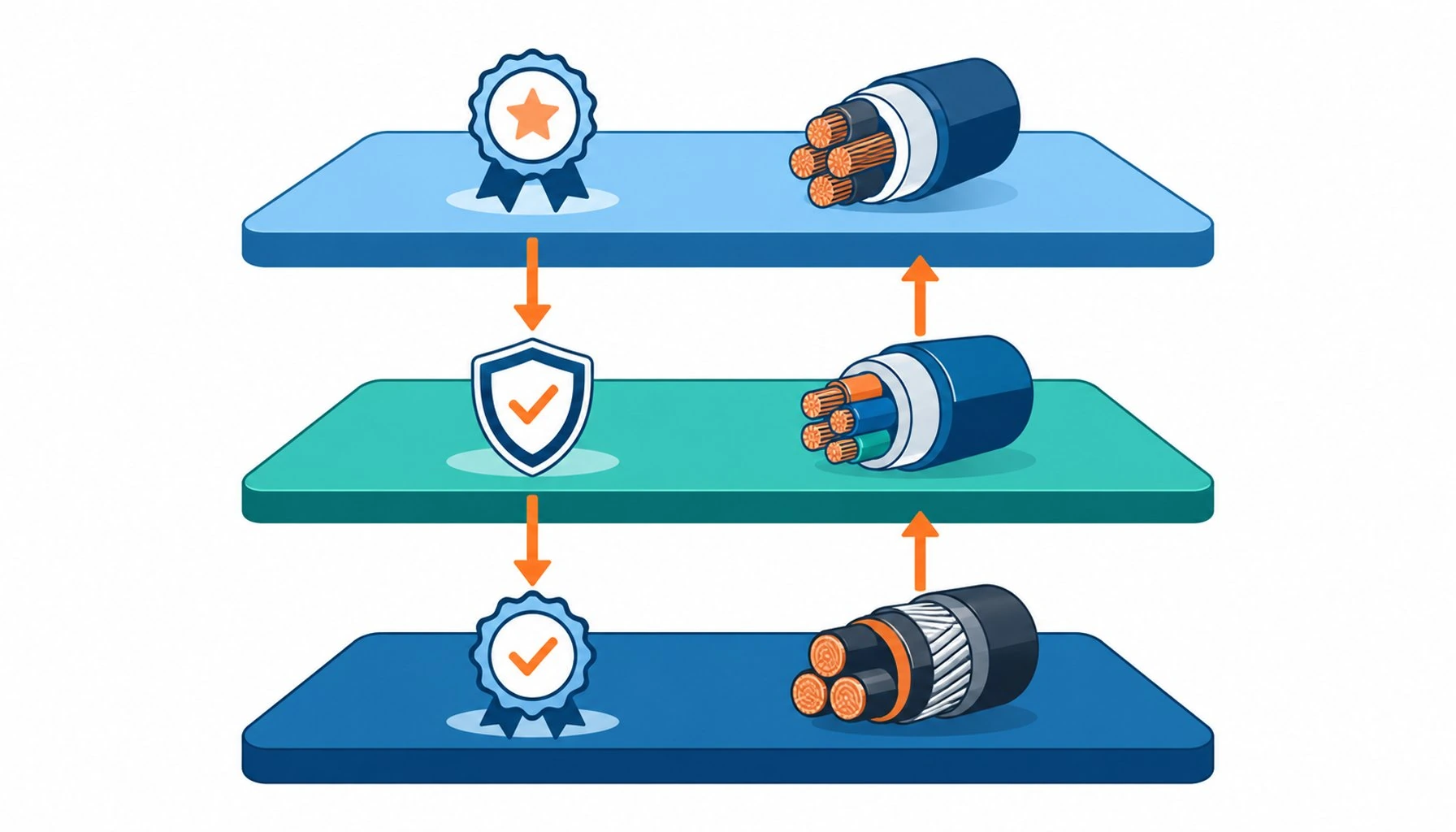
Understanding the tiers is the whole game, because suppliers routinely buy the wrong one. The heaviest tier applies where the risk is judged highest and involves type testing plus a factory audit, with the certificate held by the manufacturing entity and surveillance continuing afterwards. The middle tier requires testing and technical documentation without the full audit regime. The lightest tier is a supplier’s own declaration, with no certificate issued.
| Track | Risk tier | What it requires | Who can hold it |
|---|---|---|---|
| Safety certification | Highest | Type testing plus initial factory audit, with continuing surveillance | The manufacturing entity, named per factory |
| Safety confirmation | Middle | Testing and technical documentation filed, with a fixed validity | Manufacturer, importer or supplier |
| Supplier's declaration | Lowest | A declaration of conformity by the supplier, with no certificate issued | Manufacturer, importer or supplier |
| Electromagnetic compatibility track | Separate regime | Emission and immunity testing under its own authority and identification | Applicant, through the designated route |
| Machinery safety obligations | Separate legislation | Safety certification for certain machinery categories under occupational safety rules | The machine's responsible entity |
Which Cable Actually Falls in Scope
Wires and cables have sat in the regulated product list for over two decades, covering insulated constructions for fixed wiring and flexible cords, rubber-insulated types and cord sets. The declared voltage range is broad enough to capture most industrial low-voltage product. What matters for a machine builder is the boundary: the regulated items tend to be the cable products placed on the market as such, including the cord set that connects equipment to the supply, while wiring internal to a machine is often treated as part of the machine rather than as a separately certified cable product.
That boundary decides your route. If you sell bare cable types into the Korean market as products, expect to be in the certification system. If you build machines that contain cable, the obligation usually attaches to the machine and to whatever connects it to the wall. Buyers who assume the opposite in either direction either buy unnecessary certification or ship a cord set that a customs officer refuses.
Holding the Certificate: Manufacturer, Factory and Agent
The heaviest tier is held by the manufacturing entity rather than by a distributor, and the certificate names a factory. A supplier with several plants therefore does not hold one certificate covering all of them, and a change of production site is not a paperwork update but a new case. Foreign manufacturers can apply in their own name now rather than only through a local agent, with the certificate issued per factory, and one certificate can serve several local agents, which removes the older constraint of one agent per certificate.
Two practical levers shorten the process. An international certification report can be accepted as a basis for the testing, which substantially reduces laboratory time for a construction already evaluated elsewhere. And being a factory rather than a trading company matters, because the audit is of the plant, not the sales office. The questions that establish whether a supplier genuinely owns the production being certified are collected in the guide to vetting equipment manufacturers.
Machinery Safety Is a Second Track
Certain machinery categories carry safety certification obligations under occupational safety legislation, which is a different regime from the electrical product rules and is administered differently. A machine can satisfy the electrical product requirements completely and still owe evidence under the machinery track, and the two are not interchangeable. Builders entering Korea for the first time discover this when a customer asks for machinery documentation they did not know existed, usually late in the project.
Labels, Language and What Has to Be Printed
Label content is prescribed rather than conventional. The mark appears with the certificate number, and the product information has to include the product name in Korean, the model, the voltage and frequency, the manufacturer, the country of origin, the date of manufacture and a Korean after-sales contact. Technical documentation supporting an application is expected in Korean as well.
For a cable supplier, two consequences follow. The print legend on the jacket and the label on the product are separate obligations, and both may be inspected. And the Korean-language requirement is not a translation task bolted on at the end; it changes what has to be produced, and it is one of the reasons a local partner is often worth having. The evidence requirements that accompany a delivery are otherwise familiar, and the same discipline described in the guide to technical documentation applies to assembled project files. Where a construction has to be sized against the installation’s conditions, the guidance in the cable selection guide covers the calculation side.
| Decision | Route that avoids delay | Cost of leaving it late |
|---|---|---|
| Is the cable sold as a product or used inside a machine? | Establish the boundary before quoting | Certification bought for the wrong obligation, or a refused cord set |
| Which risk tier applies to the construction? | Confirm the tier from the regulated list, not from a supplier's assumption | A factory audit appearing on the critical path |
| Who will hold the certificate? | The factory, named per site, with agents arranged accordingly | Lost time when production moves to a second plant |
| Can an existing international report be used? | Reuse it to cut laboratory time, covering national differences | Full re-testing that was avoidable |
| Are machinery safety obligations also in scope? | Check the machine category early | A late request for documentation nobody prepared |
| Labels and Korean-language files | Produce them as part of the application, not after approval | Findings at import or at the customer's receiving |
When the Electrical Certificate Is Not the Answer
Three limits apply. An electrical product certificate is not a machinery safety document, and passing one does not discharge the other. A certificate covers the construction and the factory named on it, so a second site or a changed compound starts a new process. And neither track says anything about flex endurance, which is the question a robot builder actually cares about; a certified construction can still be the wrong cable for a continuously moving axis.
RFQ Checklist: Cable and Certification for Korea
Send these with the inquiry so the certification route is settled before quotation:
- Whether the cable will be sold as a product or used inside a machine, and which the customer requires
- The risk tier applicable to each construction, and the evidence the customer expects to see
- Which factory will produce the order, since the certificate names a site
- Any international certification report that can be reused as the testing basis
- The label content required, including the Korean product name and after-sales contact
- Whether machinery safety certification obligations also apply to the equipment category
- Lead time for the certification process itself, separate from the production lead time
Conclusion
Korea offers the densest automation market in the world and attaches an explicit certification requirement to the cable products sold into it. Neither fact is bad news, but they have to be handled together. Establish whether your product is a cable or part of a machine, find the risk tier, name the factory, and plan the certification lead time alongside the production one. The suppliers who treat it as a project input win orders that others lose to a customs hold.
Kexingyu Cable Group (KXYE) supplies control, servo and robot cable with the test documentation and material records a Korean application needs, and where a qualified version of a construction is required we source it through our partner arrangements and identify the certificate holder honestly rather than claiming a mark we do not hold. Send the constructions and the customer’s certification expectations through the RFQ page.