Sourcing DC Breakers for 800V HVDC: Ratings, the Standards Gap and What to Put in the RFQ
Quick Answer: Direct current has no natural zero crossing, so a DC breaker has to force an arc out rather than wait for it to die. At 800V that makes protection the least commoditised purchase in the whole distribution layer — fewer qualified suppliers, longer lead times, and a standards framework that is still catching up with the products being installed.
Every other article about 800V data center power eventually reaches the same sentence: the protection devices are the problem. That sentence is usually left where it is, without saying what a buyer is supposed to do about it. This article is about the buying side of that sentence.
Introduction
AC protection is a solved category. A moulded case circuit breaker rated for a fault level, at a voltage class, with a documented breaking capacity and a well-established type test regime — there are dozens of manufacturers, published selection tables, and a supply chain that behaves predictably. Data center electrical engineers have specified it for decades.
Move the same duty to 800V direct current and three things break at once. The physics changes, because an arc in DC has no half-cycle zero to exploit and must be extinguished by design. The device market changes, because the number of manufacturers with genuine DC breaking capability at this voltage and current is a fraction of the AC world. And the evidence trail changes, because the standards that govern DC breaking are still being extended while products are already being installed. A buying process built on AC habits will not survive all three.
Four Ways to Protect an 800V DC Distribution Point
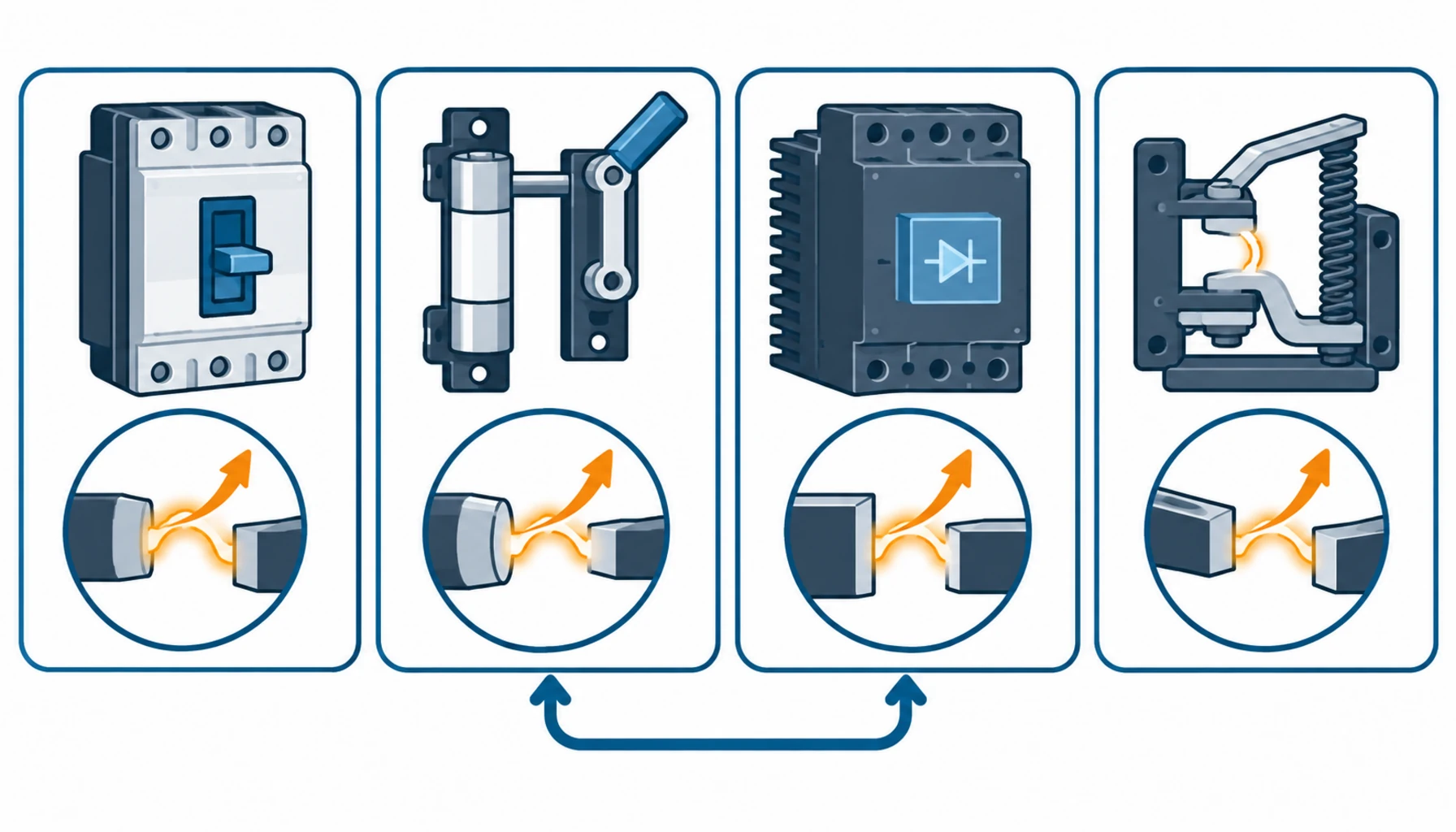
The protection decision is not simply which breaker to buy. There are four routes, and they differ far more in verification burden than in list price — which is the part that surprises procurement teams.
| Option | What You Must Declare | Evidence to Demand | Cost and Lead Time | Main Risk |
|---|---|---|---|---|
| DC-rated circuit breaker | DC voltage class, breaking capacity, circuit time constant, number of poles in series | DC breaking test at the declared time constant, not an AC equivalent | Longest lead time in the distribution layer, from a short supplier list | Ordered late, it becomes the item that stops the hall being energized |
| Fuse and isolator | DC voltage rating, prospective current, melting and clearing characteristics | DC test data at the system time constant, plus fuse coordination curves | Cheaper and shorter lead time, but one-shot protection | Replacement after a fault means downtime that a resettable device would have avoided |
| Solid state circuit breaker | Interruption time, on-state losses, cooling, and the failure mode when the device itself fails | Interruption time under fault, plus the passive back-up that covers a device failure | Fastest interruption, highest cost, and a young supply base | A protection device that can fail closed needs protection of its own |
| AC device used in DC service | Whether it genuinely carries a DC rating for the duty, not just a voltage figure | Documented DC breaking capacity at the system time constant | Looks cheapest and fastest until the test evidence is requested | An arc that does not clear — the failure is not graceful and not isolated |
Why DC Breaking Is Harder Than the Voltage Suggests
On an alternating current system the current passes through zero twice every cycle. That moment is the opportunity a breaker uses: the arc is stretched, cooled, and allowed to go out at the natural zero. Direct current offers no such moment, so a DC breaker has to build one — typically by driving the arc into a splitter plate stack, stretching it, and forcing the voltage across the arc above the system voltage until the current is driven to zero.
That mechanism has two consequences for a buyer. First, the device is physically larger and more expensive for the same current, because it is doing work that AC does for free. Second, and more importantly, the performance depends on the circuit’s time constant — the ratio of inductance to resistance in the fault loop. A DC breaker’s declared breaking capacity is only meaningful when quoted against a stated time constant. Take a filled-out DC rating of 800V, 1000A and 25 kA, strip off the time constant, and you have a number that cannot be checked against your installation.
This is the single most common procurement gap in the category. Buyers who have specified AC breakers for years ask for the voltage and the breaking capacity out of habit, and the time constant — the one parameter that makes the other two meaningful — is left to the vendor’s default. Write it into the enquiry.
The Standards Gap and How to Buy Across It
Part of the reason DC protection is awkward to purchase is that the framework is still filling in. DC ratings have been carried in the established low voltage switchgear and circuit breaker standards for a long time, but the higher voltage DC classes, the time constants and the coordination rules that data center installations actually rely on are being extended while equipment is already going into halls.
For procurement this creates a specific situation: you may be buying against a standard whose relevant part is not yet complete, and the vendor’s test evidence may reference a regime that is not the one your engineer assumed. There are only three honest ways to handle that, and all of them are contract clauses rather than specification lines.
State the test regime you will accept, in the purchase order, rather than leaving it to be interpreted. Require the DC breaking test to be reported at your system’s time constant, with the test house named. And require the coordination study to be a deliverable, because a protection device’s breaking capacity tells you nothing about whether it and the device upstream of it will behave as a pair. Our note on the switchgear standard explained covers how the equivalent framework works on the AC side, which is useful for seeing exactly where the DC editions diverge.
What to Freeze in the DC Protection Specification
Every item below is something a DC breaker supplier has a default for, and every default is a way for the order to be technically compliant and practically wrong.
| Parameter | What to State | Evidence to Demand | Cost of Leaving It Open |
|---|---|---|---|
| Circuit time constant | The L/R of the fault loop at each protection point | Breaking test reported at that time constant | A breaking capacity figure that cannot be checked against your installation |
| Breaking capacity | Prospective fault current at the device, at the declared time constant | DC breaking test report naming the device and the values | A device that is nominally rated but not for your fault duty |
| Poles in series | How many poles are used in series to achieve the DC rating, and the wiring arrangement | Test arrangement drawing, not just the headline rating | A rating achieved on a wiring pattern different from yours |
| Polarity and earthing | The polarity arrangement and whether the system is earthed or unearthed | Device rating for the polarity arrangement used | A device rated for an arrangement it is not installed in |
| Coordination and selectivity | The upstream and downstream device pair, and the discrimination target | Coordination study with the settings schedule | A fault that trips the whole row instead of one branch |
| Insulation monitoring | Monitoring device, alarm thresholds and response procedure | Scheme drawing and device data | A ground fault that stays invisible until it becomes a trip |
| Back-up protection | What covers the case where the primary device fails to operate or fails closed | Back-up device rating and its independent test basis | A protection layer with a single point of failure |
When to Stay With Conventional AC Protection
DC protection is expensive, slow to arrive and thinly sourced. There are three situations where it should not be bought at all.
Density below roughly 100 kW per rack. The current levels that make DC distribution worthwhile are not present, and conventional AC protection is a mature, multi-source, short-lead-time purchase. The AC reference architecture is set out in our note on 415V data center distribution.
A project energizing before DC-rated devices are genuinely available. A protection device on the critical path that cannot be supplied is worse than a slightly less elegant architecture that can be. Where the hall must energize on a fixed date, rating the distribution layer for the eventual voltage while protecting it with proven equipment for the phase one voltage is the sequence most operators are taking.
No capability to run selective coordination. DC protection lives or dies on coordination — which device operates first, and whether the installation isolates the fault or the hall. A site without the engineering depth to model and verify that is better served by architecture whose protection behaviour is predictable. The wider power chain that these devices sit in is mapped in our data center power chain overview.
The mistake to avoid is treating a DC breaker as an AC breaker with a different label and a longer lead time. It is a different device doing a harder job, and the specification that gets it right is the one that names the time constant, the poles in series, the coordination pair and the back-up — all four, before the order goes out.
RFQ Checklist for 800V DC Protection
Send the fault duty, not just the current. Each enquiry should carry:
- DC voltage class of the distribution layer and the voltage the system is energized at
- Prospective fault current at each protection point, and the circuit time constant assumed
- Earthing arrangement and polarity, with the insulation monitoring philosophy
- Poles in series intended, and the wiring arrangement the rating is claimed under
- The upstream and downstream device pair, and the discrimination target for the study
- Back-up protection philosophy if the primary device fails to operate
- Enclosure type, form of separation, and the cabinet or panel the devices sit in
- The test regime you will accept, and the test house or standard edition it must reference
- Coordination study ownership, scope and the settings schedule to be handed over
- Delivery schedule with dates, plus the spares position for the devices themselves
- Certification for the destination market and the edition of each standard applied
Conclusion
DC protection is the least commoditised purchase in an 800V distribution layer and the one most likely to decide the schedule. The physics explains why: no zero crossing means the device has to manufacture the interruption, and the performance depends on a time constant that most enquiries never mention. The supply base explains the rest — few manufacturers, long lead times, and a standards framework still filling in the details.
Buy it deliberately. Name the time constant, the poles in series, the polarity arrangement and the coordination pair. Require a DC breaking test at your duty rather than an AC equivalent, and make the coordination study a deliverable rather than a commissioning finding. Kexingyu Cable Group (KXYE) supplies the distribution cabinets, busbar tap-off hardware and medium voltage switchgear that house these devices — the GGD power distribution cabinet and KYN28 medium voltage switchgear ranges are the conventional reference points — together with the power, control and mineral insulated cable ranges used across these halls: WDZ-YJY, WDZN-YJY, BTTZ, BBTRZ, NG-A (BTLY), KVV and YJV. Send your fault level and time constant and we will size the distribution package with the evidence list attached; the fastest start is a request for quotation.