Introduction
If you’re an EPC contractor scheduling a substation, industrial, or data center project right now, you already know that “lead time” has become one of the most important variables in your project plan — sometimes more important than the engineering itself. But switchgear and transformers don’t behave the same way when it comes to delivery timelines, and treating them as interchangeable line items in your procurement schedule is a common, and costly, mistake.
Why transformers and switchgear have different bottlenecks
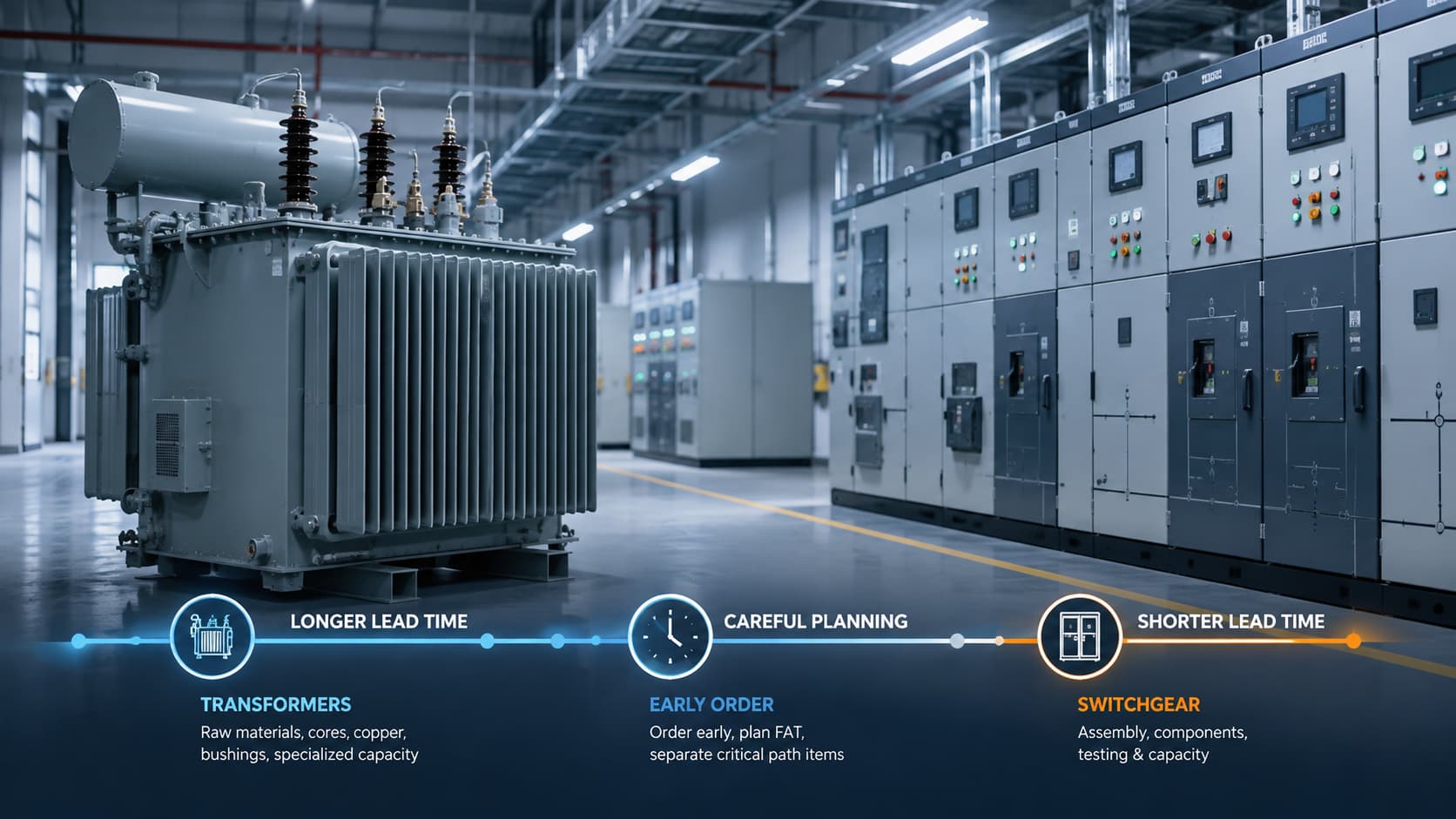
Transformers are constrained primarily by raw material and core component availability — grain-oriented electrical steel, copper windings, and bushings all have their own global supply chains, and large power transformers require specialized manufacturing capacity that takes years to build out, not months. This is why large power transformer lead times have stretched from under two years to an average of around 128 weeks, with high-capacity units taking four to five years in some cases.
Switchgear, particularly medium voltage metal-clad switchgear, is more assembly-intensive — it depends on component availability such as circuit breakers and protection relays, plus in-house wiring and testing capacity. Many channels are already booked past 2028 for MV switchgear, but the bottleneck here is more about manufacturing throughput than raw material scarcity.
The practical implication: you can’t assume that solving your transformer lead time problem also solves your switchgear problem, or vice versa. They need to be procured on separate tracks, often from different specialized sources.
A rough current benchmark
These numbers shift by region, capacity class, and specific manufacturer backlog — always confirm directly with your supplier rather than planning against generic industry figures.
How this should change your procurement sequencing
Order transformers and MV switchgear first, before final civil design is locked — waiting for full design certainty before issuing purchase orders is a habit built for a world where lead times were short, and that world doesn’t exist anymore for this equipment category. Separate critical path items from flexible items, since LV panels and accessories can usually be sourced faster and later in the schedule. Get FAT scheduling in writing, not just a ship date — a supplier that gives you a delivery date without a documented factory acceptance test process is a red flag. And get multiple supplier quotes even if you have an existing vendor relationship, since the market has shifted enough in the past two years that your usual supplier’s lead time may no longer be competitive.
Where this leaves data center and industrial projects
For projects where MV switchgear and transformers are both on the critical path — data centers being the clearest example — the compounding effect of both bottlenecks hitting simultaneously is what’s driving the widely discussed 30-50% project delay estimates for 2026. Understanding that these are two separate procurement problems, not one, is the first step to actually managing around them.
Where Kexingyu Power fits in
We manufacture both MV switchgear and transformers in-house, which means your procurement team deals with one coordinated delivery schedule instead of reconciling two separate suppliers’ backlogs.
(Lead time figures reflect industry estimates as of early 2026.)