Temporary Power on Site: What the Standards Actually Require of Buyers
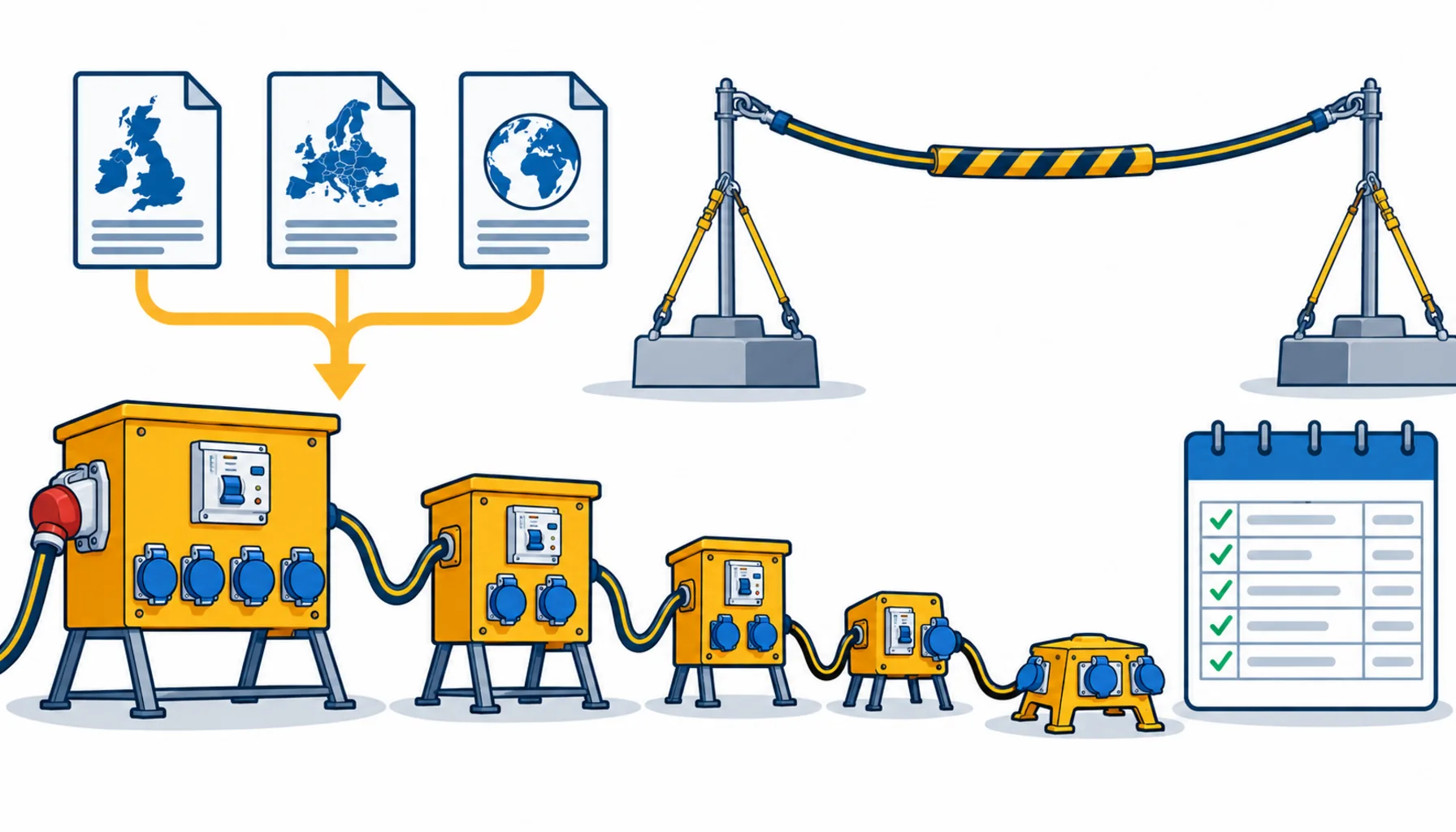
Quick Answer: The temporary power standards, IEC 60364-7-704, BS 7671 Chapter 70 and China’s JGJ 46, look different on the page and converge on the same requirements: graded distribution with protection at every level, reduced low voltage or sensitive RCDs where people work close to the supply, cable specified for the moving duty it actually sees, reduced fire behaviour inside structures, and records proving all of it. Translate the clauses into a purchase specification and compliance stops being an inspection drama.
Introduction
Temporary power is where standards enforcement bites hardest in construction, because the installations change weekly and the auditors know it. The international standard IEC 60364-7-704, the UK’s BS 7671 Chapter 70, and China’s JGJ 46 code each regulate construction and demolition sites, and a contractor working across markets meets all three.
The good news for buyers is that the three converge. They grade protection the same way, they worry about the same cable duties, and they ask for the same evidence. This guide reads the standards as a purchase specification: what each requires, where the versions differ, and what to put in the RFQ so the delivered system passes audit the first time.
What the Standards Agree On
Graded distribution. All three frameworks expect an origin of supply, intermediate distribution, and final circuits, with protection coordinated at each level rather than one device protecting everything. The practical buying unit is the graded distribution box; our three-level construction distribution box exists because the standards demand the grading, and buying boxes built to the scheme is cheaper than assembling it.
Protection against indirect contact. The standards recognise that construction sites have high earth loop impedances, and each offers the same two answers: automatic disconnection sized for the real loop, or residual current protection at useful sensitivity, or reduced low voltage for the wettest and closest work. JGJ 46 is the strictest of the three in practice, requiring residual current protection at multiple levels with defined sensitivities, which is why Chinese site packages specify graded RCDs as standard equipment rather than options.
Inspection and records. Every framework requires the temporary installation to be inspected and tested at intervals, and the interval is short precisely because the installation moves. The records requirement is the part buyers most often miss: the audit asks for dated test records per device, and the hardware for that, testable joints, labelled boards, accessible devices, is bought at the start or retrofitted expensively.
Where the Versions Differ
The differences are narrower than the documents suggest, but they decide equipment in each market, and a buyer who plans a multi-market programme reads them once and writes the answer into the fleet standard rather than renegotiating it project by project.
Voltage arrangements. BS 7671 Chapter 70 pushes reduced low voltage, 110 volts centre-tapped, for portable tools on sites, which is why UK site distribution is a 110-volt world with yellow transformers at every level. IEC 60364-7-704 accepts the same measure among options. Markets running 230-volt portable equipment lean harder on 30 milliamp RCDs instead. The buyer’s decision is which protection philosophy the fleet follows, because it decides the transformers, the plugs and the cable core counts in every kit.
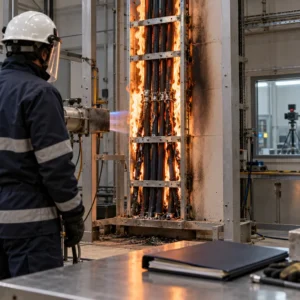
Fire behaviour inside structures. Cable run through temporary accommodation, hoardings and enclosed works takes the standard’s fire clauses, and markets differ in how they grade it. Flame retardance is the common floor; our note on ZA, ZB and ZC flame retardant classes explains the grading, and where smoke matters, tunnels and enclosed occupied areas, our comparison of LSZH versus fire retardant cable covers the halogen-free upgrade. JGJ 46 and its parent codes are specific about the fire performance expected in temporary installations, and exports built for China-market sites should meet it rather than assume equivalence.
Cable protection method. All three expect cable to be protected from mechanical damage, and the acceptable methods vary with the market’s enforcement habits: armoured construction and elevated routing satisfy every version, and our note on armoured versus unarmoured cable helps decide where armour is the cheap answer.
| Requirement Area | IEC 60364-7-704 | BS 7671 Chapter 70 | JGJ 46 (China) | What to Buy |
|---|---|---|---|---|
| Distribution structure | Graded supply, distribution and final circuits with coordinated protection | Same grading, RCD levels defined in detail | Three-level architecture, graded RCDs mandatory at each level | Graded distribution boxes built to the scheme, not assembled |
| Shock protection | Reduced low voltage or RCDs or fast disconnection per loop | 110 V centre-tapped preferred for portables, 30 mA RCDs elsewhere | Leakage protection at multiple levels with defined sensitivities | Protection philosophy decided fleet-wide before buying kits |
| Cable duty | Protected from damage; flexible constructions for moving parts | Same, with specific guidance on routing and mechanical protection | Overhead or protected routing specified, buried runs restricted | Heavy flexible site cable, armour at damage points, elevated routes |
| Fire behaviour | Per the installation's general requirements | Flame retardance expected in structures and routes | Specific flame retardance and layout rules for temporary installs | Flame retardant cable as floor, LSZH for enclosed occupied areas |
| Inspection | Periodic inspection and testing required | Defined intervals and documented results | Frequent checks with organisational responsibility assigned | Testable hardware bought at start; record template from day one |
The Cable Clauses, Read as Duty
The cable requirements in all three frameworks reward being read as a list of duties rather than a list of clauses. Stripped of the legal language, the temporary standards ask the cable to survive being moved, survive the weather, survive mechanical contact, and not feed a fire.
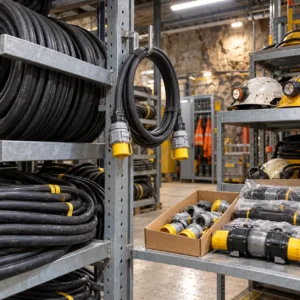
Moving duty. Everything from the distribution box outward on a site is handled, coiled and repositioned, and the standards’ flexible-construction requirements exist because fixed-installation cable fails quickly under that treatment. Fine-stranded rubber-sheathed construction is the baseline the frameworks assume, and buyers who substitute a cheaper fixed type are buying the failure the standards anticipated.
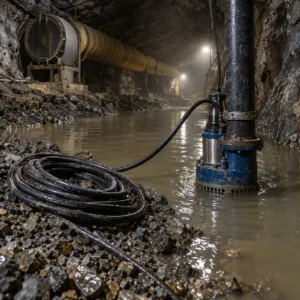
Weather and water. Temporary installations run through winters and monsoons, and the sheath compound plus the connection protection decide whether the installation survives its first season. Rain-tight enclosures and elevated routing are treated by the standards as protection methods, not suggestions, and JGJ 46 in particular is prescriptive about route heights and the prohibition on casual ground laying.
Mechanical protection. The frameworks require protection against impact and pressure wherever the route is exposed, with armour, conduit or elevation as the accepted answers. The enforcement detail differs, but the direction is identical: a cable a truck can reach without surviving the truck is non-compliant, whatever the market.
Fire behaviour. Covered above as a market difference, but the buying action is the same everywhere: state the grade per route, buy it certificated, and keep the declaration with the delivery documents so the auditor reads it instead of guessing it.
Reading the Standards as a Purchase Specification
The translation from clause to order is mechanical once the framework is chosen, and it produces five line items.
One. The distribution scheme: the graded boxes, sized to the site plan, with the protection levels named. Buy them complete and certificated rather than assembled on site, because the certificate is the first thing the auditor reads.
Two. The cable schedule: heavy flexible construction for everything that moves, armour or elevated routing where damage is plausible, and the fire grade matched to where each run passes. State the standard each run is bought against, because a mixed-market project can carry two fire grades for two areas.
Three. The protection accessories: transformers where the reduced-voltage philosophy applies, weather-rated enclosures, and testable, labelled connections at every joint a future inspector will open.
Four. The test regime and its records: installation tests on every new run, including insulation resistance before energisation, and a dated retest cycle; our note on insulation resistance testing covers the measurement. The template the site uses should produce a record per device, because that granularity is what the standards’ inspection clauses actually demand.
Five. The evidence pack: certificates for the boxes and cable, factory test reports from the manufacturers, and the declarations that tie the delivered goods to the standard named in the order. Buyers can verify the factory side before shipment rather than at the audit, and our notes on cable factory testing and third-party cable inspection cover both routes.
What to Freeze Before the Order
| Decision | What to State | Evidence to Attach | Cost of Leaving It Open |
|---|---|---|---|
| Governing standard | Which framework the installation is built to, per market | The named standard in the contract | Mixed-market kits that satisfy no auditor |
| Protection philosophy | Reduced voltage, RCD sensitivity, or both, fleet-wide | A protection schedule per level | Transformer and connector chaos across the fleet |
| Distribution hardware | Graded boxes bought complete and certificated | Factory certificates per box | Site-assembled boards that fail audit on paper |
| Cable schedule | Fire grade and construction per route | Standards named per run | Wrong fire grade discovered at the worst inspection |
| Test regime | Installation tests plus dated retest cycle | Record template producing a record per device | Compliance without proof, which audits treat as absence |
| Evidence pack | Certificates and factory reports attached to delivery | Pre-shipment verification | Compliance argued from memory instead of documents |
Cost Structure: Compliance Is Cheaper Bought Once
Standards-compliant temporary power costs more at the start and less everywhere else. The graded boxes, the correctly rated cable and the testable hardware are each a modest premium over the improvised versions, and each removes a category of audit finding, rework and downtime. The expensive version of compliance is the retrofitted kind: re-testing an undocumented installation, re-buying hardware the audit rejected, and the programme risk of a stop-work finding on a live project.
The savings compound across a fleet of projects. A contractor who standardises one compliant distribution scheme, one cable schedule and one record template buys the next project’s temporary power as a repeat order with the certificates already in the file. That standardisation is also the cheapest route to quality assurance on the supply side, because a repeating order holds the factory to the same build every time, and the same logic applies to the warranty conversation at the end of the project. There is a staffing saving as well: a site whose temporary system is standard and documented spends its electricians’ time on the works, not on explaining the installation to a new inspector every month, and across a multi-year programme that time is worth more than any hardware premium.
When a Standards-Led Specification Is Not the Answer
When the market has its own mandatory code. Where a local code exceeds the international standard, the local code governs, and buying to the international text produces compliant-looking equipment that fails inspection. Check the local layer first.
When the installation is not really temporary. Systems that will serve for years, site infrastructure that becomes permanent, deserve permanent-installation design, and the temporary standards are the floor for them, not the specification.
When the fault is management, not hardware. A site whose protection keeps getting defeated has a supervision problem, and more hardware will not fix it. Fix the grading and the culture before re-buying.
When the audit finding is documentation. Re-buying hardware because records are missing is the most expensive form of paperwork. Build the record template before the first delivery arrives.
RFQ Checklist
- Governing standard named per market, local codes checked
- Graded distribution scheme with protection levels per box
- Protection philosophy fleet-wide: reduced voltage, RCD sensitivity, or both
- Cable schedule with fire grade and construction per route
- Flexible site cable constructions declared with evidence
- Certificated boxes and factory test reports attached to delivery
- Installation test record template, one record per device
- Dated retest cycle assigned to a named role
- Pre-shipment verification for the factory side
- Repeat-order standardisation across the project fleet
- Route protection method stated per crossing and work area
- Compliance file location named in the project handover plan
Conclusion
The temporary power standards, read properly, are a shopping list with a test schedule attached: graded distribution, a protection philosophy applied fleet-wide, cable bought for the duty it sees, fire grades matched to the routes, and records that prove the chain. Translate the clauses into the RFQ once, and every project after it inherits a compliant, auditable system instead of a fresh argument with the next inspector.
Kexingyu Cable Group (KXYE) has manufactured cable in Quanzhou since 1996, supplying certificated flame retardant and heavy-duty flexible constructions for temporary power systems built to IEC, BS and JGJ requirements, with factory test reports attached to every delivery. Send us the standard your project is built to, and we will come back with the constructions and the evidence pack. The fastest route is a request for quotation.