Stadium Cable for Arenas and Exhibition Halls: What to Specify Before the Order
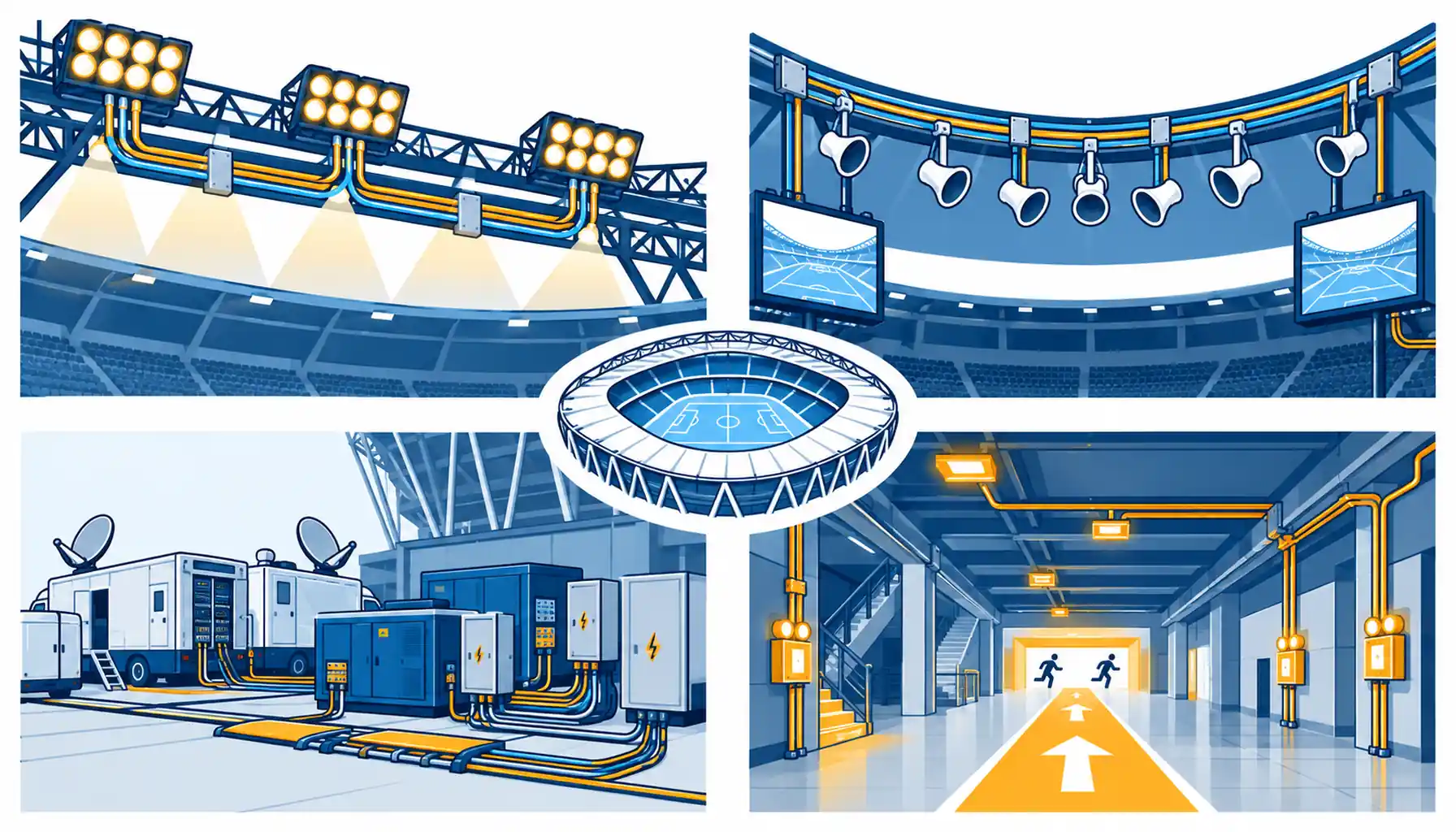
Quick Answer: A venue cable package serves a building that is almost empty most of the year and draws the power of a small town for a few hours at a time, with thousands of people inside it. That produces three specification pressures at once: very high intermittent loads, mixed signal types that have to share a structure with those loads, and an evacuation problem in a crowd. Buy the lighting and the audio circuits on their own duty rather than on a generic building allowance, separate the signal routes from the power routes, and treat the emergency circuits as the part that cannot be value-engineered.
Introduction
A stadium, arena or exhibition hall is a shed with a very particular electrical profile. The roof and the pitch need hundreds of kilowatts of lighting that is switched as a block, the public address and broadcast systems need clean and quiet circuits, and the concourses and stands need an evacuation strategy that works with a crowd rather than with a floor plan.
The cable package is where all three meet, because they share the same structure and often the same containment. This guide covers the scopes, the load behaviour that drives sizing, and the decisions to freeze before the order.
What Makes a Venue a Different Cable Problem
Loads are switched in blocks, not gradually. Floodlighting, arena lighting and scoreboard systems come on together. That produces a step change in current, harmonic content from the control gear, and inrush that the protection has to ride through. A cable sized on steady-state current alone is the standard mistake on venue projects.
Most of the year the load is almost nothing. The cable sits dormant in humid, sometimes unheated spaces between events. Insulation resistance in a dormant, cool and damp installation is a real commissioning issue rather than a formality, and it is more common in venues than in continuously occupied buildings.
Crowds change the egress requirement. Stands and concourses hold people in numbers that make assisted escape unrealistic, and the smoke behaviour of materials along the escape route matters more than in an office. The evacuation circuits are the ones that must survive, and they are the last place to cut cost.
Signal and power share the building. Broadcast, public address, timing, ticketing and CCTV all run through the same structure as the lighting and the catering supplies, and the design has to keep them apart without making the containment impossible to install.
Venue Cable Scopes
| Scope | Duty | What to Specify | Evidence to Demand | Cost and Lead-Time Driver | How It Fails |
|---|---|---|---|---|---|
| Pitch, roof and arena lighting | Block switching, high harmonics from control gear, long runs to remote positions | Conductor size on the starting and harmonic condition rather than steady state, neutral sizing for triplen harmonics, circuit integrity only where the circuit must survive | Sizing calculation showing the starting basis and the harmonic allowance, protection co-ordination study | Copper and the switchgear rating; the control gear can double the circuit count | Nuisance tripping at switch-on, or an undersized neutral running hot in a lighting circuit |
| Public address, AV and control | Low level signals in a building full of drives and dimmers, very long cable runs, live events | Screened construction with a stated earthing convention, balanced topology where the system uses it, segregation from power routes | Screen continuity test records, segregation drawing, earthing convention marked at each panel | The screening and the accessories rather than the conductor; approved device lists narrow supply | Earth loops and hum audible only when the venue is full, and no opportunity to rewire |
| Broadcast and media positions | Temporary and permanent feeds, camera positions with long runs, commentary and timing systems | Dedicated circuits for broadcast positions, clean earth arrangements where the broadcaster requires them, isolation for technical supplies | Isolation and clean earth test records agreed with the broadcaster, socket and connector schedule | Access and the fit-out of media positions; the cable is a small part of the bill | A power feed that injects noise into a commentary circuit, discovered during the first live match |
| Egress, alarm and emergency lighting | Must work during an incident with a crowd that does not know the building | Reaction-to-fire class along the escape routes, circuit integrity grade and duration for alarm, evacuation lighting and smoke control | Class declaration plus survival test evidence and system approval for fixings and terminations | The class and the grade, not the copper; the approved accessories are the constraint | A system that tests correctly in an empty venue and does not survive a fire in a full one |
| Stand, concourse and catering power | Dense small power, food outlets, kitchen loads, cleaning and washdown | Sheath for the environment, circuits arranged so an outlet fault does not take a concourse, mechanical protection where reachable | Circuit schedule with protection discrimination, ingress rating at outlets, test results per circuit | Metreage across a large plan; the containment cost can exceed the cable | A kitchen load added later on a circuit designed for vending machines |
Audio, Broadcast and the Earthing Problem
Venue audio is where cable procurement and system performance overlap most directly. A modern stadium has loudspeaker lines running hundreds of metres, radio microphone infrastructure, commentary positions and a broadcast compound, all fed from a distribution system serving dimmers and drives.
Choose the construction for the run, not the rack. Loudspeaker distribution in a large venue means long runs with meaningful current, and the voltage drop that matters is at the furthest speaker cluster. Where the system is constant voltage, transformer tapping decisions interact with the cable size, so buy the loudspeaker wiring and the speaker selection as one calculation rather than two. Our audio cable range covers the constructions used for loudspeaker and line level distribution.
Keep the earthing convention consistent end to end. Audio problems in venues are usually earth problems. Screens earthed at one end only, a single technical earth for the broadcast and AV systems, and a documented policy for what may be bonded to it are the practical requirements. Where the broadcaster supplies equipment, the clean earth arrangement they expect has to be agreed before the containment is fixed, not after. An isolation transformer or technical power conditioner at the technical supply point is often the cheapest way to make that work in an existing building, and our audio isolation power conditioner page shows how it is applied.
Broadcast feeds deserve their own circuits. Camera positions, commentary boxes and the outside broadcast compound normally need dedicated final circuits that nobody else can load. Sharing them with a catering outlet is how a live broadcast ends up with interference, and the fix afterwards is a new circuit through a finished stand.
Coaxial and signal runs. Where the venue still uses coaxial distribution for video and radio microphone infrastructure, the construction and the terminations have to match the impedance of the system throughout. Our coaxial cable range covers the standard impedance constructions; mixing families across a building is a common and avoidable fault.
Lighting Loads, Harmonics and Neutral Sizing
Venue lighting has moved largely to electronic control gear, and that changes two calculation inputs.
Neutral loading in three-phase lighting circuits. Electronic drivers and dimmers produce triplen harmonic currents that sum in the neutral rather than cancelling. On a large lighting distribution this can push the neutral current above the phase current, which means a full-size neutral and, on long runs, an oversized one. Our note on cable derating factors covers the factors that apply to a shared and enclosed containment, and both effects have to be in the same calculation.
Inrush and switching. Light-emitting and discharge lighting presents a starting current well above its running current, and a block-switched floodlighting installation is one of the harder protection problems in a building. The cable has to tolerate the starting duty, the protection has to ride through it without nuisance tripping, and the two decisions are linked. Specify the starting basis on the drawing rather than leaving the electrical contractor to guess.
Circuit arrangements. Fewer, larger lighting circuits reduce cost and make a single fault take out a large area; many small circuits cost more and keep the venue usable when one fails. For a venue that is hired out, the second arrangement is usually what the operator wants, and it is worth agreeing with them before the board is selected. Our lighting power distribution board page covers the assembly that sits at the end of those circuits.
What to Freeze Before the Order
| Decision | What to State | Evidence to Attach | Cost of Leaving It Open |
|---|---|---|---|
| Sizing basis | The starting current and harmonic allowance that the lighting feed is sized on | A sizing calculation with both stated | Nuisance tripping at switch-on, and a cable or protection change after commissioning |
| Neutral sizing | Neutral conductor size for each three-phase lighting distribution | Harmonic assessment or a stated design assumption | A neutral running hot in a circuit that appears correctly sized on the phase current alone |
| Earthing convention | Where screens are earthed, and the technical earth arrangement for AV and broadcast | A schematic with the convention marked and test records at handover | Hum and interference that only appears when the venue is full |
| Segregation of signal routes | Minimum separation between power and signal containment, and the crossing method | A segregation drawing approved before first fix | Signal faults found at commissioning with the containment already closed up |
| Egress class and survival grade | The class along escape routes and the grade and duration for the circuits that must survive | Class declaration plus survival test evidence and system approval | A compliance package that cannot be signed off before the first event |
| Circuit granularity | How many lighting and small power circuits per zone, agreed with the operator | A circuit schedule reviewed by the venue operator | Relighting or re-cabling the stands to keep the venue usable during events |
| Temporary and overlay provision | Where production, exhibition and temporary stand power will be taken from | A provision drawing with the outlets and ratings marked | Events cabled with temporary feeders draped through public areas |
When a Full Venue Specification Is Not the Answer
When the class is being applied to spaces nobody evacuates through. The premium belongs on the routes the crowd uses and on the circuits that must survive. Buying it for plant rooms and service tunnels spends money the design does not need.
When the audio problem is being solved with heavier cable. Hum and interference are normally earthing and segregation problems, not conductor problems. A larger cross section does not fix an earth loop, and it costs more than the fix.
When sizing was done on the running current alone. A lighting installation sized on steady-state current will trip at switch-on somewhere, usually on the first evening event with a full house.
When the temporary provision was left to the event contractor. Venues are hired out with a technical rider, and the power that production asks for has to exist at the right place and rating. Agreeing it at design stage costs little; discovering it a week before an event does not.
RFQ Checklist
- Sizing basis for each lighting circuit, including starting current and harmonic allowance
- Neutral conductor size for three-phase lighting distributions
- Class required along each escape route, with the route plan marked
- Survival grade and duration for alarm, evacuation lighting and smoke control circuits
- Earthing and screen convention for audio, AV and broadcast circuits
- Segregation distance between power and signal containment, and the crossing detail
- Dedicated circuits for broadcast, camera and commentary positions
- Circuit granularity per stand and concourse zone, agreed with the operator
- Temporary and overlay power provision points with ratings marked
- Containment support and bracing suitable for the roof and stand structure
- Spare ways, spare pairs and spare route space for later production demands
Conclusion
A venue cable package is decided by its load behaviour and its signal content rather than by its size. Size the lighting circuits on the starting and harmonic condition, keep a full neutral where the control gear demands it, separate the audio and broadcast routes from the power routes and give the signal systems a documented earthing convention, and protect the egress circuits from value engineering. Those four decisions make the difference between a venue that works on the first event and one that is rewired during its first season.
Kexingyu Cable Group (KXYE) has manufactured cable in Quanzhou since 1996, supplying the fire-rated, screened control, audio, coaxial and building wire constructions that venues and exhibition halls need, with the test records that a commissioning engineer will ask for. Send us the circuit schedule, the class plan and the broadcast requirement, and we will come back with the constructions, the evidence for each scope and the accessories that suit the structure. A request for quotation is the fastest route.