Cable Sheathing Materials Compared: PVC, PE, XLPE and LSZH Jackets
Quick Answer: The outer sheath is the cable's armor — PVC balances cost and flame retardancy, PE wins on moisture and cold, XLPE raises temperature, LSZH buys clean fire behavior. Buyers argue about conductor size and insulation class and then accept whatever sheath the factory suggests — yet the sheath is the only layer that faces soil, sun, cold, solvents and fire directly. Choose it by environment and the cable lives out its design life; choose it by default and the failure usually announces itself as a cracked, degraded or burning jacket. This guide compares the four dominant sheath materials and turns the comparison into a selection rule.
Introduction
Sheath selection errors are quiet at the quotation stage and expensive at year five: a PVC jacket chalked gray by UV on an outdoor run, a standard jacket split by a northern winter, a halogen-rich cable smoking through an occupied corridor. The materials are not exotic — four polymers cover most of the market — but their property profiles differ sharply, and the correct answer changes with every route. The insulation-side comparison of PVC and XLPE is covered separately in our XLPE versus PVC guide; this article stays on the outer jacket, where moisture, weather and fire behavior dominate.
The Four Materials, Profiled
PVC (polyvinyl chloride) is the default sheath of the industry: economical, tough in handling, easy to gland and terminate, inherently flame-retardant by formulation, and available in flame-retardant, oil-resistant and cold-weather grades. Its weaknesses are moisture resistance inferior to PE, cold-temperature brittleness in standard grades, and heavy smoke with halogen acid gas in fire. PE (polyethylene) is the moisture champion: superb water resistance, excellent low-temperature flexibility, strong abrasion behavior — the buried, ducted and outdoor jacket — at the cost of poor inherent flame retardancy and UV sensitivity without stabilization. XLPE (cross-linked polyethylene) takes the PE molecule and cross-links it, raising temperature capability, cut-through and environmental stress resistance; as a sheath it serves hot, harsh and industrial niches. LSZH (low smoke zero halogen) is the fire-safety answer: little smoke and no halogen acid gas in fire, mandated in occupied buildings and tunnels, at the cost of price and slightly stiffer handling. The XLPE molecule itself is profiled in our XLPE cable primer.
| Property | PVC | PE | XLPE | LSZH |
|---|---|---|---|---|
| Moisture resistance | Good | Excellent | Excellent | Good |
| Flame retardancy (inherent) | Good, gradeable | Poor | Poor without additives | Good |
| Smoke / halogen in fire | Heavy smoke, halogen gas | Heavy smoke, halogen gas | Similar to PE | Low smoke, zero halogen |
| Low temperature | Brittles in deep cold (grade-dependent) | Stays flexible | Good | Moderate |
| UV resistance | Moderate with stabilization | Needs stabilization | Good with stabilization | Moderate with stabilization |
| Temperature ceiling | ~70°C | ~75°C | ~90°C+ | ~70â90°C by grade |
| Gland and termination feel | Easy | Tougher, standard tooling works | Tough | Easy, slightly stiffer |
| Relative cost | Baseline | Baseline to modest premium | Premium | Premium |
PVC vs PE: The Indoor-Outdoor Divide
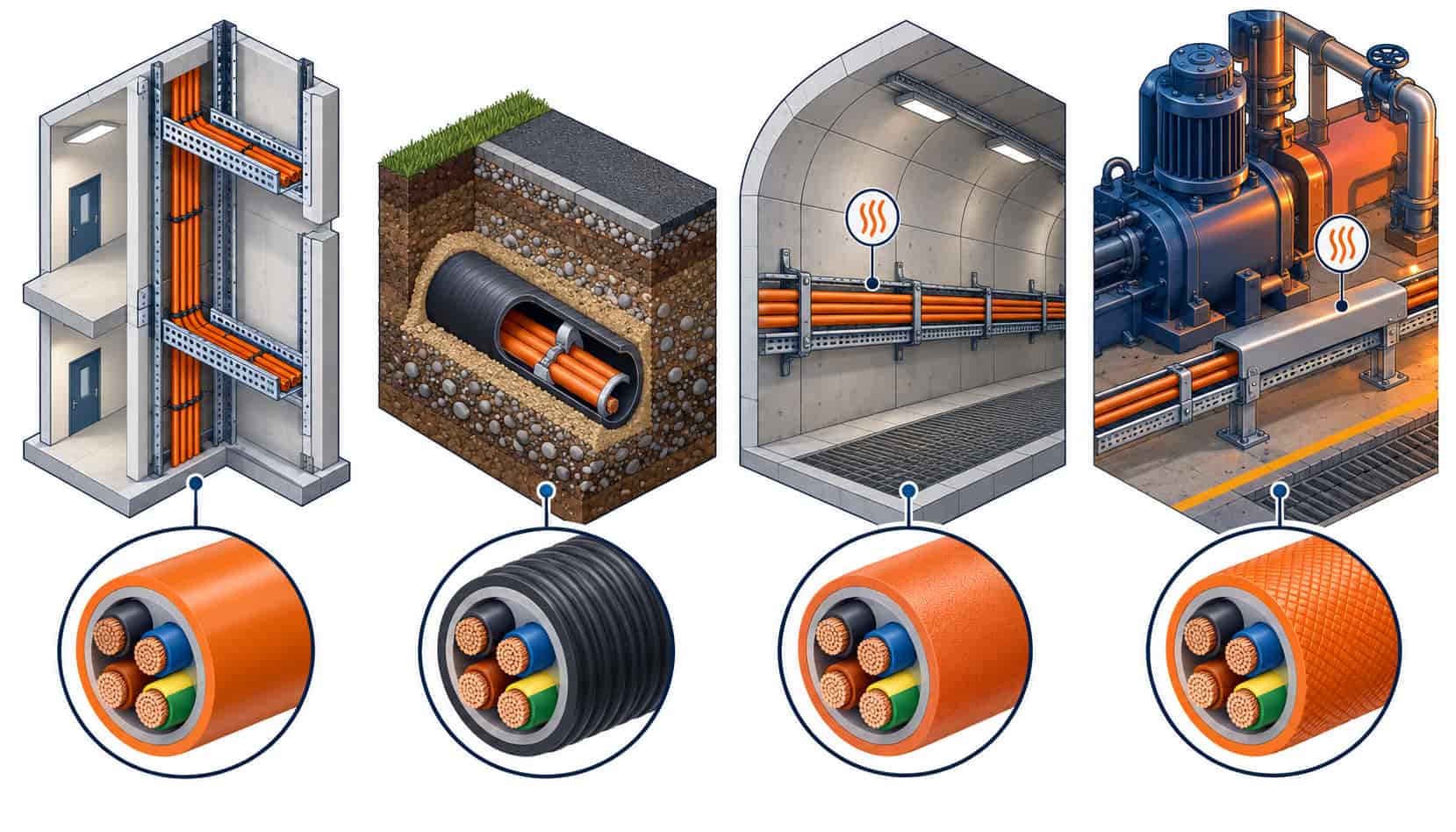
The most common sheath decision is also the simplest: buildings take PVC, the ground takes PE. PVC’s flame retardancy and termination ease own the indoor tray and riser world, where fire behavior and handling matter more than water; PE’s moisture and cold behavior own the buried, ducted and outdoor world, where water is the permanent enemy and flame retardancy is rarely audited. The YJV-versus-YJY pairing in the Chinese designation system encodes exactly this divide — same insulation, sheath letter V or Y. Where a route crosses both worlds, the tie-breaker is which exposure dominates: a duct run under a building stays PVC or moves to PE by moisture, an external wall stays PVC or moves to LSZH by fire code, and hybrid environments deserve the argument rather than the default.
LSZH: When Fire Behavior Rules the Jacket
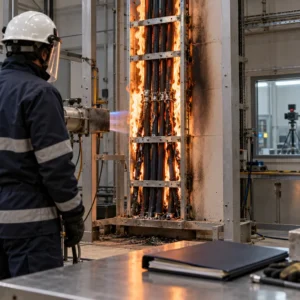
Occupied spaces changed the sheath conversation. In a corridor, tunnel, transit car or data hall, the smoke and acid gas a burning jacket releases decide whether people escape and whether adjacent equipment survives — and PVC’s halogen chemistry is exactly what fire codes moved against. LSZH jackets emit little smoke and no halogen acid gas, which is why occupied-building codes and tunnel specifications increasingly mandate them. The trade-offs are real: higher cost, marginally stiffer handling, and flame-retardant grades to be verified rather than assumed — LSZH describes smoke and halogen behavior, not spread class, and the full fire-behavior picture needs the prefix system behind it. The contrast between the LSZH story and the flame-retardant story is worked through in our LSZH versus flame-retardant guide.
| Environment | Sensible Sheath | Why |
|---|---|---|
| Indoor trays, risers, panels | PVC (or LSZH by code) | Handling, flame retardancy and cost rule indoors |
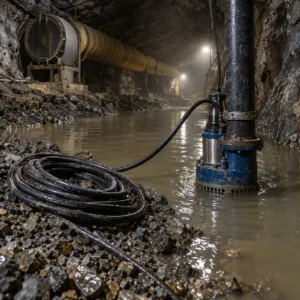
| Buried and ducted routes | PE | Moisture is the permanent enemy; PE is the champion |
| Cold-region outdoor runs | PE (cold grade) | Stays flexible where PVC brittles |
| Occupied corridors, tunnels, transit | LSZH | Smoke and halogen behavior mandated by code |
| Data halls and dense cable fields | LSZH or graded PVC per fire design | Occupancy plus cable mass drive the fire story |
| Hot industrial environments | XLPE sheath | Temperature ceiling and cut-through resistance |
| Open sun exposure | UV-stabilized grade of any choice | UV kills unstabilized jackets of every family |
Grades Within Grades: Saying What You Mean
Each polymer family hides a grade ladder, and the RFQ must climb it explicitly. PVC comes in general-purpose, flame-retardant (ZR-prefixed systems), cold-temperature (rated to −25 °C and below), oil-resistant and UV-stabilized grades — “PVC sheath” alone leaves every choice open. PE comes in high- and medium-density versions with different stiffness and abrasion behavior, plus UV-stabilized grades for solar exposure. LSZH grades differ in spread class and temperature ceiling. Two verification points catch most grade fraud: the datasheet fields naming the grade and its test basis — the fields worth reading are marked in our equipment datasheet guide — and batch certificates confirming the compound matches the type-tested formulation. The supplier verification discipline for catching compound substitution is the one in our power cable manufacturer checklist.
Export Mapping and Mechanical Neighbors
The sheath vocabulary translates cleanly: PVC, PE (ST-type in some nomenclatures), XLPE and LSZH are international words, but the grades behind them are local — state the test basis (temperature range, UV method, fire tests) rather than the grade name alone, and attach the certification paperwork per the destination market. Where the environment is mechanically hostile as well as chemically hostile, remember that the sheath answers chemistry and weather while armor answers impact and rodents — the division of labor between jacket and steel is the one in our armored versus unarmored guide. And when the jacket fails in service, the diagnosis usually reads UV, cold, abrasion or chemical attack — the failure mechanisms that degraded jackets seed are among the routine entries in our cable failure causes guide.
When Sheath Selection Is Not the Answer
No jacket rescues a cable from the wrong route: a sheath is a surface, not a structural system, and routes that crush, stretch or abrade need armor or conduit regardless of polymer. Nor does sheath selection size the conductor, fix the termination, or substitute for fire engineering — LSZH on an undersized feeder is still an undersized feeder. And at the extremes (deep-subsea, high-radiation, continuous-flex), specialty compounds beyond this quartet are the honest answer. Sheath selection is the highest-leverage polymer decision in the schedule — after the electrical decisions have been made correctly.
RFQ Checklist: Specifying the Sheath
Make the jacket quotable, so include:
- Material named with grade: cold-grade PVC, UV-stabilized PE, not “PVC sheath”
- Environment described: buried, ducted, outdoor, sun, chemical, temperature range
- Fire requirements: LSZH where mandated, spread class and smoke grade stated
- Temperature ceiling required in service
- UV stabilization method or standard cited for sun exposure
- Compatibility with glands and termination hardware
- Test basis for the grade: datasheet fields and batch certificate requirements
- Armor decision made separately per the mechanical exposure
- Batch certificates tying compound to type-tested formulation
- Destination-market certification needs stated up front
Conclusion
Four polymers cover the sheath world — PVC for the building, PE for the ground, XLPE for the heat, LSZH for the occupied fire-safe space — and each hides a grade ladder the RFQ must name. Choose by environment, state the grade, verify the compound, and the cheapest polymer in the cable pays out across its whole design life.
Kexingyu Cable Group (KXYE) manufactures with the full sheath portfolio — PVC grades, PE, XLPE and LSZH — with compound traceability to type tests and export-ready documentation, so the jacket that arrives matches the environment it will serve.