CPR-Rated Cable for Buildings: Reading the Classes Before You Buy
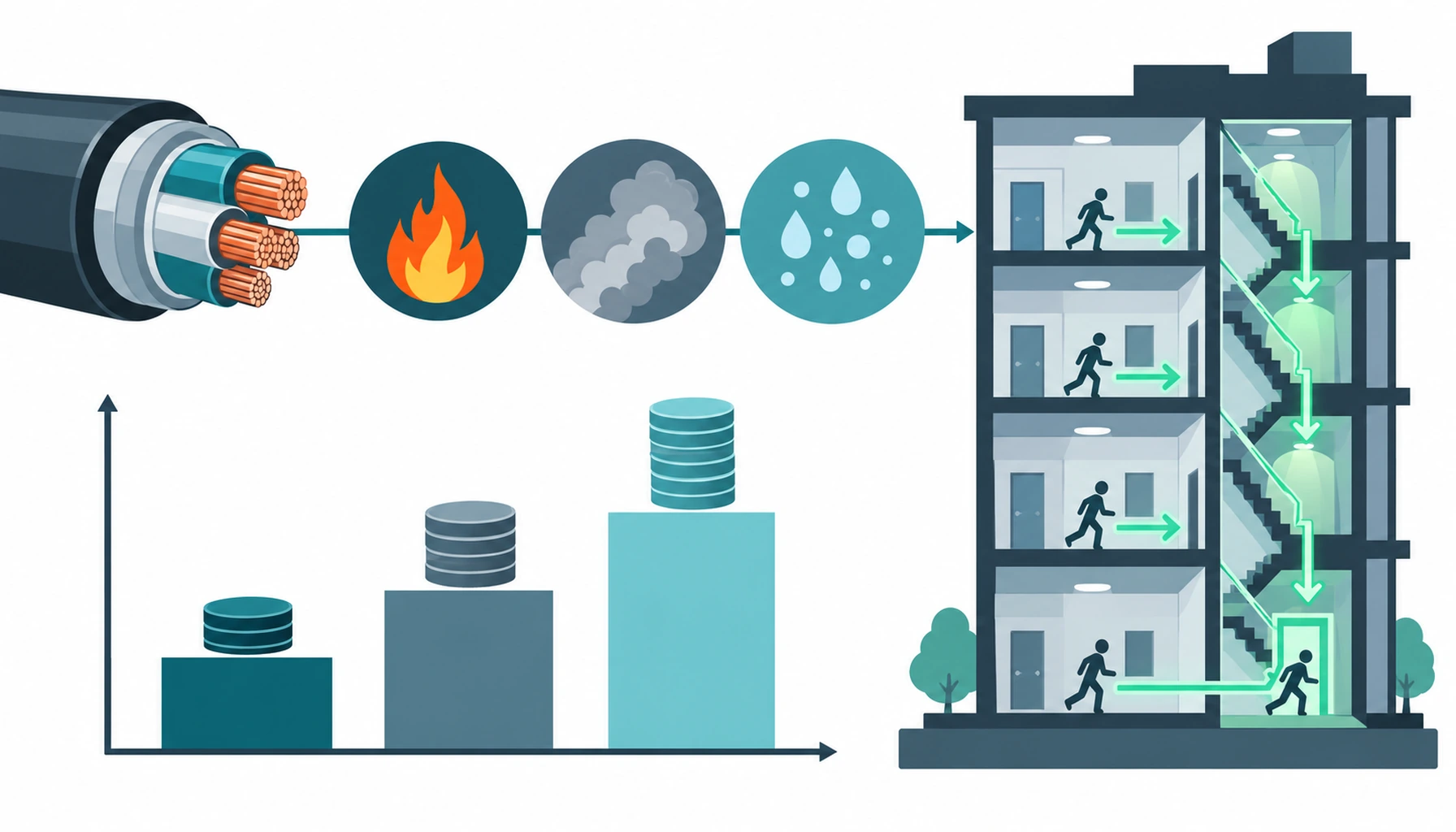
Quick Answer: A CPR class describes what a cable does when it burns, not whether it will keep working during a fire. The class string carries three things at once: flame spread and heat release, smoke production, and burning droplets and acidity. Read it as a set, demand the declaration of performance for the exact construction quoted, and keep the fire survival requirement on a separate line of the schedule, because a cable can be excellent at one and useless at the other.
Introduction
For any project inside the European regulatory orbit, cable sold into a building is a construction product, and construction products have to be declared. That is what CPR means in practice, and it changed the way cable is bought: instead of arguing about whether a sheath is low smoke, the specification names a class, and the supplier either holds the test evidence for it or does not.
The difficulty is that the class string is compressed and easy to read partially. Buyers who stop at the first letters routinely buy a cable that satisfies the smoke requirement and misses the flame spread one, or the reverse. And a class is a reaction-to-fire statement, so it says nothing about the circuits that have to keep working during a fire. This guide takes the string apart and puts it back into a procurement decision.
What CPR Requires of a Cable
Cable that permanently forms part of a construction works falls inside the construction products framework, which means it needs a declared performance against a harmonised technical specification, supported by testing and factory production control, and a declaration document that travels with the product. The practical consequences for a buyer are three.
The performance is declared, not described. Marketing words like flame retardant or low smoke are replaced by a class that refers to test methods, so the claim becomes verifiable.
The class attaches to a construction. A conductor size, insulation, screen and sheath combination is what was tested. Substituting a compound, moving to a second production line or changing a sheath thickness can put the declaration out of scope.
Factory production control is part of the product. The declaration rests on the manufacturer running a consistent process, which is why the paperwork question is not a formality and why buying from a manufacturer who can show the control regime matters.
Reading the Class String
A class is a short string, and it is worth reading as three separate scores rather than one.
The main class. The letter and the sub-class at the front describe the flame spread and heat release performance, running from the best down to a class for products where no performance is determined. The higher bands are genuinely harder to pass, and they cost more to make, because they need more of the sheath and insulation chemistry to be engineered rather than assumed.
The smoke score. The next element rates smoke production, from a strict level to a permissive one. This is the score that matters for escape routes, because smoke rather than flame is what stops people leaving a building, and it is the one buyers most often look at alone.
The droplets and acidity scores. The remaining elements rate burning droplets and the acidity of the gases released. Droplets matter mechanically, and acidity matters to equipment in the room and to the people exposed to the smoke.
Read as a set, the difference between two cables that both claim a good main class can be substantial, and the difference shows up in price. Our notes on LSZH versus fire retardant cable and on the flame retardant cable classes go through where the compounds differ.
Classes, Applications and What to Demand
The table below maps the class bands onto building applications, with the evidence to demand and what drives the price.
| Class band | What it means | Typical Application | What to Declare | Evidence to Demand | Cost Driver |
|---|---|---|---|---|---|
| Highest bands | Very limited contribution to fire growth, with strict smoke and droplet scores available | Congested escape routes, atria, high occupancy spaces, tunnels and stations | The full class string, not just the letters, plus the construction it applies to | Declaration of performance with the test reports behind it and a construction drawing | The most engineered compounds and the heaviest sheaths; the range narrows and lead time grows |
| Mid bands | Limited contribution to fire growth, with a mid-range smoke score | General building distribution, risers and plant areas away from escape routes | Main class plus smoke and droplet elements stated separately | Declaration of performance and factory production control evidence | Reasonable material cost; substitutions between compounds are where savings hide and risk appears |
| Lower bands | Acceptable where the space is protected or unoccupied and the route is not an escape path | Equipment rooms, service voids, outdoor runs and protected shafts | The class actually achieved, stated without embellishment | Declaration of performance, dimensional records | Cheapest material; the trap is using it where the design assumed a better class |
| Specialist constructions | Classes for cables whose real job is circuit survival rather than reaction to fire | Fire pump supplies, fire lifts, alarm and life safety circuits | The reaction class and the survival grade as two separate lines | Declaration of performance plus a survival test report and a system approval | Two test programmes and two sets of accessories; the specialist range carries a premium |
| Alternative national schemes | The same question answered under another country's classification | Projects outside the European framework, or with a national overlay | Which framework governs and which class of it applies | The national classification report for the exact construction | Certification for one framework is not transferable to another without retesting |
The Paperwork Chain and Where It Breaks
The declaration must match the drum. The construction named in the declaration has to be the construction delivered, and the check is a comparison of the construction drawing with the sheath marking and the dimensional records. Buying on the class alone, without the construction description, leaves the comparison impossible.
Substitution is the usual failure. A compound change to reduce cost, a sheath thickness change to hit an outside diameter, or a move to a second production line can take a delivery outside the tested scope while the class on the quotation stays the same. Requiring the declaration at order stage, not at delivery, is what prevents it.
Declarations are per construction, per standard. Where a project mixes voltage classes or screened and unscreened variants, expect more than one declaration, and check that each delivery note references the right one. Our note on cable factory testing covers the tests that sit behind the paperwork, and on export work the same rigor applies to whatever local scheme governs, as our note on the GB 31247 B1 class sets out for the Chinese framework.
How the Class Changes the Quotation
Class bands are not just labels; they move through the price and the lead time in ways worth understanding before the negotiation.
Compound cost. A higher main class generally needs more flame-retardant loading in the sheath and often in the insulation, and those additives cost more than the base polymer. The increase is modest per metre on large conductors and noticeable on the small sizes that make up most of a building’s distribution metreage, which is why the class decision on final circuits matters more to the budget than the class on the risers.
Smoke and acidity. The strictest smoke and acidity scores drive halogen-free formulations, and those are the ones with the narrowest processing windows. The price difference between a mid and a strict smoke score is often larger than the difference between two main class bands, and it is the score most often left unspecified.
Range and lead time. The highest bands are produced by fewer lines, so the construction may be a made-to-order item rather than a stocked one. On a programme with a fixed handover that is the most important commercial consequence of the class decision, and it is worth asking which of the specified classes are stock and which are made to order.
Substitution pressure. The higher the class, the more pressure there is to reduce cost by adjusting a compound. A purchase order clause requiring written approval before any change to the tested construction is cheap to add and is the clause that protects the declaration.
What to Freeze Before the Order
| Decision | What to State | Evidence to Attach | Cost of Leaving It Open |
|---|---|---|---|
| Framework and class | Which regulation governs and which class band applies, area by area | The design spec section naming the class | A delivery that cannot be accepted on paperwork |
| Full class string | Main class plus smoke, droplet and acidity scores stated separately | The declaration showing the whole string | Paying for one score while a different one decides the application |
| Construction scope | The tested construction, with conductor, insulation, screen and sheath named | Construction drawing matched to the declaration | Substitutions that invalidate the class after delivery |
| Survival requirement | Separate grade and duration for circuits that must keep working | Survival test report plus system approval | A compliant reaction class and an unprotected life safety circuit |
| Production control | Which factory, and confirmation that control evidence exists | Factory production control documentation | Paperwork that cannot be supported at inspection |
| Per-delivery referencing | Each delivery note tied to the right declaration | A cross-reference list checked at goods-in | A mismatch found at commissioning rather than at the gate |
Reaction to Fire Is Not the Whole Requirement
Two separate regulatory ideas govern building cable, and they are frequently confused in tender documents.
Reaction to fire is the CPR axis: what the cable contributes to a fire once it is involved, expressed as the class. It is a property of the product and it applies whether or not the circuit matters during the incident.
Circuit integrity is the survival axis: whether the circuit keeps working while the fire is being fought, expressed as a grade and a duration for a tested assembly of cable, terminations and fixings. It is a property of the installed circuit and it is the requirement that life safety equipment lives or dies by.
A tender that names a reaction class and stops is a tender that has specified half the problem. On any project with a fire strategy, the schedule should carry both, and the buyer should be able to point at the document that sets each. Where the two are combined in a single request, insist they stay on separate lines, because a supplier who can meet one may not be able to meet the other on the same construction, and the answer changes the price in opposite directions. This is the trap that catches projects which have already bought to the highest reaction class and assume the life safety circuits are covered as a result. On the building side, the cable families available for each duty are set out across the building wire range.
When a CPR Class Is Not the Answer
When the class is being bought for a circuit that has to survive. A high reaction class is not a survival grade. If the circuit matters during the fire, the class does not solve it.
When the destination runs a different framework. A declaration under one scheme does not transfer to a project governed by another. Getting the governing framework named at tender stage is cheaper than retesting.
When the class is being used to compensate for a bad route. A cable passing through an unprotected space is a problem of route, not of class, and no reaction score fixes it.
When the declaration and the drum do not match. A class is only as good as the construction it was tested on, and a mismatch makes the paperwork useless at the one moment it is needed.
RFQ Checklist
- Governing framework named, and class band assigned area by area
- Full class string required, with smoke, droplet and acidity elements specified
- Declaration of performance for the exact construction quoted
- Construction drawing with conductor, insulation, screen and sheath named
- Separate survival grade and duration for life safety circuits
- Factory production control evidence from the named production site
- Delivery notes cross-referenced to the right declaration
- Dimensional and material records available for goods-in checks
- Substitution control clause in the purchase order
- Test and record list for the delivery, and the checks to be witnessed
Conclusion
A CPR class is a useful, verifiable statement about how a cable behaves in a fire, and it is worth having in full rather than in part. What it is not is a substitute for a survival grade on a circuit that has to keep working. Put the reaction class and the survival requirement on separate lines of the same schedule, tie the declaration to the construction that was tested, and check the drum against the construction at goods-in. That is the whole of the procurement job, and it is mostly paperwork done at the right moment.
Kexingyu Cable Group (KXYE) has manufactured cable in Quanzhou since 1996 and supplies building projects under the frameworks their destinations require, with construction drawings and test documentation matched to each delivery. Send us the specification with the governing framework, the classes assigned area by area and the survival grades for life safety circuits, and we will come back with the constructions, the declarations that apply and the evidence behind them. The fastest route is a request for quotation.