Fire Pump and Fire Lift Supply Circuits: Cable Integrity You Can Prove
Quick Answer: Fire pumps and fire lifts rarely fail because somebody forgot to order fire-rated cable. They fail because what was installed was never a fire-rated circuit: a rated cable entering an ordinary gland, passing through an untested penetration, clipped with combustible fixings, or run through a space the fire strategy assumed was protected. Buy the circuit as an assembly, ask for the system approval rather than the cable certificate, and put the grade, the duration and the route on the schedule before the order goes out.
Introduction
Fire pump and fire lift supplies are the circuits a building is judged on after a fire, and they are also the ones most often bought by catalogue number. A specification that says fire rated on the cable schedule looks complete until the commissioning test asks a harder question: whether that particular cable, in that particular gland, through that particular wall, clipped that particular way, actually survives the fire, the water and the impact the fire strategy assumes.
This guide is about the evidence chain rather than the chemistry. It sets out what each circuit has to do, how the grades differ, where approvals are lost on site, and what to freeze so the circuit that gets commissioned is the circuit that was bought.
What These Circuits Actually Have to Do
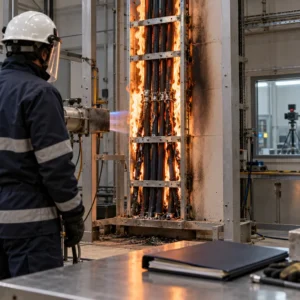
Keep running while the building is on fire. The pump has to start and stay running with the fire service in the building; the lift has to bring the fire crew up and take occupants down. The requirement is not that the cable resists burning as a material property, but that the circuit keeps working for a stated duration under conditions that include heat, water and sometimes mechanical shock.
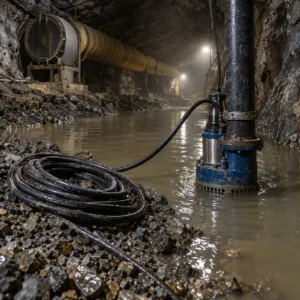
Keep running wet. Firefighting water pools in basements and pump rooms, and cables on the floor or in low trays get soaked. A survival test that includes a water spray is testing exactly this, and a cable approved without that element has not been tested for the way the room will actually be.
Keep running after the protected route stops protecting. A circuit is only as protected as its weakest section, and the fire compartment boundaries it crosses are as important as the cable itself. A rated cable that leaves a protected shaft through an untested opening is a rated cable with an unprotected gap.
Support the controls, not just the power. Pump control circuits, lift control and communication and the fire alarm interface all have to keep working for the pump to start and the lift to move. Buying the power cable to a high grade and leaving the control pair as ordinary cable is one of the most common ways a compliant-looking installation fails its purpose; the screened and paired constructions that this duty needs are part of the fire resistant communication cable range.
The Evidence Chain: Cable, Termination, Route
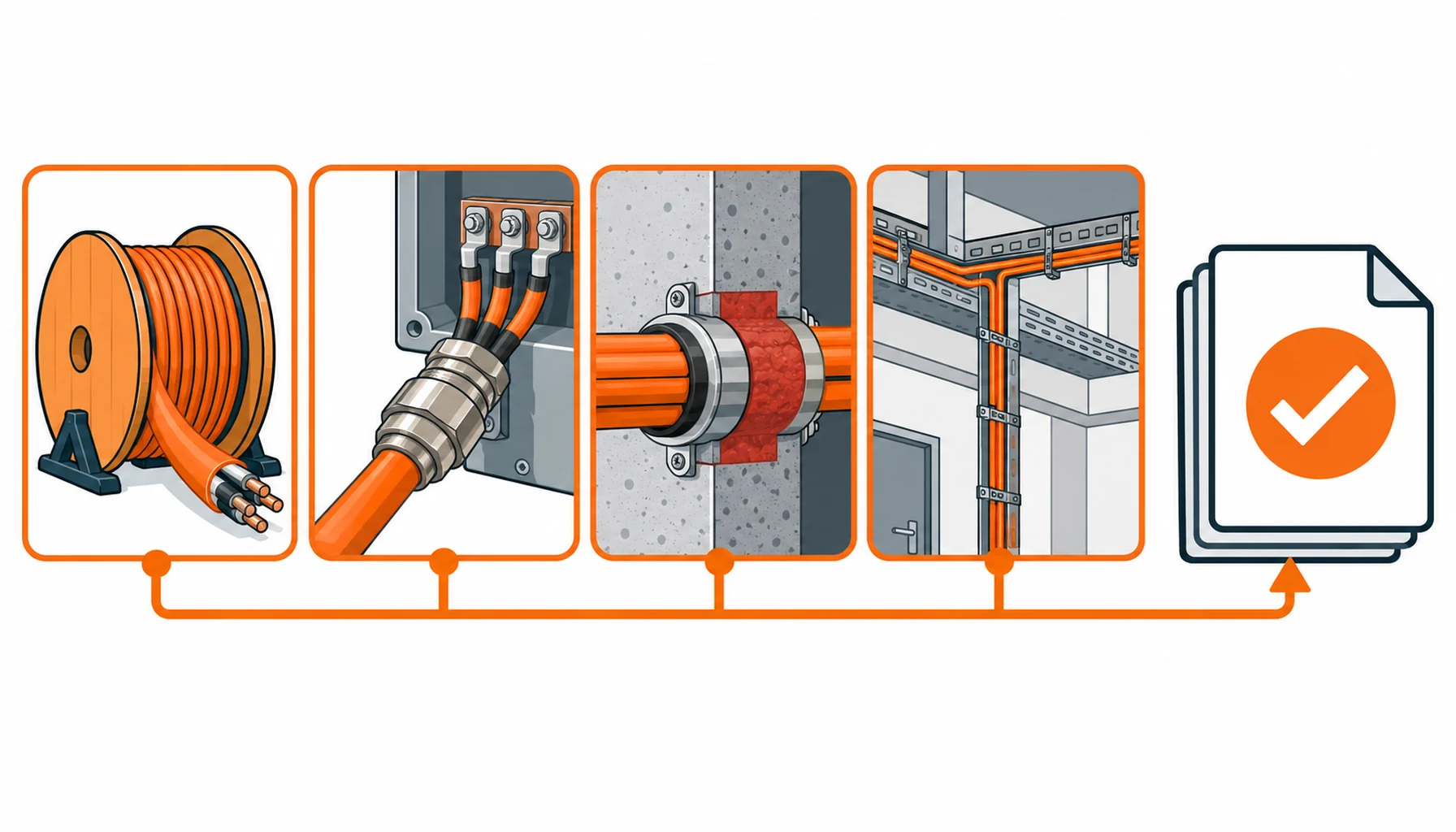
At the cable. A survival test report against a named standard, at a stated grade and duration, and a statement of whether water spray and mechanical shock were included in that test. This is the piece buyers usually hold, and it is the least useful on its own.
At the termination. Glands, joints and terminations that were part of the tested system, or a system approval that names them. A rated cable entering a plastic gland and a standard enclosure loses its rating at the first fitting.
Along the route. A tested firestop detail at every compartment crossing, fixings that are part of the approved system, and a route that stays inside protected space for the duration the strategy claims. Our note on firestop cable penetrations covers what the detail has to include, and the combination matters: two separately certified parts assembled in an untested way are not a system.
In the paperwork. The three items above should appear in one document that the fire engineer signs. If they are spread across three suppliers and two subcontractors, nobody owns the circuit, and the first inspection finds it. Where a project needs a worked example of how these pieces chain together, our note on fire survival testing and its grades takes the categories apart.
The table below sets out the fire supply circuits a typical building has, what each one needs specified, the evidence to demand, and how each one fails.
| Circuit | Duty | What to Specify | Evidence to Demand | Cost and Lead-Time Driver | How It Fails |
|---|---|---|---|---|---|
| Fire pump supply, power | Start and run during the fire, often wet, from a source outside the fire zone | Survival grade and duration with water and impact, conductor size for starting current and voltage drop, route inside protected construction, gland and fixing system | Survival test report at the grade, system approval naming terminations and fixings, route drawing with the protected sections marked | The highest grade at the longest duration, plus the approved accessories; specialist builds add lead time | Voltage drop leaves too little at the pump terminals to start it, terminations fail before the cable, a route change voids the approval |
| Fire pump control and monitoring | Signalling and control throughout, often the weak link in the chain | Circuit integrity grade matched to the power circuit, screening where the panel needs it, separation from power runs | Integrity test evidence, screen continuity records, panel compatibility and protocol limits | Small conductor sizes, so the integrity grade rather than copper drives cost | Power cable survives and the control pair does not, so a healthy pump never receives the start signal |
| Fire lift supply and control | Run the lift for the fire service through the incident, in a shaft that acts as a chimney | Survival grade and duration, protection within the shaft, travelling cable rating where the circuit moves, control and communication integrity | Survival test report, travelling cable flex data, shaft installation detail, system approval for terminations | Two rated constructions in one shaft, plus flexible travel cable with its own testing | A shaft fire deteriorates the riser faster than the design assumed, or the travelling cable becomes the first failure |
| Smoke and pressurisation fans | Run for the full escape period to hold stair and lobby pressure | Survival grade and duration, motor starting current and voltage drop, route inside the protected stair where possible | Survival test report, voltage drop calculation at the fan terminals, pressure control interface evidence | Fan motors pull heavy starting current, so conductor size rather than grade dominates | Fans that cannot start on the reduced voltage available, or a circuit that fails at the top of a long vertical run |
| Sprinkler and jockey pump controls | Keep pumping and signalling through the incident | Integrity grade for the control circuit, protection of the pressure switch wiring, route away from the pump room flooding level | Integrity test evidence, immersion and water spray evidence where the route is at floor level, commissioning records | Modest currents; the cost is in the protection of the route rather than the conductor | Control wiring drowned or damaged in the very water the pump is supplying |
Choosing the Grade Without Over-Buying
The grades in common use all express the same three variables, combined differently: how long the circuit must survive, whether water is applied, and whether mechanical shock is applied. A scheme that tests fire alone sits at the bottom; one that adds water and impact sits at the top, and the price difference between them is real.
The procurement rule is to grade by circuit and by route, not by building. A pump supply in a protected room with a short route to the pump may need less than a lift riser crossing several unprotected floors. Applying the top grade everywhere inflates the order; applying one grade everywhere fails the strategy at whichever circuit crosses the wrong kind of space. Where the environment is harsh and the requirement is high, the copper-sheathed mineral-insulated family in our note on mineral insulated cable is worth costing, because it has no organic material to degrade, though it is less flexible to install and its terminations need the right tooling. The same calculation, done across the fire resistant cable range, is what turns the strategy into a cable schedule.
Where an Approval Is Lost on Site
At the gland. A rated cable needs a gland that was part of the tested assembly. Where a project substitutes a cheaper gland of the right size, the circuit becomes untested even though both parts are individually certified.
At the fixing. Clips and cleats are part of the system approval, and a combustible fixing on a rated circuit is a contradiction. Specify the fixing type and spacing with the cable, not after.
At the penetration. Slab and wall crossings need a tested firestop detail that includes the cable type. A generic sealant detail applied to a rated cable is a common inspection finding.
At the route change. The most expensive failure, because it happens after the cable is bought. A design change that moves a run outside protected space, or adds a length the original test did not cover, invalidates the assumption behind the grade.
At the joint. Every joint in a rated circuit has to be one the approval covers. Where a drum length forces a joint, that joint is a procurement decision, not a site convenience.
What to Freeze Before the Order
| Decision | What to State | Evidence to Attach | Cost of Leaving It Open |
|---|---|---|---|
| Grade per circuit | Duration, and whether water and impact apply, circuit by circuit | The fire strategy schedule mapping grades to circuits | Top grade bought everywhere, or one grade that fails at the first crossing |
| System approval scope | The cable, glands, fixings and jointing named as one tested assembly | A system approval document, not a cable certificate | A circuit nobody can prove at commissioning |
| Route and protected sections | Which lengths sit inside protected construction and for how long | Route drawing with the protected sections and firestops marked | The most expensive kind of redesign, after the drums have arrived |
| Voltage drop at starting | Starting current and the minimum voltage needed at the pump or fan terminals | The calculation, with the conductor size it produces | A pump that has the right cable and still will not start |
| Drum lengths and joints | Where joints are permitted and the maximum continuous length per circuit | A drum schedule checked against the route | A joint outside the approval in a circuit that must survive |
| Test and witness plan | Which tests are witnessed, when, and what records ship with each drum | A written plan with acceptance criteria and dates | A life safety circuit accepted on paperwork nobody verified |
Proving It at Commissioning
Insulation resistance and continuity. The standard electrical tests, on the finished circuit, with records. Our note on insulation resistance testing covers the measurement and the values that matter for a wet-prone installation.
Documentation matching. The drum references on the delivery note should link to the test reports, and the gland and fixing part numbers should be the ones in the system approval. Reconciling three documents is tedious and it is the only moment when a mismatch is cheap to fix.
Functional test under the design condition. For a pump, that means a start test at the real supply voltage with the real circuit; for a lift, a run through the fire service mode. A circuit can pass every insulation test and still fail the only test that matters.
When a Fire-Rated Cable Specification Is Not the Answer
When the source is inside the fire zone. A perfectly rated circuit from a switchboard that burns delivers nothing. The protection of the source and the integrity of the feed are part of the same problem.
When the route is the problem. If the circuit has to cross an unprotected space, no grade of cable fixes it; the answer is a protected route, an enclosure, or moving the equipment.
When the starting voltage is the problem. A pump that will not start on the voltage available at its terminals has a sizing problem, and buying a higher grade of cable repeats it more expensively.
When the controls are the weak link. Grading the power cable and leaving the control circuit ordinary produces a pump with a healthy supply and no start signal. Grade the whole chain.
RFQ Checklist
- Fire strategy schedule mapping grade and duration to each circuit
- Water spray and mechanical shock requirements stated explicitly
- System approval naming the cable, glands, fixings and jointing
- Route drawing with protected sections and firestop details marked
- Starting current and minimum terminal voltage for pumps and fans
- Maximum continuous drum length and permitted joint positions per circuit
- Control and monitoring integrity grade matched to the power circuit
- Travelling cable flex rating for the fire lift, with test data
- Fixing type and spacing as part of the approved assembly
- Tests to be witnessed and the records that ship with each drum
- Documentation cross-reference between drum, report and approval
Conclusion
A fire pump or fire lift circuit is only as good as the assembly that was installed and the document that proves it. Buy the cable with the glands, fixings and joints its approval names, keep the route inside the protection the strategy assumes, size the conductor for the starting condition rather than the running one, and grade the control circuit with the power circuit. Do that and the commissioning test is a formality instead of a discovery.
Kexingyu Cable Group (KXYE) has manufactured cable in Quanzhou since 1996, supplying the fire-rated, mineral-insulated and control constructions that life safety circuits call for, together with the glands, fixings and accessories their approvals depend on. Send us the fire strategy schedule with the circuits, the durations, the route conditions and the starting duty, and we will come back with the constructions, the system evidence that applies to each, and a delivery plan against your commissioning date. The fastest route is a request for quotation.