
BTTZ Rigid Mineral Insulated Cable: The Fire-Proof Workhorse
Quick Answer: BTTZ is mineral insulated cable in its purest form — copper conductors, magnesium oxide insulation, a seamless copper sheath, nothing organic to burn. Most fire-resistant cables are engineered to survive fire longer than ordinary cable. BTTZ does not participate in the fire at all: its insulation is a mineral, its sheath is the same metal as its conductor, and there is nothing in its cross-section that combustion can consume. That is why the most demanding fire specifications on earth — tunnels, petrochemical plants, life-safety feeders in high-rise and data center critical circuits — keep landing on this construction.
Introduction
BTTZ (rigid mineral insulated cable, from the Chinese standard family descended from BS-style MI practice) is the fire-performance ceiling of the cable world — and also its most demanding installation. The properties that make it nearly indestructible in fire make it unforgiving at the bend and at the gland. This article covers what the construction is, why it survives what polymer cables can’t, where it earns its premium, the installation discipline its terminations demand, and how to write it into an export specification. The comparison with its flexible rival is treated separately in our armor decision guide — for BTTZ, the mechanical-protection conversation ends at the copper sheath itself.
Anatomy: Three Materials, Nothing Wasted
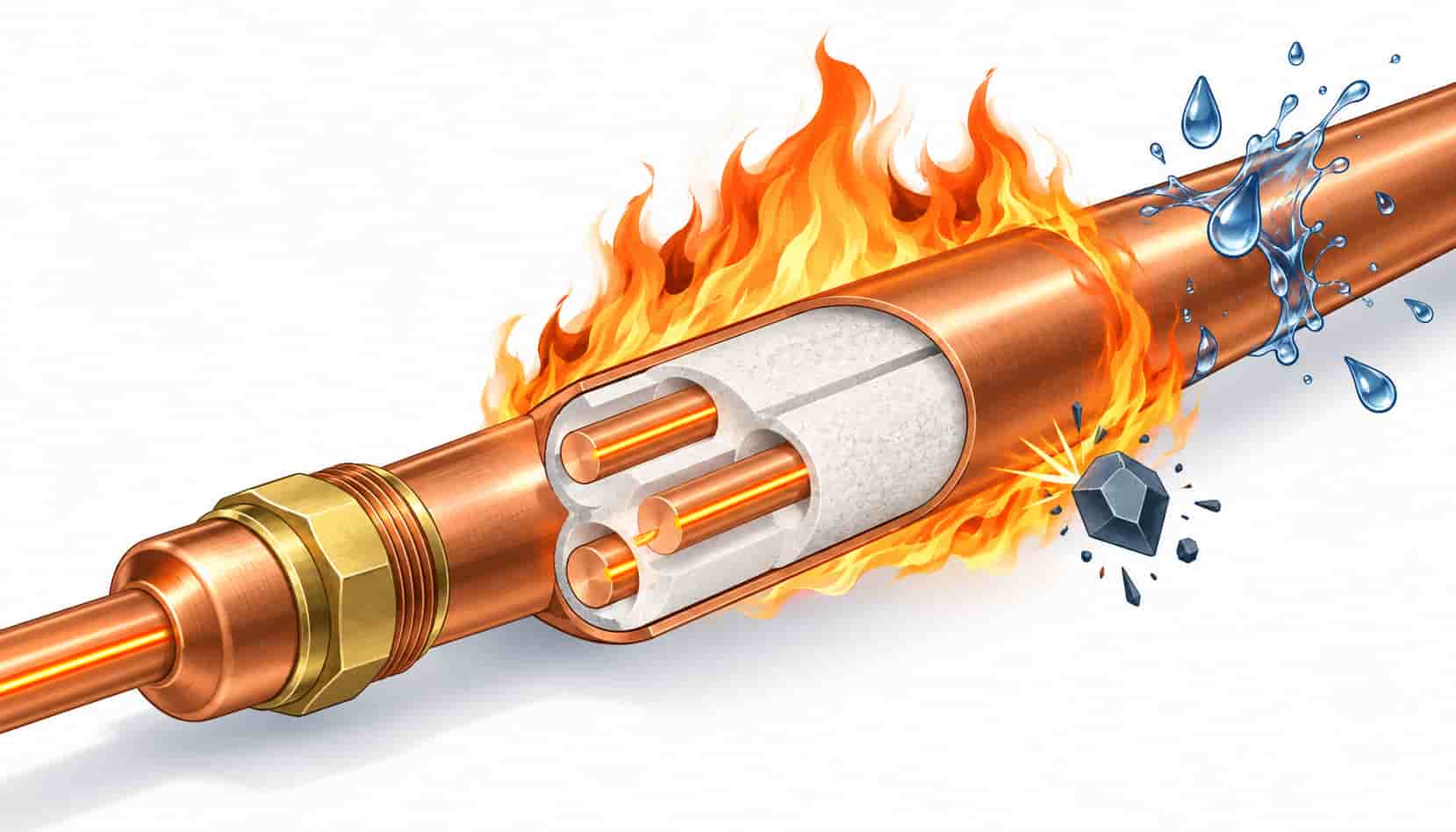
A BTTZ cross-section has exactly three constituents: solid copper conductors, highly compressed magnesium oxide powder as the insulation, and a seamless copper sheath drawn over the assembly. No polymer touches the current path. Copper melts around 1083°C; magnesium oxide is stable far beyond that. And because the sheath is metal, the cable is also waterproof, rodent-proof, corrosion-resistant in the right conditions and mechanically tough in ways no jacketed cable matches.
| Layer | Material | Function in Fire and in Service |
|---|---|---|
| Conductor | Solid copper | Carries current; melts only beyond 1080°C |
| Insulation | Compressed magnesium oxide | Inorganic dielectric; stable at flame temperature |
| Sheath | Seamless copper tube | Waterproof, rodent-proof, mechanically tough, zero fuel |
| Ends | Sealing pots and glands | The only vulnerable point â moisture enters here if left open |
Why It Survives What Polymer Cables Cannot
The fire-resistance logic is subtraction, not addition. Polymer cables resist fire by delaying combustion of their organic layers; BTTZ has no organic layers, so there is nothing to delay. It keeps insulation integrity through direct flame at around 950°C plus mechanical shock and water spray — the combined survival profile that standards describe as surviving the fire, the fire fighting and the building falling on it. Insulation resistance at flame temperature stays high enough to keep circuits live, which is why life-safety feeders and critical data center circuits get specified to it despite the premium. The standards families that formalize these survival tests are compared in our IEC, GB and BS standards guide.
In normal service, the same mineral construction buys longevity: no thermal aging of polymer, no moisture pathway except the ends, and a service life routinely longer than the equipment it feeds. The premature-failure modes that plague polymer cables are catalogued in our cable failure causes guide — BTTZ simply removes most of them from the list.
Where BTTZ Earns Its Premium
The specification pattern is consistent across markets: circuits where failure during fire would be catastrophic. Fire pump and smoke-extraction feeders in high-rise, tunnel and metro life-safety circuits, petrochemical plant emergency systems, generator and transformer critical ties — the last category follows the protection logic in our transformers and substations collection — and the fire-alarm backbone itself. Data centers adopt it for the same reason: a circuit that has to run the smoke management system through a hall fire can’t depend on polymers.
What BTTZ is not: a general distribution cable. Its premium buys a property most circuits never use, and its installation demands a skill set standard crews do not keep warm. Spread it where the job demands it, not by momentum.
Installation Discipline: Where BTTZ Projects Go Wrong
The cable is nearly indestructible; the installation is not. Four disciplines decide whether the fire performance survives construction. First, bending: rigid MI has a larger minimum bend radius than polymer cable, and kinking the copper sheath cracks the geometry — survey routes for it before ordering lengths. Second, moisture: magnesium oxide is hygroscopic, so factory-sealed ends must stay sealed until the moment of termination; a drum left open overnight in humid weather can absorb enough moisture to fail insulation tests. Third, terminations: every end needs a pot, gland and seal kit properly installed — the accessory discipline is laid out in our cable accessories checklist, and here it isn’t optional hardware, it’s the cable’s moisture defense. Fourth, testing: insulation resistance after installation, with moisture-fault location and drying procedures known in advance.
| Check Item | Requirement | Why It Matters |
|---|---|---|
| Route survey for bends | Measured routes with bend radius verified | Rigid MI cannot forgive a tight corner |
| Factory seals intact | Ends stay sealed until termination | MgO is hygroscopic; open ends absorb moisture |
| Termination kits scheduled | Pots, glands, seals per end, matched to gear | The ends are the cable's only weak point |
| Crew competency | MI-experienced hands, not first-time crews | Termination skill is scarce and decisive |
| Post-install IR testing | Test after install, dry-out plan ready | Moisture faults are fixable if caught early |
| Fire test evidence | Batch certificates to the named standard | The premium buys a testable property |
Export Mapping: Specifying BTTZ Abroad
Three documentation moves make BTTZ portable. First, name the fire-survival test: the combined flame-plus-impact-plus-water profile, in the standard family the destination market recognizes. Second, spell out the electrical spec: voltage class, conductor sizes, and the single- and multi-core formats per route. Third — unique to MI — write the installation requirements into the RFQ: termination kits, sealing consumables, bend radius limits and crew competency. A perfectly manufactured BTTZ cable can be installation-killed in one humid afternoon. Supplier capability on this construction varies widely; the verification steps are the same ones in our power cable manufacturer checklist.
When BTTZ Is Not the Answer
Three honest boundaries. Cost: general distribution circuits gain nothing from fire-proofing they’ll never use — mica-tape WDZN-YJY or plain XLPE is the rational choice. Installability: routes full of tight bends, long vertical runs and confined risers favor the flexible mineral families (BBTRZ, NG-A/BTLY), which bend and pull like normal cable; the head-to-head is covered in our flexible-versus-rigid comparison. And speed: BTTZ terminations are measured in skilled hours, which matters on compressed schedules. Choose the construction for the route, not the brochure.
RFQ Checklist: Ordering BTTZ
Make the premium verifiable by writing these into the RFQ:
- Fire-survival test named: flame, temperature, duration, impact and water
- Single- and multi-core formats, voltage class, conductor sizes per route
- Measured routed lengths with bend radii confirmed feasible
- Termination pots, glands and sealing kits per end, matched to equipment
- Spare sealing consumables for field contingency
- Factory end seals guaranteed intact to point of termination
- Insulation resistance test protocol, including dry-out procedure
- Batch fire-test certificates keyed to drum IDs
- Copper price linkage across the delivery calendar
- Delivery phased to installation fronts — sealed drums, short storage
Conclusion
BTTZ is the cable you buy when the circuit’s job doesn’t end when the building catches fire: copper, mineral and nothing else, carrying current through the fire itself. It rewards disciplined installation with a service life measured in decades and fire performance nothing polymer-based can reach — and it punishes casual handling at the bend and the gland.
Kexingyu Cable Group (KXYE) supplies BTTZ with factory-sealed ends, complete termination kits, batch fire-test certificates and installation guidance — so the fire-proof workhorse arrives ready to keep its promises.
Recent Posts
Thermal Runaway in Lithium Batteries: What BESS Buyers Should Understand
Thermal Runaway in Lithium Batteries: What BESS Buyers Should Understand How thermal runaway starts, how it propagates, and which evidence buyers should require before approving
Energy Storage for Data Centers: A Growing Backup Power Option
Energy Storage for Data Centers: A Growing Backup Power Option Batteries have always backed up data centers in the form of UPS strings. Grid-scale BESS
YJV vs YJY: Reading Chinese Cable Designations Like a Local
YJV vs YJY: Reading Chinese Cable Designations Like a Local YJV vs YJY: Reading Chinese Cable Designations Like a Local Quick Answer: YJV and YJY