
How to Choose the Right Switchgear for Your Substation Project
A practical framework for narrowing down switchgear type, rating, and configuration before you request quotes.
Introduction
If you’re new to specifying switchgear, or even if you’re experienced but tackling an unfamiliar project type, it helps to work through the decision in a consistent order rather than trying to nail down every detail at once. If you need a refresher on what switchgear actually is and does first, see our switchgear basics guide before diving into selection criteria.
Start with voltage class and system requirements
Voltage class is the first and most fundamental decision — low voltage switchgear (typically up to 1kV) serves building and facility-level distribution, while medium voltage switchgear (commonly 3.3kV to 40.5kV) serves substation, utility, and large industrial applications. This should already be defined by your overall electrical system design, but it’s worth confirming explicitly before evaluating anything else, since it eliminates most switchgear types from consideration immediately.
Fixed vs withdrawable switchgear
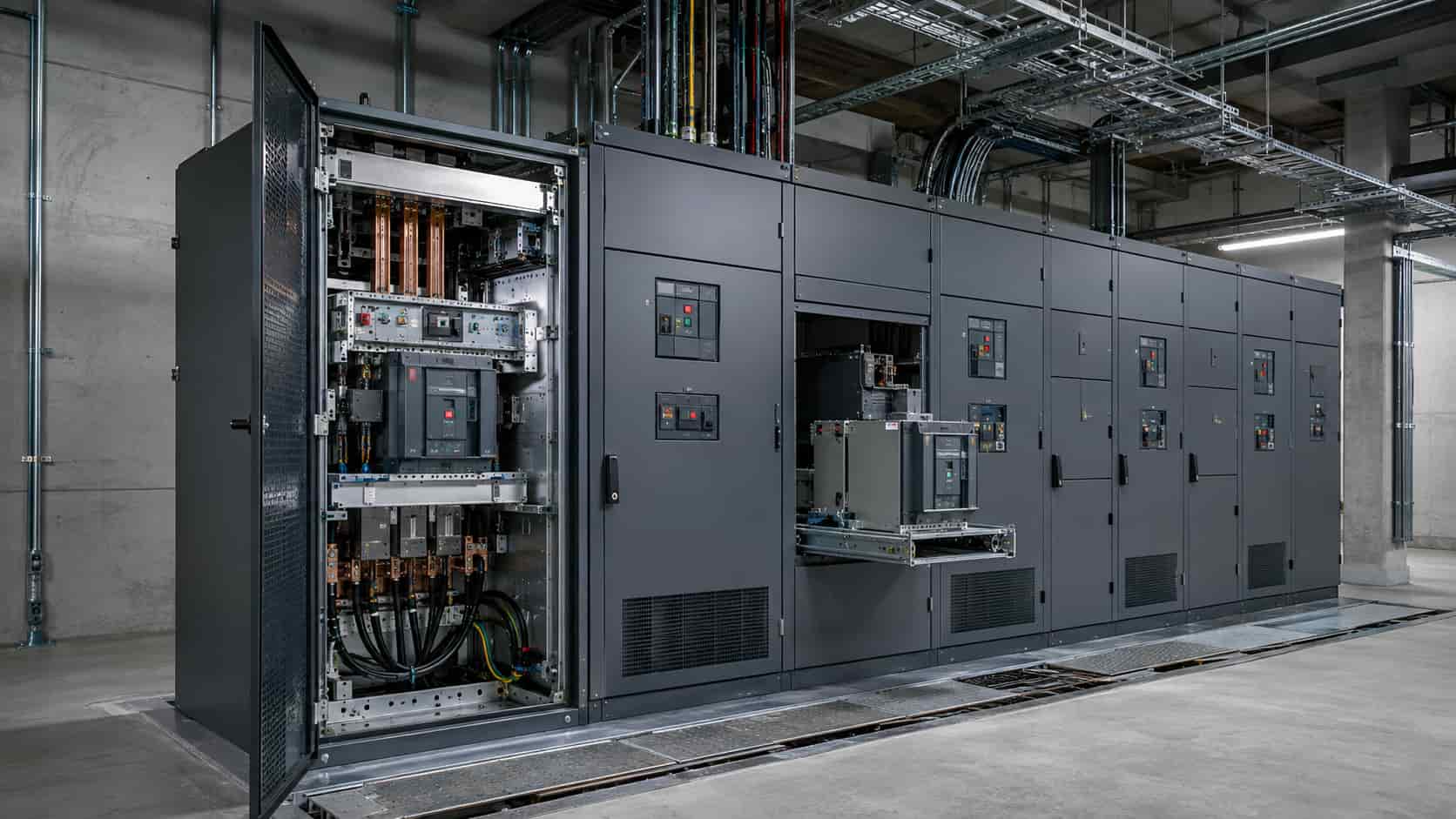
Fixed-type switchgear has breakers permanently mounted within the enclosure, offering a simpler, more compact, and generally lower-cost design. Withdrawable switchgear allows breakers to be racked out for maintenance or replacement without de-energizing the entire assembly, which matters significantly for facilities where downtime during maintenance is costly or operationally difficult to schedule. Data centers, hospitals, and continuous industrial processes often specify withdrawable switchgear specifically for this reason.
Circuit breaker type and rating
Breaker type — vacuum, SF6 gas-insulated, or air circuit breaker depending on voltage class — and current rating need to match both your normal operating load and the fault current your system could realistically experience. Undersizing breaker interrupting capacity is a genuine safety issue, not just a performance shortfall, so this figure should come from a proper fault current study rather than an estimate.
Protection and relay requirements
Protection relay configuration determines how the switchgear detects and responds to fault conditions — overcurrent, earth fault, differential protection, and other schemes depending on your system’s complexity and criticality. This is an area where working closely with your electrical engineer or the switchgear manufacturer’s technical team matters, since protection coordination across an entire facility needs to work together, not just at the individual switchgear level.
Environmental and installation conditions
Indoor vs outdoor installation, ambient temperature range, altitude, humidity, and any corrosive or dusty environmental factors all affect enclosure rating and material selection. Switchgear specified for a standard indoor environment may not hold up in a coastal, high-humidity, or high-altitude installation without adjustments to the base design.
Working with your supplier on custom requirements
Most projects don’t fit a completely standard, off-the-shelf configuration — busbar arrangement, cable entry position, metering requirements, and communication/SCADA integration often need project-specific adjustment. A supplier with in-house engineering capability can typically accommodate these without the delays that come from routing custom requests through a trading company to a factory that has no direct relationship with your project.
A simple selection checklist
Confirm voltage class and required current/fault ratings from your system design; decide fixed vs withdrawable based on maintenance and downtime tolerance; confirm protection relay scheme with your electrical engineer; account for installation environment in enclosure specification; and flag any custom requirements early rather than after quotes are already in hand.
Where Kexingyu Power fits in
We manufacture low and medium voltage switchgear with in-house engineering support for project-specific configurations, factory-tested before export. Browse the full range on our Switchgear & Distribution page.
Choosing Switchgear
Common questions from engineers and project buyers selecting switchgear for substations, industrial facilities and critical power systems.
01 Is withdrawable switchgear always worth the additional cost?
Not for every project. Withdrawable switchgear is most valuable where maintenance downtime is costly, operational continuity is critical or circuit breakers must be replaced quickly, such as in data centers, hospitals and continuous-process industrial facilities. Fixed-type switchgear may be a more economical choice where planned shutdowns are acceptable and maintenance access is less critical.
02 Who determines the required short-circuit or fault current rating?
The required rating should be established through a fault-current study based on the actual electrical system. The study considers utility supply strength, transformer ratings and impedance, generator contribution, cable impedance and system configuration. The switchgear's short-time withstand and interrupting ratings must meet or exceed the calculated fault level at its installation point.
03 Can standard switchgear be adapted for a coastal or high-humidity site?
Often yes, but the environmental conditions must be identified before the equipment is designed and ordered. Coastal, humid or corrosive locations may require upgraded enclosure materials, anti-corrosion coatings, space heaters, improved sealing, higher ingress protection, stainless-steel hardware and special treatment of busbars or internal components. These requirements should not be assumed to be included in a standard indoor design.
04 Should protection relay settings be finalized before ordering switchgear?
The protection philosophy, relay functions, hardware model, current transformer ratios, voltage transformer requirements and communication protocol should be confirmed before the order is finalized. Exact pickup values and time-delay settings are often completed later through a protection coordination study and then programmed and verified during testing or commissioning.
Recent Posts
Voltage Stabilizers vs UPS: Do You Need Both?
Voltage Stabilizers vs UPS: Do You Need Both? One device fixes how high or low the voltage is; the other fixes whether there is voltage
Energy Storage for Data Centers: A Growing Backup Power Option
Energy Storage for Data Centers: A Growing Backup Power Option Batteries have always backed up data centers in the form of UPS strings. Grid-scale BESS
Thermal Runaway in Lithium Batteries: What BESS Buyers Should Understand
Thermal Runaway in Lithium Batteries: What BESS Buyers Should Understand How thermal runaway starts, how it propagates, and which evidence buyers should require before approving