PUR vs PVC vs TPE Jackets for Motion Cable: Choosing by Environment
Quick Answer: PUR wins oil and abrasion, TPE wins cold and chemical balance, PVC wins cost on benign routes, and the drag chain market has already voted: roughly 45 percent of it specifies PUR.
Ask three cable suppliers what jacket a moving cable needs and you may get three different answers, each defensible, each wrong for somebody else’s machine. The jacket is the cable’s working skin, and on motion cable it takes more abuse than any other layer: it slides along chain dividers, rides over rollers, meets coolant mist and cutting oil, flexes at low temperature in unheated logistics halls and gets wiped with cleaning agents at shift end. The three compounds that dominate the motion market, PUR, PVC and TPE, split those duties unevenly, and choosing by habit or by price rather than by environment is how jackets end up swollen, cracked or worn through long before the conductors inside them are tired. This guide compares the three honestly, environment by environment, with the trade-offs each one hides. One clarification before the comparison: jacket and insulation are different layers doing different jobs, a distinction the static-cable world knows well from the discussion of XLPE versus PVC, and on motion cable the jacket decision matters even more because it is the layer the machine actually touches.
Introduction
The market has already done part of this comparison for you. Polyurethane holds roughly 45 percent of the drag chain cable market, and that share is not an accident of marketing; it reflects what chain duty demands. But the market share is an average, and your machine is not the average. A cable that lives in a warm, dry, clean electrical cabinet environment is over-served by PUR and under-served by PVC’s price. A cable that flexes in a frozen food plant at minus 30 will embarrass a standard PUR compound. And a cable wiped daily with aggressive cleaning agents needs chemistry that neither classic PVC nor standard PUR handles gracefully, which is where TPE earns its seat. The sections below go through each compound’s strengths, weaknesses and honest limits, then map them to the environments machine builders actually face. The failure patterns that follow from a wrong jacket choice are part of the broader catalog in the common causes of cable failure; here we stay upstream, at the decision that prevents them.
PUR: The Motion Workhorse
Polyurethane earns its market share on three fronts. Abrasion resistance first: a good PUR jacket outwears PVC by a wide margin in sliding contact, which is exactly what a chain or a dress pack does all day. Oil and coolant resistance second: PUR shrugs off the mineral oils, emulsions and mists that machine tools and robots bathe their wiring in, where PVC swells and stiffens. Mechanical toughness third: PUR takes impacts, edge contact and rough handling without the memory marks that softer compounds accumulate. Its costs are real but manageable. PUR costs more than PVC, sometimes half again or more per meter, which matters on long runs in benign environments. Classic polyester-based PUR hydrolyzes in warm, wet conditions, so continuous hot-water or steam exposure needs a polyether-based grade, a distinction worth asking suppliers about explicitly. And PUR is stiffer at extreme cold than the best TPE compounds, with flex performance degrading sooner below roughly minus 25 to minus 35 depending on formulation. None of these limits changes PUR’s position as the default answer for chain, robot and gantry duty in ordinary industrial environments; they only define the edges where the default stops being right.
PVC: The Budget With Conditions
PVC survives in the motion market on price, availability and genuine adequacy in light duty. A cable that flexes occasionally, at generous radii, in a dry and chemically calm environment can run a PVC jacket for years, and paying PUR money for that duty is waste. PVC also accepts flame-retardant and low-smoke formulations cheaply, which matters where route regulations demand them, and it is the easiest compound to source in odd colors and small batches. Its limits in motion duty are the flip side. Plasticizer migration hardens PVC over time, and a jacket that was supple at installation can be cracking a few years later, especially in heat or oil contact. Oil swells standard PVC, coolant mists attack it slowly, and cold turns it glassy: standard grades lose usable flex life well above the temperatures TPE handles. For motion applications, PVC is a decision that must be justified by the environment’s mildness, not by the invoice. Where the environment is genuinely static, benign and warm, it is the right answer; everywhere else it is a discount taken against service life.
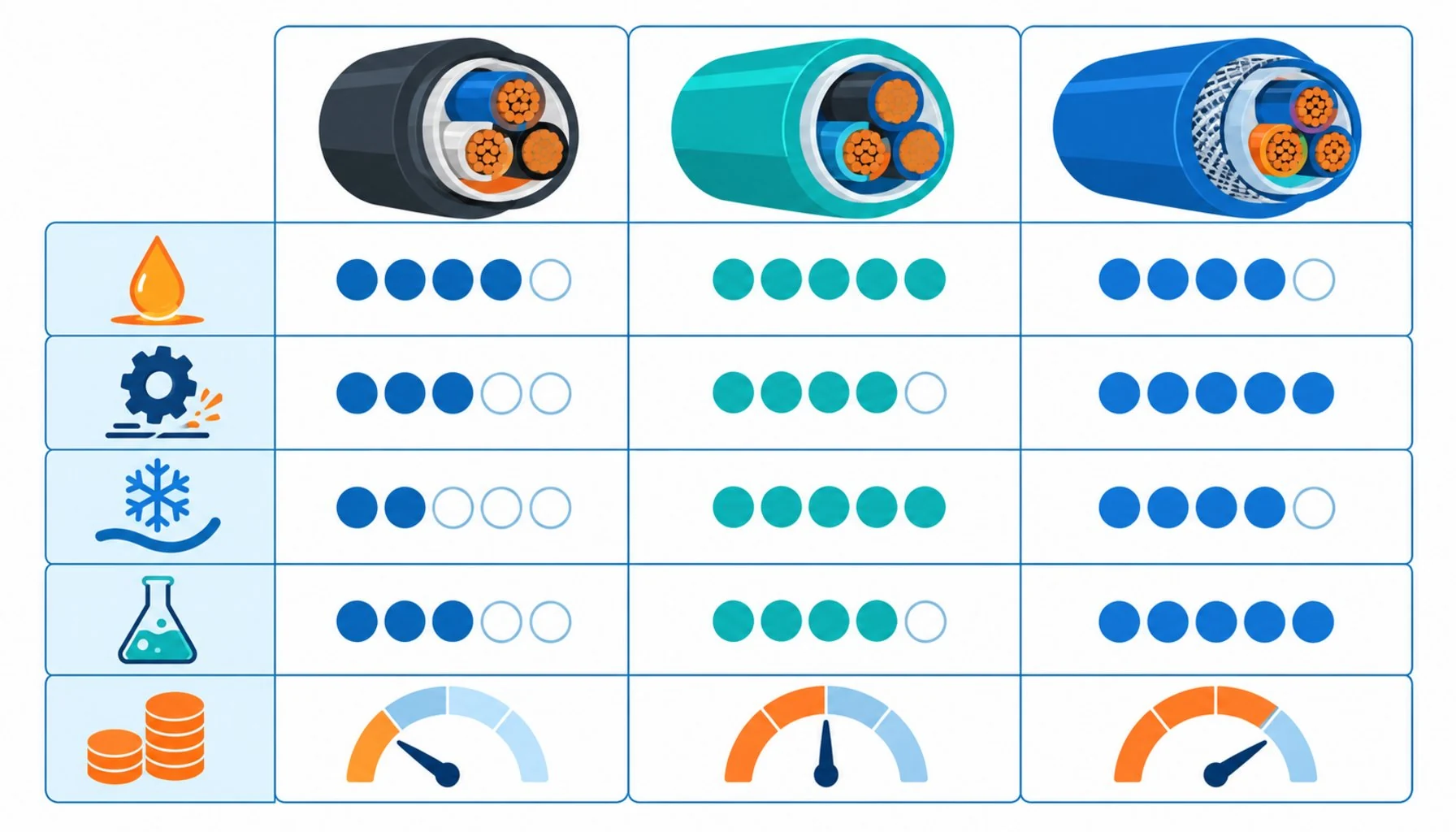
| Property | PUR | PVC | TPE |
|---|---|---|---|
| Abrasion resistance | Excellent, the motion benchmark | Moderate, degrades with age | Good, compound-dependent |
| Oil and coolant resistance | Excellent in standard grades | Poor to moderate, swells | Good to excellent by grade |
| Cold flex | Good to about -25/-35 C | Poor, stiffens early | Excellent, to -40 C and below |
| Hydrolysis (hot, wet) | Polyester grades weak; polyether good | Acceptable | Good by grade |
| Cleaning chemical tolerance | Moderate, formulation-specific | Moderate | Strongest overall, grade-dependent |
| Cold-oil combination duty | Watch the cold end | Not recommended | Usually the best fit |
| Cost | Highest | Lowest | Middle, above PVC |
| Best use on moving cable | Chains, robots, gantries in oily plants | Light duty, benign and warm | Cold, washdown, chemical balance |
TPE: The Specialist With Range
Thermoplastic elastomers are a family rather than a single compound, which is both their strength and the source of most specification confusion. The family spans styrenic, olefinic and other bases, and performance varies by grade more than the label suggests, so TPE decisions need datasheets, not category names. Where TPE clearly wins is the environment PUR finds hardest: cold. Food logistics halls, outdoor gantries, cold-chain automation and unheated workshops flex their cable at temperatures where standard PUR stiffens and PVC becomes a liability, and low-temperature TPE grades keep usable flex life to minus 40 and below. Many TPE grades also balance chemical exposure better than either alternative, which is why washdown and hygiene-critical machines often land there, and halogen-free formulations are widely available where smoke and toxicity requirements apply. The costs: price between PVC and PUR, abrasion that is good but not PUR-class in sliding contact, and a grade jungle that punishes buyers who specify by family name instead of by tested property. The practical rule: when the duty map shows cold, chemicals or both, TPE is the first candidate; when the duty map shows oil and abrasion at ordinary temperatures, PUR usually keeps the crown.
| Your Environment | First Choice | Watch Out For |
|---|---|---|
| Machine tool, coolant and oil mist, ordinary temperatures | PUR | Polyester hydrolysis only if hot and wet combine |
| Robot dress pack, sliding contact, long cycles | PUR | Jacket thickness and abrasion data, not just the name |
| Cold store, outdoor or unheated logistics | Low-temperature TPE | Confirm tested flex at your actual minimum temperature |
| Food or pharma washdown with aggressive agents | TPE, hygiene grades | Agent list with concentrations; verify each |
| Dry cabinet-to-cabinet runs, light motion, warm | PVC | Plasticizer migration over years; heat accelerates it |
| Flame or smoke regulated routes | PVC FR or halogen-free TPE by regulation | Confirm the route's actual regulation before choosing |
Reading Jacket Claims Like a Buyer
Whatever the compound, the purchasing discipline is the same, and it starts with reading claims as hypotheses rather than facts. Abrasion resistance quoted against what test, at what pressure, over how many cycles? Oil resistance tested in which oil, at what temperature, for how long? Cold flex tested at what radius, because a compound that survives minus 30 at 100 millimeters may fail at 30? Compound names confuse more than they clarify, since two PURs can differ more than a PUR and a good TPE, so the honest comparison is property against property with test methods stated. Suppliers who provide that data unprompted are telling you how they build; suppliers who resist are telling you too. The habit generalizes to every cable document you sign, which is why the wider method in the datasheet reading guide pays for itself across the whole bill of materials. And when the environment sits at a compound’s known edge, hot and wet for PUR, cold and oily for anything, ask for the combination test rather than the two separate results, because the combination is what your machine will actually deliver. Where the environment also decides armor and mechanical protection choices, the same duty-first logic applies, as the comparison of armored and unarmored cable shows for the static side of the plant.
When Jacket Selection Rules Are Not the Answer
Straight talk about limits: the jacket cannot rescue a cable whose conductors, stranding or shielding are wrong for the duty, and it is common to see PUR specified as a quality signal while the build inside remains a stationary cable that no skin can save. Jacket choice also sits inside a system that includes routing, hardware and fill ratio; the best compound in an overfilled chain rubbing a sharp divider still loses. And edge environments, cold plus oil plus abrasion together, may need compounded solutions: hybrid jackets, sleeves at contact points or a duty split across two cables. The selection rules here narrow the field and kill the worst mistakes; the final call belongs to the duty map of your specific machine, tested where the map has no precedent.
RFQ Checklist: Specifying the Jacket
Bring the environment to the supplier in this form:
- Agent list with concentrations and contact temperatures, from the machine not from habit
- Minimum and maximum ambient, plus local hot spots and cold zones on the route
- Contact conditions: sliding, rolling, edge contact, with the hardware materials involved
- Cold flex requirement at the installed radius if cold applies
- Regulatory needs: flame, smoke, halogen-free, food-contact where applicable
- Test evidence required: oil immersion, abrasion cycles and cold flex at stated radius
Conclusion
The jacket comparison is not a ranking, it is a mapping: PUR for oil and abrasion at ordinary temperatures, TPE for cold and chemical balance, PVC for benign routes where its price is honest money rather than false economy. Machines that map the environment first buy jackets that last; machines that buy by habit or price meet the difference in their maintenance logs, usually within two winters or two coolant seasons.
Kexingyu Cable Group (KXYE) builds motion cable in all three jacket families and quotes compounds with the test data behind them: oil immersion results, abrasion cycle counts and cold flex at the radius you specify. Send your environment list through the RFQ page, and we will map it to a compound with evidence rather than a family name.