String Inverter vs Central Inverter: A Buyer's Comparison
Both convert DC to AC — the real decision comes down to project scale, redundancy tolerance, and how you want to monitor performance.
Introduction
String and central inverters both perform the same fundamental job — covered in our solar inverter basics guide — but they’re built for very different project scales, and the choice between them shapes how the rest of your solar array is designed, monitored, and maintained.
What string inverters are
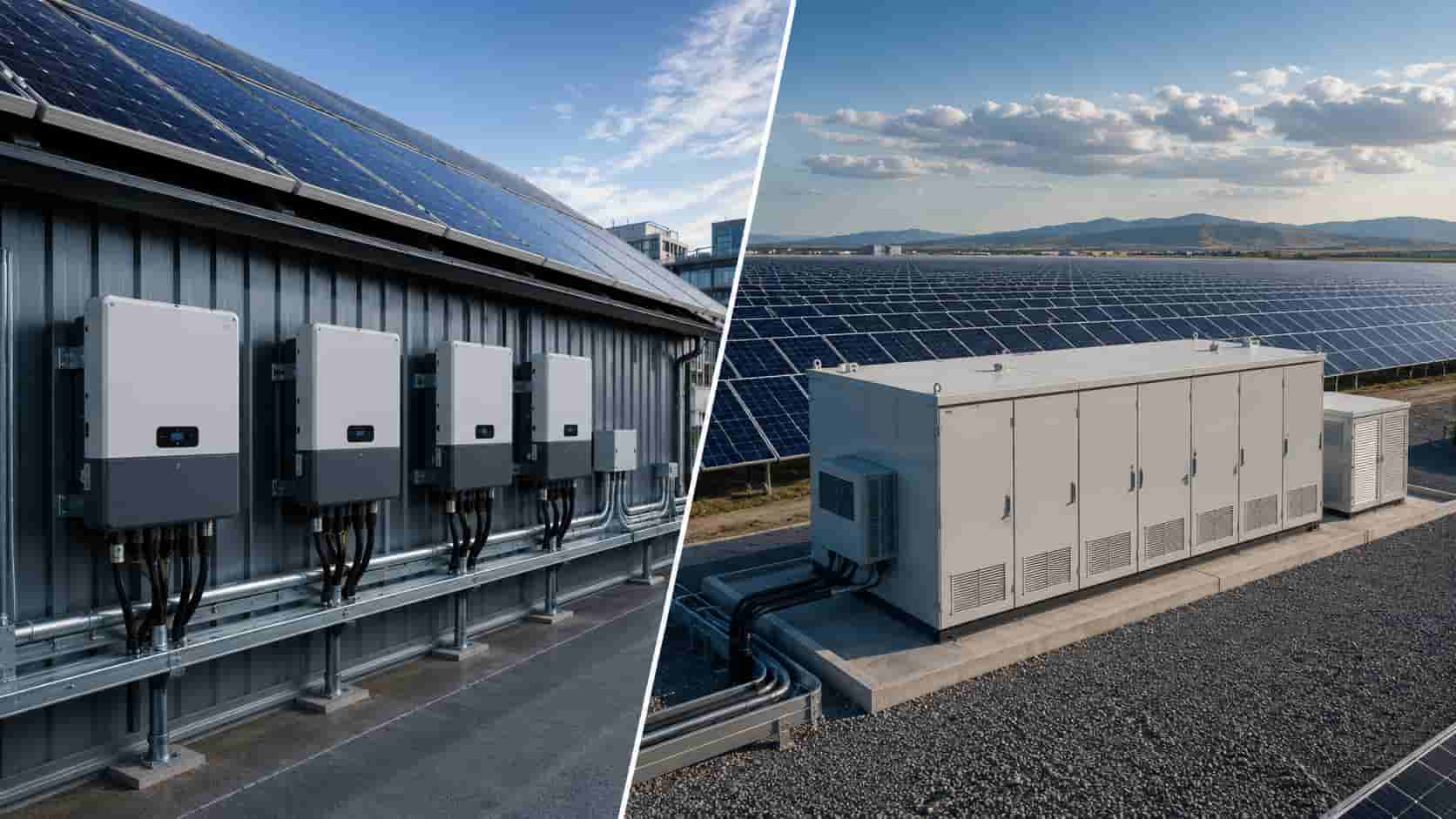
A string inverter connects to one or a small number of panel “strings” — series-connected groups of panels — converting their combined DC output to AC. Multiple string inverters are typically used across a larger installation, each handling a portion of the total panel array independently.
What central inverters are
A central inverter is a single, large-capacity unit that aggregates DC power from many panel strings (often via combiner boxes) and converts the entire array’s output through one central conversion point. Central inverters are sized for utility-scale and very large commercial installations, typically handling capacities in the hundreds of kilowatts to several megawatts.
Key differences
Redundancy is the most significant practical difference: with multiple string inverters, a single unit failure only affects the portion of the array it serves, while a central inverter failure can take the entire array offline until it’s repaired. Monitoring granularity also differs — string inverters typically provide per-string performance data, making it easier to identify an underperforming section of panels, while central inverters generally provide array-level data with less granular visibility into individual string performance. Cost per watt tends to favor central inverters at very large scale, where the economics of one large unit outweigh the redundancy benefit of many smaller ones.
When string inverters make more sense
String inverters are generally the better fit for residential, commercial, and mid-scale C&I installations, projects where partial shading or varied roof orientations mean different panel groups perform differently and benefit from independent MPPT tracking, and projects that prioritize granular monitoring and reduced single-point-of-failure risk over the lowest possible cost per watt.
When central inverters make more sense
Central inverters are the standard choice for utility-scale ground-mount solar farms with large, uniform panel arrays and consistent sun exposure across the site, where the cost efficiency of fewer, larger units outweighs the redundancy trade-off, and where a dedicated on-site maintenance team can respond quickly if the central unit does require service.
Where Kexingyu Power fits in
We manufacture both string and central inverters, and can help evaluate which fits your project’s scale and risk tolerance. Browse the full range on our Inverters & Power Conversion page.
String vs Central Inverters
Common questions from project developers and buyers comparing string and central inverter architectures for commercial and utility-scale solar projects.
01 Can a solar project use both string and central inverters?
Yes, although most projects standardize on one inverter architecture to simplify engineering, monitoring, maintenance, training and spare parts management. Mixed systems may appear in phased developments, retrofit projects or sites with sections that have different design constraints. When both types are used, the electrical interfaces, monitoring platform, protection philosophy and maintenance strategy should be coordinated at project level.
02 Is partial shading more difficult to manage with central inverters?
It can be, but the result depends on the inverter's MPPT architecture, string arrangement and site layout. String inverters generally divide the array into smaller independently controlled sections, which can improve performance where different strings experience uneven shading, orientation or soiling. Central inverter systems can still perform effectively on uniform utility-scale arrays, so shading behavior should be evaluated as part of the complete system design.
03 Which inverter architecture is easier to service in the field?
String inverters are often easier to replace as individual units because each inverter is relatively small and a failure normally affects only part of the array. Central inverters concentrate much more capacity in one unit and may require trained technicians, specialized spare parts or lifting equipment for major service work. However, centralizing equipment can also reduce the total number of inverter units that maintenance teams need to manage.
04 Does inverter choice affect solar module and string design?
Yes, the inverter and module configuration must be designed together. The number of modules connected in each string must keep the array voltage within the inverter's permitted DC input and MPPT operating ranges under expected temperature conditions. Designers must also check maximum input current, short-circuit current, connector and cable ratings, the number of strings per MPPT and the overall DC-to-AC sizing ratio.