Torsion Cable Construction: Layer Direction, Stranding and Anti-Twist Design
Quick Answer: A cable that survives twisting is built in alternating long-lay layers that balance torque against each other; a 90-degree twist rating is earned in test rigs, not printed on datasheets.
Twisting is the cruelest duty a cable can be asked to survive, and the least forgiving of shortcuts. Bending concentrates stress at one point, but a good construction spreads the damage over a million cycles. Twisting winds the entire cable around its own axis: every layer, every pair, every shield, rotating relative to its neighbors with each turn of the machine. Cable built without a strategy for that motion kinks within days, and a kinked torsion cable is finished; no repair restores it. Yet rotation is everywhere in modern machinery: robot joints, rotating tables, wind monitoring, turntables, camera turrets, cable reels. This guide opens up the torsion-rated cable and shows what is actually inside: why layers are laid in alternating directions, why torsion builds use long lays where bending builds use short ones, how the center element and the outer jacket participate in the balance, and how twist ratings are honestly tested. It is the construction-side companion to the application guide on torsion duty, which covered where this cable lives; this one covers how it is made to live there.
Introduction
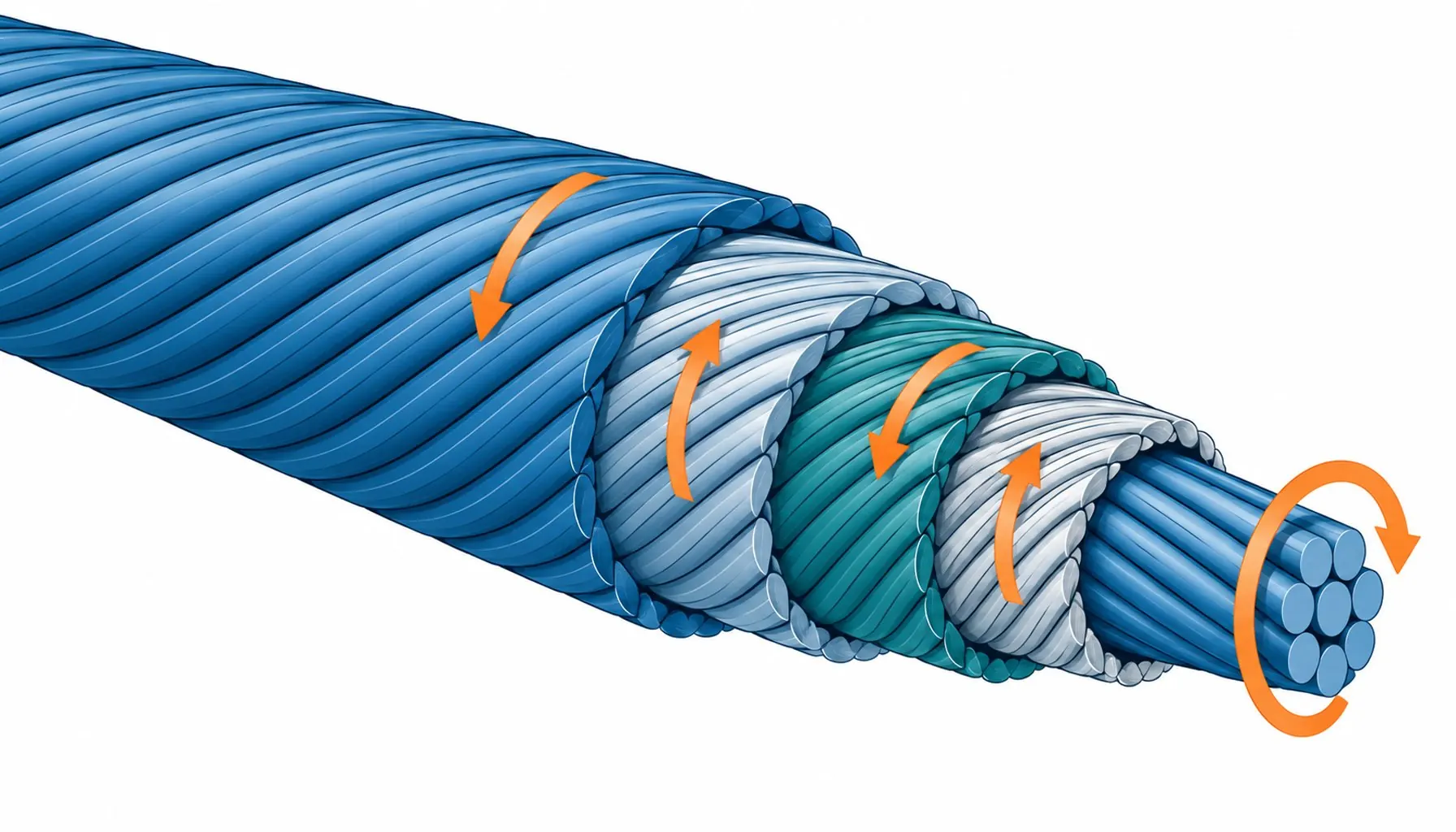
The physics of a twisted cable starts with a simple observation: when you twist a cable, its layers rotate relative to each other by amounts that depend on their radius from the axis. The outer layers travel further than the inner ones, and if every layer is laid in the same direction, the twist accumulates: each turn of the machine adds mechanical stress to every layer in the same sense, the cable shortens, loops and finally kinks. The strategy of torsion construction is to break that accumulation by alternating the lay direction of successive layers. A right-lay layer wants to tighten under one twist direction and loosen under the other; a left-lay layer does the opposite. Stack them alternately and the torques balance, so the cable’s response to machine twist is distributed rather than concentrated, and the construction can absorb thousands of degrees of accumulated rotation without storing it as a kink. That alternation is the skeleton of every torsion build, and everything else in this guide, lay lengths, stranding, elements and jackets, exists to make the skeleton work in practice. The failure it prevents is the mode-three kink from the failure catalog, and the broader context sits in the common causes of cable failure.
Layer Architecture: Alternating Directions and Long Lays
The layering of a torsion cable inverts several habits of ordinary flex design, and the inversions are deliberate. Lay length comes first: bending cable wants short lays, tight wraps that keep strands and pairs sliding over short distances, but twisting cable wants long lays, because a long-lay layer has more angular reserve before its geometry closes up under twist. A torsion build therefore uses long lays throughout, typically much longer than the equivalent flexing cable, with each successive layer reversed in direction. The conductors and pairs sit in these alternating layers, each layer’s twist tendency canceling the one beside it. The shield participates too: a torsion build either uses braid with a long, open geometry that can rotate without compacting, or places sensitive elements where the relative rotation is smallest, near the center. The center element anchors the geometry, often a support or tensile member chosen to hold the cable’s axis stable while the layers around it wind and unwind. And the jacket is applied with the same logic, a compound and thickness that stretch and recover without permanently deforming, because a jacket that takes a set under twist turns the cable’s balance into a memory of imbalance. Metallic armor, meanwhile, rarely appears in torsion builds, since rigid armor fights the winding; the protection question is answered differently than in the comparison of armored and unarmored cable. The result is a construction that looks almost lazy compared to a tight, compact flexing cable, and that laziness is the engineering: slack is the material that absorbs rotation.
| Layer | Torsion Design Choice | Why It Differs From Flexing Cable |
|---|---|---|
| Conductor stranding | Fine strands, longer lay than flex builds | Angular reserve matters more than tight bending geometry |
| Pair and element layers | Alternating right and left lay, long lay lengths | Torque balance between layers prevents accumulation |
| Shield | Open-geometry braid or protected central placement | Foil cannot survive relative rotation; braid must stay loose |
| Center element | Support or tensile member holding axis stability | The winding layers need a stable spine to wrap around |
| Jacket | Elastic compound, generous thickness, no set | A jacket that remembers twist converts balance into kink |
| Overall slack | Deliberately loose packing | Slack is the material that absorbs rotation |
How Twist Ratings Are Actually Tested
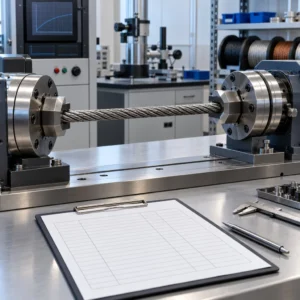
A torsion rating is a test outcome, and the honest ones read like a story rather than a number. The standard rig clamps the cable between a fixed end and a rotating end, applies the rated tension and a defined bending geometry, and rotates the moving end through the claimed twist, back and forth, at a stated speed, while monitoring every conductor, the shield and the insulation. The claim that survives scrutiny states degrees per meter or total degrees at the test length, the tension applied, the bend radius present during the test, and the failure criterion, which should be first sustained fault on any monitored element, not the cable’s final death. Combined-duty testing goes further and matters more: real machines twist while bending, so the strongest evidence rotates the cable while it flexes through a radius, which is exactly what a robot wrist or a cable reel delivers. A report that says 180 degrees per meter with five million cycles, tension stated, radius stated, shield intact at end of test, is evidence; a datasheet that only says torsion resistant is marketing. The same skepticism framework applies here as in the honest reading of equipment datasheets, and for good reason: the two ratings describe the same kind of experiment done to different geometries.
| Specification Line | What to State | Evidence to Require |
|---|---|---|
| Twist duty | Degrees per meter or per cycle, both directions, from machine geometry | Test data at that twist rate, not at a generic value |
| Combined duty | Whether bending, tension and speed share the rotation | Combined bend-plus-twist test at your geometry |
| Failure criterion | First sustained fault on conductors and shield | Monitoring list and criterion in the test report |
| Tension during twist | The pull the cable carries while rotating | Test tension matched to your duty |
| Termination method | Anti-rotation glands or floating terminations as the machine allows | Termination guidance that survives the twist at the ends |
Termination: Where Twist Concentrates
The cable’s interior is balanced, but its ends are clamped, and that is where twist tries to concentrate. A cable rotating in a machine accumulates its twist between the two fixed points, and the last decimeters before each gland take the transition between a winding cable and a stationary fitting. Construction helps, with the lay of the outer layers chosen to release rather than store twist near the ends, but installation matters more: anti-rotation glands that let the cable’s torque escape where the machine allows, floating or freely rotating terminations where the design permits, strain relief that does not clamp the cable at the exact point of maximum winding, and routing that never adds a bend at the transition where twist is highest. A torsion cable installed with rigid glands at both ends and a tight bend at one of them has been set up to fail at that bend regardless of its rating. The hardware around the ends, glands, strain reliefs and the fittings reviewed in the cable accessories checklist, is part of the torsion system, not an accessory to it.
When Torsion Construction Rules Are Not the Answer
Honest limits: torsion construction is specialized material, and using it well means knowing where it does not apply. Pure bending duty does not need it, and paying torsion prices for a chain that never rotates buys slack where tightness was the virtue; the lay that serves twist works against maximum flex density. Very high twist duty, continuous rotation beyond what balanced lay can absorb, belongs to slip rings, rotary unions or contactless power and data transfer, not to any cable however well built; a cable rating of degrees per meter is not an invitation to infinite rotation. And extremely fine torsion duty inside humanoid-scale joints pushes the whole field toward constructions still being tested, where honest suppliers say so. The rules here cover the machines that rotate within a range; the machines that spin forever need a different answer entirely.
RFQ Checklist: Buying Torsion-Rated Cable
Bring the rotation to the supplier in numbers:
- Twist per meter and per cycle, both directions, from the machine’s actual motion
- Tension, bending radius and speed that share the duty with the twist
- Target life in cycles, with the failure criterion you accept
- Evidence required: combined bend-plus-twist test data, shield continuity at end of test
- Termination plan: anti-rotation or floating glands, strain relief placement
- Routing statement: no bends at the twist transitions, slack managed as designed
Conclusion
Torsion-rated cable is a lesson in balance: alternating layers cancelling each other’s torque, long lays keeping angular reserve, a stable spine, an elastic jacket and deliberate slack, all engineered so that the machine’s rotation passes through the cable without staying in it. The rating on the datasheet is the shadow of a test rig, and the honest ones carry their conditions with them. Specify rotation in numbers, demand combined-duty evidence, install the ends with the respect that twist demands, and rotating machinery stops being where cables go to die.
Kexingyu Cable Group (KXYE) builds torsion constructions with alternating-lay architecture and publishes twist-test evidence with its conditions attached: degrees, tension, radius and shield condition at end of test. Send your rotation duty through the RFQ page, and we will match the balance to the machine.